Sanctuary for the Abused
Wednesday, June 13, 2018
Awakening

Then, like a child quieting down after a tantrum, you blink back your tears and begin to look at the world through new ayes. This is you awakening.
You realize it’s time to stop hoping and waiting for something to change, or for happiness, safety and security to magically appear over the next horizon.
You realize that in the real world there aren’t always fairy tale endings, and that any guarantee of “happily ever after” must begin with you…and in the process a sense of peace and calm is born of acceptance.
You awaken to the fact that you are not perfect and that not everyone will always love, appreciate or approve of who or what you are…and that’s OK. They are entitled to their own views and you learn the importance of loving and championing yourself…and in the process a sense of new found confidence is born of self-approval.
You stop complaining and blaming other people for the things they did to you-or didn’t do to you- and learn that the only thing you can really count on is the unexpected.
You learn that people don’t always say what they mean or mean what they say and that not everyone will always be there for you and that everything isn’t always about you.
So, you learn to stand on your own and to take care of yourself. And in the process a sense of safety and security is born of self-reliance. You stop judging and pointing fingers and you begin to accept people as they are and to overlook their shortcomings and human frailties…and in the process a sense of peace and contentment is born of forgiveness.
You learn to open up to new worlds and different points of view. You begin reassessing and redefining who you are and what you really stand for.
You learn the difference between wanting and needing and you begin to discard the doctrines and values you’ve overgrown, or should never have bought into to begin with.
You learn that there is power and glory in creating and contributing and you stop manoeuvring through life as a “consumer” looking for your next fix.
You learn that principles such as honesty and integrity are not the outdated ideals of a bygone era, but the mortar that holds together the foundation upon which you must build a life.
You learn that you don’t know everything, it’s not your job to save the world and that you can’t teach a PIG to sing. You learn that the only cross to bear is one you choose to carry and that martyrs get burned at the stake.
Then you learn about LOVE. You learn to look at relationships as they really are and not as you would have them be. You learn that alone does not mean lonely. You stop trying to control people, situations and outcomes. You learn to distinguish between guilt and responsibility and the importance of setting boundaries and learning to say NO.
You also stop working hard at putting your feelings aside, smoothing things over and ignoring your needs. You learn that your body really is a temple. You begin to care for it and treat it with respect. You begin to eat a balanced diet, drink more water, and take more time to exercise.
You learn that being tired fuels doubts, fear, and uncertainty and so you take more time to rest. And, just as food fuels the body, laughter fuels our soul. So you take more time to laugh and to play. You learn that, for most part, you get in life what you believe you deserve, and that much of life truly is self-fulfilling prophecy.
You learn that anything worth achieving is worth working for and that wishing for something to happen is different than working towards making it happen.
More importantly, you learn that in order to achieve success you need direction, discipline and perseverance. You also learn that no one can do it all alone, and that it’s OK to risk asking for help.
You learn the only thing you must truly fear is fear itself. You learn to step right into and through your fears because you know that whatever happens you can handle it and to give in to fear is to give away the right to live life on your own terms.
You learn that life isn’t always fair, you don’t always get what you think you deserve and that sometimes, bad things happen to unsuspecting, good people… and you learn not to always take it personally. You learn that nobody’s pushing you and everything isn’t always somebody’s fault. It’s just life happening. You learn to admit when you are wrong and to build bridges instead of walls.
You learn that negative feelings such as anger, envy and resentment must be understood and redirected or they will suffocate the life out of you and poison the universe that surrounds you. You learn to be thankful and to take care of many of the simple things we take for granted, things that millions of people upon the earth can only dream about.
Then you begin to take responsibility for yourself by yourself and make yourself a promise to never betray yourself and to never, ever settle for less than your heart’s desire. You make it a point to keep smiling, to keep trusting, and to stay open to every wonderful possibility.
Finally with courage in your heart, you take a stand, you take a deep breath, and you begin to design the life you want to live as best as you can.
http://groups.msn.com/SpousalAbuseSupport
Labels: accepttance, awakening, blaming, change, denial, fears, getting out, low self esteem


Thursday, April 19, 2018
Loved? No: Dishonored and Abused

Loved? Dishonored, and Abused
Hey Honey, "express yourself"...
("wife" in this article can also mean "significant other"... such as girlfriend, etc.)
- be sure to tell your wife that the only reason she married you was so she could sit around the house all day and do nothing, even though she was fifteen weeks pregnant at the time and in a high risk category due to a previous miscarriage and on doctor's orders to REST REST REST
- also tell her that the only reason she wrote for the newspaper was so she could provoke, because you were jealous of the fact that she could write what the people want to hear, and you couldn't
- act like you can never have anything by throwing everything you own in the garbage, or out the bedroom window. (I remember looking out our window one day to see stuffed toys that had been torn apart, laying on the lawn for the superintendent of the building to clean up; at first I didn't realize what the mess was until I took a good look, then I was completely stunned... even more-so when I realized they were the stuffed mementos that belonged to my husband!)
- You could even fake walking in your sleep in order to scare your wife -- pretending to attempt climbing out your bedroom window (I should have let him; we were on the third floor).
- leave the room that you're in, acting perfectly normal, then go into the bathroom and pound your fist into your hand when you're in the bathroom alone talking to yourself
- when pounding your fist into your hand be sure to whisper loudly "bam, bam, bam"
- when you're done doing this come out of the bathroom and return to the room you were in; when your wife asks you if all is okay look at her dumbfounded & answer "yes, why wouldn't it be?"
- you could take a butcher knife to your work shirts and shred them, then throw them into the closet so that when your wife is cleaning she will find them and "feel guilty because she must have upset poor little you."
- or you could just tear your shirts apart with your bare hands
- take out your anger by banging your head and your feet onto your vehicle (this was witnessed on more than one occasion by a neighbor)
- when your wife wishes to discuss something respond with yelling and screaming
- don't forget to drool like a wild animal while you're yelling and screaming, a documented trait of an abuser
-add the touch of pounding and kicking the furniture while you respond to discussion (more often than not I was sitting on this furniture)
- if perhaps you might want to respond in a reasonable tone, do so with these words: "I don't know", "I don't remember", or "I don't want to talk about it"
- after you have repeated the above words like they're the only ones in your vocabulary, sit on the sofa with your arms at your side, your shoulders slouched, your chin hanging, your eyes glazed over, and your tongue hanging slightly out of your mouth so that you appear as an "idiot" as defined in the dictionary; this intimidation is used to 'scare' your wife into thinking she's 'really done it this time' therefore she'll back off and leave poor little you alone
- when you're screwing around on your wife (or significant other) be sure to look her straight in the eye and tell her you love her and tell all your friends & family you love her too. Repeatedly.
- when your wife catches you in one of your numerous lies be sure to go ballistic and blame her
- you could also choke her and throw her to the floor by her neck, and just to make sure she learned her lesson you could also go for her throat again a few days later
- and always, always remember, that everything that goes wrong in your life is your wife's fault.
There's even more:
- your ex-wife tells your present wife that you used to start fires in the basement to keep warm after a night of drinking, with her & the baby asleep upstairs... oh, and your ex-wife knew the dents in your car were from your head and your feet
-you stay up half the night on internet porn sites then blame your step-child's boyfriend for the access charges or download history (meanwhile he hadn't even been to our residence at these times, or on our computer at all for that matter).
- the floor under where you were sitting at the computer half the night is all gooey in the morning (I am not kidding...at first I thought it was 'cat barf' but upon further inspection I came to the realization of exactly what it was. A couple of nights I walked out into the living room when he was on the computer to the wee hours of the morning; as soon as he saw me he immediately shut the computer off).
- even after it was proven that you were the only one accessing the porn sites on the net, up half the night doing who knows what to yourself, you still persist in yelling & screaming at the top of your lungs at your wife, that it wasn't you; your own ex-wife will tell the current wife that is your response when you've been caught red-handed (in this case 'one-handed') at something.
Oh, here's the best one of all:
- drink out of a glass that is obviously sitting & soaking at the back of the counter away from everything else and realize the glass has Javex in it, freak out & accuse your wife of trying to poison you, meanwhile the cupboard is full of clean glasses and you always, always get cold water from the filter jug in the fridge; just another thing to "blame your wife for"
- bang holes in the wall with an obvious object then claim to know nothing about it
- take all your friends phone numbers out of the memory system on the phone while in one of your 'feel sorry for me' moods then yell & scream at your wife that you can't have any friends (the only reason my hubby did this was because I liked his 'outside of work' friends & enjoyed visiting them; but with my hubby, I was supposed to bitch & complain about them, not have a good word to say about them, and not want him to associate with them; now you know where I'm coming from with 'mind games & twisted facts'; if you think you're confused just imagine living with this psychopath)
- tell your wife that she is insignificant, her existence is meaningless, and she is a burden, just like you told her your first wife was
- when the curtains that your wife bought from a friend who smokes interfere with her breathing, as she has asthma, and your wife has to sleep in another room, be sure to go apesh*t & accuse her of being pissed off at you because you were on the computer half the night, put your boots on & proceed to leave the house over 'her issues.'
- be sure to obliterate your wife in everyone else's eyes, especially when your own mother tells you that your temper will ruin your life & your wife comes out looking better than you do; you must destroy her image in everyone's eyes because you're afraid of the truth coming out
- you must convince everyone else that your wife is a psycho.
SOUND FAMILIAR?
(NOTE: Women can be just as abusive and crazy-making as men.)
Labels: abuse, anger, blaming, control, gaslighting, porn addiction, projection, psychopath, rage, sociopath, temper
Tuesday, December 12, 2017
Dealing With Manipulative People
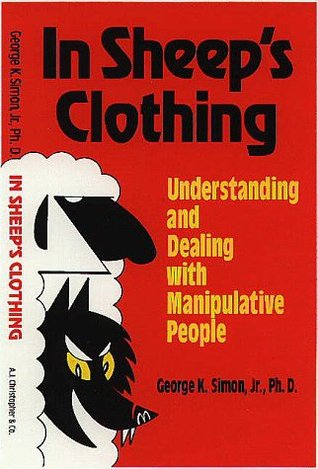
In Sheep's Clothing by George K. Simon
Two Basic Types of Aggression
There are two basic types of aggression: overt-aggression and covert-aggression. When you're determined to have something and you're open, direct and obvious in your manner of fighting, your behavior is best labeled overtly aggressive. When you're out to "win," dominate or control, but are subtle, underhanded or deceptive enough to hide your true intentions, your behavior is most appropriately labeled covertly aggressive. Now, avoiding any overt display of aggression while simultaneously intimidating others into giving you what you want is a powerfully manipulative maneuver. That's why covert-aggression is most often the vehicle for interpersonal manipulation.
Acts of Covert-Aggression vs. Covert-Aggressive Personalities
Most of us have engaged in some sort of covertly aggressive behavior from time to time. Periodically trying to manipulate a person or a situation doesn't make someone a covert-aggressive personality. Personality can be defined by the way a person habitually perceives, relates to and interacts with others and the world at large.
The tactics of deceit, manipulation and control are a steady diet for covert-aggressive personality. It's the way they prefer to deal with others and to get the things they want in life.
The Process of Victimization
For a long time, I wondered why manipulation victims have a hard time seeing what really goes on in manipulative interactions. At first, I was tempted to fault them. But I've learned that they get hoodwinked for some very good reasons:
A manipulator's aggression is not obvious. Our gut may tell us that they're fighting for something, struggling to overcome us, gain power, or have their way, and we find ourselves unconsciously on the defensive. But because we can't point to clear, objective evidence they're aggressing against us, we can't readily validate our feelings.
The tactics manipulators use can make it seem like they're hurting, caring, defending, ..., almost anything but fighting. These tactics are hard to recognize as merely clever ploys. They always make just enough sense to make a person doubt their gut hunch that they're being taken advantage of or abused. Besides, the tactics not only make it hard for you to consciously and objectively tell that a manipulator is fighting, but they also simultaneously keep you or consciously on the defensive. These features make them highly effective psychological weapons to which anyone can be vulnerable. It's hard to think clearly when someone has you emotionally on the run.
All of us have weaknesses and insecurities that a clever manipulator might exploit. Sometimes, we're aware of these weaknesses and how someone might use them to take advantage of us. For example, I hear parents say things like: "Yeah, I know I have a big guilt button." – But at the time their manipulative child is busily pushing that button, they can easily forget what's really going on. Besides, sometimes we're unaware of our biggest vulnerabilities. Manipulators often know us better than we know ourselves. They know what buttons to push, when and how hard. Our lack of self-knowledge sets us up to be exploited.
What our gut tells us a manipulator is like, challenges everything we've been taught to believe about human nature. We've been inundated with a psychology that has us seeing everybody, at least to some degree, as afraid, insecure or "hung-up." So, while our gut tells us we're dealing with a ruthless conniver, our head tells us they must be really frightened or wounded "underneath." What's more, most of us generally hate to think of ourselves as callous and insensitive people. We hesitate to make harsh or seemingly negative judgments about others. We want to give them the benefit of the doubt and assume they don't really harbor the malevolent intentions we suspect. We're more apt to doubt and blame ourselves for daring to believe what our gut tells us about our manipulator's character.
Recognizing Aggressive Agendas
Accepting how fundamental it is for people to fight for the things they want and becoming more aware of the subtle, underhanded ways people can and do fight in their daily endeavors and relationships can be very consciousness expanding. Learning to recognize an aggressive move when somebody makes one and learning how to handle oneself in any of life's many battles, has turned out to be the most empowering experience for the manipulation victims with whom I've worked. It's how they eventually freed themselves from their manipulator's dominance and control and gained a much needed boost to their own sense of self esteem. Recognizing the inherent aggression in manipulative behavior and becoming more aware of the slick, surreptitious ways that manipulative people prefer to aggress against us is extremely important. Not recognizing and accurately labeling their subtly aggressive moves causes most people to misinterpret the behavior of manipulators and, therefore, fail to respond to them in an appropriate fashion. Recognizing when and how manipulators are fighting with covertly aggressive tactics is essential.
Defense Mechanisms and Offensive Tactics
Almost everyone is familiar with the term defense mechanism. Defense mechanisms are the "automatic" (i.e. unconscious) mental behaviors all of us employ to protect or defend ourselves from the "threat" of some emotional pain. More specifically, ego defense mechanisms are mental behaviors we use to "defend" our self-images from "invitations" to feel ashamed or guilty about something. There are many different kinds of ego defenses and the more traditional (psychodynamic) theories of personality have always tended to distinguish the various personality types, at least in part, by the types of ego defenses they prefer to use. One of the problems with psychodynamic approaches to understanding human behavior is that they tend to depict people as most always afraid of something and defending or protecting themselves in some way; even when they're in the act of aggressing. Covert-aggressive personalities (indeed all aggressive personalities) use a variety of mental behaviors and interpersonal maneuvers to help ensure they get what they want. Some of these behaviors have been traditionally thought of as defense mechanisms.
While, from a certain perspective we might say someone engaging in these behaviors is defending their ego from any sense of shame or guilt, it's important to realize that at the time the aggressor is exhibiting these behaviors, he is not primarily defending (i.e. attempting to prevent some internally painful event from occurring), but rather fighting to maintain position, gain power and to remove any obstacles (both internal and external) in the way of getting what he wants. Seeing the aggressor as on the defensive in any sense is a set-up for victimization. Recognizing that they're primarily on the offensive, mentally prepares a person for the decisive action they need to take in order to avoid being run over. Therefore, I think it's best to conceptualize many of the mental behaviors (no matter how "automatic" or "unconscious" they may appear) we often think of as defense mechanisms, as offensive power tactics, because aggressive personalities employ them primarily to manipulate, control and achieve dominance over others. Rather than trying to prevent something emotionally painful or dreadful from happening, anyone using these tactics is primarily trying to ensure that something they want to happen does indeed happen. Using the vignettes presented in the previous chapters for illustration, let's take a look at the principal tactics covert-aggressive personalities use to ensure they get their way and maintain a position of power over their victims:
Denial – This is when the aggressor refuses to admit that they've done something harmful or hurtful when they clearly have. It's a way they lie (to themselves as well as to others) about their aggressive intentions. This "Who... Me?" tactic is a way of "playing innocent," and invites the victim to feel unjustified in confronting the aggressor about the inappropriateness of a behavior. It's also the way the aggressor gives him/herself permission to keep right on doing what they want to do. This denial is not the same kind of denial that a person who has just lost a loved one and can't quite bear to accept the pain and reality of the loss engages in. That type of denial really is mostly a "defense" against unbearable hurt and anxiety. Rather, this type of denial is not primarily a "defense" but a maneuver the aggressor uses to get others to back off, back down or maybe even feel guilty themselves for insinuating he's doing something wrong.
Selective Inattention – This tactic is similar to and sometimes mistaken for denial It's when the aggressor "plays dumb," or acts oblivious. When engaging in this tactic, the aggressor actively ignores the warnings, pleas or wishes of others, and in general, refuses to pay attention to everything and anything that might distract them from pursuing their own agenda. Often, the aggressor knows full well what you want from him when he starts to exhibit this "I don't want to hear it!" behavior. By using this tactic, the aggressor actively resists submitting himself to the tasks of paying attention to or refraining from the behavior you want him to change.
Rationalization – A rationalization is the excuse an aggressor tries to offer for engaging in an inappropriate or harmful behavior. It can be an effective tactic, especially when the explanation or justification the aggressor offers makes just enough sense that any reasonably conscientious person is likely to fall for it. It's a powerful tactic because it not only serves to remove any internal resistance the aggressor might have about doing what he wants to do (quieting any qualms of conscience he might have) but also to keep others off his back. If the aggressor can convince you he's justified in whatever he's doing, then he's freer to pursue his goals without interference.
Diversion – A moving target is hard to hit. When we try to pin a manipulator down or try to keep a discussion focused on a single issue or behavior we don't like, he's expert at knowing how to change the subject, dodge the issue or in some way throw us a curve. Manipulators use distraction and diversion techniques to keep the focus off their behavior, move us off-track, and keep themselves free to promote their self-serving hidden agendas.
Lying – It's often hard to tell when a person is lying at the time he's doing it. Fortunately, there are times when the truth will out because circumstances don't bear out somebody's story. But there are also times when you don't know you've been deceived until it's too late. One way to minimize the chances that someone will put one over on you is to remember that because aggressive personalities of all types will generally stop at nothing to get what they want, you can expect them to lie and cheat. Another thing to remember is that manipulators – covert-aggressive personalities that they are – are prone to lie in subtle, covert ways. Courts are well aware of the many ways that people lie, as they require that court oaths charge that testifiers tell "the truth, the whole truth, and nothing but the truth."
Manipulators often lie by withholding a significant amount of the truth from you or by distorting the truth. They are adept at being vague when you ask them direct questions. This is an especially slick way of lying' omission. Keep this in mind when dealing with a suspected wolf in sheep's clothing. Always seek and obtain specific, confirmable information.
Covert Intimidation – Aggressors frequently threaten their victims to keep them anxious, apprehensive and in a one-down position. Covert-aggressives intimidate their victims by making veiled (subtle, indirect or implied) threats. Guilt-tripping and shaming are two of the covert-aggressive's favourite weapons. Both are special intimidation tactics.
Guilt-tripping – One thing that aggressive personalities know well is that other types of persons have very different consciences than they do. Manipulators are often skilled at using what they know to be the greater conscientiousness of their victims as a means of keeping them in a self-doubting, anxious, and submissive position. The more conscientious the potential victim, the more effective guilt is as a weapon. Aggressive personalities of all types use guilt-tripping so frequently and effectively as a manipulative tactic, that I believe it illustrates how fundamentally different in character they are compared to other (especially neurotic) personalities. All a manipulator has to do is suggest to the conscientious person that they don't care enough, are too selfish, etc., and that person immediately starts to feel bad. On the contrary, a conscientious person might try until they're blue in the face to get a manipulator (or any other aggressive personality) to feel badly about a hurtful behavior, acknowledge responsibility, or admit wrongdoing, to absolutely no avail.
Shaming – This is the technique of using subtle sarcasm and put-downs as a means of increasing fear and self-doubt in others. Covert-aggressives use this tactic to make others feel inadequate or unworthy, and therefore, defer to them. It's an effective way to foster a continued sense of personal inadequacy in the weaker party, thereby allowing an aggressor to maintain a position of dominance.
Playing the Victim Role – This tactic involves portraying oneself as an innocent victim of circumstances or someone else's behavior in order to gain sympathy, evoke compassion and thereby get something from another. One thing that covert-aggressive personalities count on is the fact that less calloused and less hostile personalities usually can't stand to see anyone suffering. Therefore, the tactic is simple. Convince your victim you're suffering in some way, and they'll try to relieve your distress.
Vilifying the Victim – This tactic is frequently used in conjunction with the tactic of playing the victim role. The aggressor uses this tactic to make it appear he is only responding (i.e. defending himself against) aggression on the part of the victim. It enables the aggressor to better put the victim on the defensive.
Playing the Servant Role – Covert-aggressives use this tactic to cloak their self-serving agendas in the guise of service to a more noble cause. It's a common tactic but difficult to recognize. By pretending to be working hard on someone else's behalf, covert-aggressives conceal their own ambition, desire for power, and quest for a position of dominance over others.
Seduction – Covert-aggressive personalities are adept at charming, praising, flattering or overtly supporting others in order to get them to lower their defenses and surrender their trust and loyalty. Covert-aggressives are also particularly aware that people who are to some extent emotionally needy and dependent (and that includes most people who aren't character-disordered) want approval, reassurance, and a sense of being valued and needed more than anything. Appearing to be attentive to these needs can be a manipulator's ticket to incredible power over others.
The consummate seducer melts any resistance you might have to giving him your loyalty and confidence. He does this by giving you what he knows you need most. He knows you want to feel valued and important. So, he often tells you that you are. You don't find out how unimportant you really are to him until you turn out to be in his way.
Projecting the blame (blaming others) – Aggressive personalities are always looking for a way to shift the blame for their aggressive behavior. Covert-aggressives are not only skilled at finding scapegoats, they're expert at doing so in subtle, hard to detect ways.
Minimization – This tactic is a unique kind of denial coupled with rationalization. When using this maneuver, the aggressor is attempting to assert that his abusive behavior isn't really as harmful or irresponsible as someone else may be claiming. It's the aggressor's attempt to make a molehill out of a mountain.
I've presented the principal tactics that covert-aggressives use to manipulate and control others. They are not always easy to recognize. Although all aggressive personalities tend to use these tactics, covert-aggressives generally use them slickly, subtly and adeptly. Anyone dealing with a covertly aggressive person will need to heighten gut-level sensitivity to the use of these tactics if they're to avoid being taken in by them.
Labels: aggression, blaming, covert, lying, manipulation, narcissist, psychopath, shaming, sheep's clothing, sociopath