Sanctuary for the Abused
Saturday, June 04, 2022
INVALIDATION

Invalidation denies the importance of your experiences, your feelings, your thoughts, your wisdom, and even your existence.
Invalidation. It takes many forms, but the person doing it is always communicating the same thing — your needs don’t matter!
People who invalidate you don’t want you to feel and think what you feel and think. They want you to feel and think what they do. It’s an imposition, an annoyance, or something else undesirable when you don’t.
Dysfunctional, toxic and abusive people are champion invalidators.
A father’s 3-year old son has gotten hurt skinning his knee on the sidewalk, and the father instantly pulls his bawling child up by the hand, exclaiming, “It’s not bad, you’re not hurt, what are you crying for? Look, it’s only a scrape, get up!”
But his son IS hurt, twice — once, physically, by falling, and again, by being denied his legitimate feelings by his father, the person whose job it is to teach him that his feelings always matter. Later in life, when the child becomes a man and marries a woman whose expectations of him are unreasonable and who calls him a baby if he complains, it is a reflection of his father’s bad parenting.
Children’s – and everyone’s – feelings are always legitimate. The feelings may be difficult to fully understand, however, if enough listening is done instead of merely trying to stuff down the unwanted feelings, the reasons make themselves known and can be addressed and healed, not just hidden.
Invalidation often takes the form of being told that you should not feel as strongly as you do. Other times, you’ll be told that your concerns are nothing to worry about. Some common invalidating statements are:
“You’re oversensitive”
“What are you crying about?”
“Everything’s fine!”
“Oh, you poor baby!”
“Get over it!”
“What’s the matter NOW???”
“So WHAT!”
Your wishes may also be ignored in favor of the other person’s preferences. You may feel as if you don’t have an equal voice in the relationship or in what takes place. When you explain that being ignored makes you unhappy, you’ll be made to feel as if your concerns aren’t legitimate, and you should be ashamed of yourself for making life difficult for the invalidator.
Getting invalidators to truly hear you out isn’t easy, and in many cases, is impossible. If nothing else, remember that your feelings – no matter what they are – always have a legitimate reason, and are there for a real and important purpose. You may experience invalidation by someone else, but you can practice what mentally healthy people do all the time – know that all feelings always matter, even when some people don’t understand them, and always, always… validate yourself.
Labels: abuse, adult children of narcissists, dysfunctional, feelings, gaslighting, invalidation, legitimate, narcissist, pathological, psychopath, sociopath


Friday, September 13, 2019
The Art of Saying "NO"

What exactly is The Art of Saying No?
A lot of people just don't like the idea of having to tell people they can't do something. Or they feel obligated when a colleague asks a favour; or feel pressurised when someone senior to them needs something done.
There are even some work places where saying no is definitely frowned upon; and in, say, the police force, could be a sackable or disciplinary offence.
After having worked for some time with people where saying no either feels impossible or just isn't allowed, we created a body of work to address it. In some cases it is indeed, how to say no without ever saying the word.
Of course, there are times when saying the 'n' word is a necessity. But in our experience, there is so much anxiety around the possible consequences of using it, that people don't say anything at all, or agree to things they'd rather not, or get landed with work that isn't theirs and so on.
That can't be good for anyone, but especially the person who finds themselves staying late at the end of the day to get their own work done after they've finished everyone else's; or who swallows their resentment when they are 'volunteered' for something they don't want to do; or who quakes at the idea of having to be a bit tougher with a supplier or even someone they manage.
It's Not Assertiveness
The reason we've been asked this is that assertiveness training has been around for some time, and people wonder if this art of saying no business isn't just more of the same.
Well, no it isn't, and here's why.
We believe the very term 'assertiveness' is limiting. For instance, people say you should be assertive rather than aggressive, as if assertiveness is the only way to deal with a difficult situation. It isn't. If you are being attacked or abused, then aggressively fighting back may well be an appropriate thing to do. The key word here is appropriate.
So yes, aggressiveness may be appropriate, assertiveness may be appropriate, but there's a greater range of choice of behaviour than those two types that could be equally appropriate.
Before we discuss them, though, we want to talk about some of the things that happen to people when what they think and feel is different from what they do.
Many 'unassertive' people recognise that their pattern of behaviour is to be nice or compliant for far longer than they really want to until they reach the point of no longer being able to hold it in; then they explode nastily and inappropriately all over whoever happens to be around.
There are three ways this 'explosion' can happen. The first is that the rage happens inside the head and remains unexpressed. The second is that it is inappropriately expressed, and someone not involved, like a work colleague or secretary or even a bus conductor, becomes the recipient. The third is properly directed at the 'offending party' but is out of all proportion to the probably small, but nonetheless final-straw-event that unleashes it.
Not Nice Not Nasty
This leaves people with the impression that there are only two states or behaviours they can do: Nice or Nasty. When, in fact, they have forgotten a whole range of behaviour that lies between Nice and Nasty that can be termed Not-Nice (or even Not-Nasty).
What we've seen with assertiveness, is that it is often seen as a single form of behaviour: just say no, stand your ground, be a broken record - all quite difficult if you are truly unassertive, or in our jargon - simply too nice for your own good. The concept of asserting yourself, (getting your voice heard, being understood, being taken into account, getting your own way) needs to be broadened to include all forms of behaviour. It can include humour, submission, irresponsibility, manipulation, playfulness, aggressiveness, etc.
The key point here is that the behaviour - nice, not-nice, nasty - is chosen. We emphasise the word key, because until people are able to choose behaviour that's free from the limiting effects of their fear of possible consequences, they will not be able to act no matter how well they are taught to be assertive. They will still feel overwhelmed in difficult situations.
Managing Feelings
It needs to be acknowledged that the strong feelings associated with changing behaviour are real and valid. Once people do that, then these (usually difficult) feelings can be looked upon as a good thing, a sign that something new is happening. At this point people can start to 'choose' to have these feelings rather than having to endure them or trying to pretend they are not happening.
The idea of choice is very important. If people feel they have real choice about how they behave, they start to realise that it can be OK to put up with something they don't like. They can choose it because they want to; it is to their advantage. They then avoid the disempowering tyranny of always having to assert themselves. (Which is almost as bad as feeling you always have to be compliant or nice.)
Many people think that in order to be assertive, you need to ignore what you are feeling and just 'stand your ground'. In fact, you ignore those feelings at your peril.
Often the magnitude of peoples' feelings is way out of proportion to what the situation warrants. They may well reflect a previous difficult event more accurately. But because that previous difficulty was so difficult, it feels as though every similar situation will be the same.
It is only by beginning to experience and understand how crippling these feelings can be that people can start to do anything about changing their behaviour. Many people know what they could say; they know what they could do. Most 'unassertive' people have conversations in their heads about how to resolve a conflict they're in; but still, their mouths say 'yes', while their heads say 'no'. Knowing what to do or say is not the issue here.
Therefore, in looking at practising 'the art of saying no', it is wise to broaden the brief to so that it isn't about becoming more assertive; rather it's about changing your behaviour to fit the circumstances.
While in many circumstances assertiveness can be a straight jacket of it's own (often creating resistance and resentment), the full lexicon of behaviour can be freeing, because there is choice in the matter. Using charm, humour, telling the truth or even deliberate manipulation, may well get you what you want without having to attempt behaviour that may go against your personality.
If you add a dash of fun or mischief, The Art of Saying No becomes a doable prospect, rather than another difficult mountain to climb.
Saying No
Here are some pointers of what could make it easier to say 'no'.
If you're saying something serious, notice whether you smile or not. Smiling gives a mixed message and weakens the impact of what you're saying.
If someone comes over to your desk and you want to appear more in charge, stand up. This also works when you're on the phone. Standing puts you on even eye level and creates a psychological advantage.
If someone sits down and starts talking to you about what they want, avoid encouraging body language, such as nods and ahas. Keep your body language as still as possible.
Avoid asking questions that would indicate you're interested (such as, 'When do you need it by?' or 'Does it really have to be done by this afternoon?' etc.)
It's all right to interrupt! A favourite technique of ours is to say something along the lines of, 'I'm really sorry; I'm going to interrupt you.' Then use whatever tool fits the situation. If you let someone have their whole say without interrupting, they could get the impression you're interested and willing. All the while they get no message to the contrary, they will think you're on board with their plan (to get you to do whatever...)
Pre-empt. As soon as you see someone bearing down on you (and your heart sinks because you know they're going to ask for something), let them know you know: 'Hi there! I know what you want. You're going to ask me to finish the Henderson report. Wish I could help you out, but I just can't.'
Pre-empt two. Meetings are a great place to get landed with work you don't want. You can see it coming. So to avoid the inevitable, pre-empt, 'I need to let everyone know right at the top, that I can't fit anything else into my schedule for the next two weeks (or whatever).'
Any of these little tips can help you feel more confident and will support your new behaviour. For that's what this is: If you're someone whom others know they can take advantage (they may not even be doing it on purpose, you're just an easy mark!) you need to indicate by what you do that things have changed.
Here's an Analogy:
Let's say you're a burglar. There's a row of identical houses and you're thinking of having a go at five of them. The first house has a Yale lock on the front door. The second house has a Yale and a Chubb lock on the front door. The third house has a Yale and a Chubb lock on the front door and bars on the window. The fourth house has a Yale and a Chubb lock on the front door, bars on the window and burglar alarm. The fifth house has a Yale and a Chubb lock on the front door, bars on the window, a burglar alarm and a Rottweiler.
Which would you burgle?
When you make it easy for other people, they will naturally keep coming back. By learning more effective ways of saying 'no' you make it harder for others to expect you to do what they want without taking into account what's going on for you. You become more burglar-proof.
Changing Others by Changing Yourself
A lot of us wish that the person we are in conflict with, or feel intimidated by, would change. Then everything would be all right. We've all heard this from a colleague, friend, partner and even said it ourselves: 'If only he'd listen to me, then I wouldn't be so frightened.' 'If only she'd stop complaining about my work, I'd be much happier.'
'If only' puts the onus on the other person to change how and who they are and makes them responsible for how we feel. By using some of the tools outlined above, people can get a sense of being in charge of situations, rather than being victims to what other people want.
It does seem to be part of human nature to blame others when things go wrong in our lives, or when we're feeling hard done by. If you take away the 'if only' excuse you also take away the need to blame and make the other person wrong. It's also rather wonderful to think that rather than waiting for someone else to change to make things all right, we all have the ability to take charge of most situations and make them all right for ourselves.
What also makes it easier is that we all just have to get better at 'the art of saying no'; none of us has to change our whole personalities to create a more satisfying outcome!
Labels: blame, excuses, feelings, guilt, responsibility, saying no, take charge
Monday, October 08, 2018
Should I End This Relationship?

Leaving a relationship before knowing what the real problem is, is generally a waste of time (aside from domestic violence) - especially if you eventually want to be in another relationship.
The reason it’s a waste of time is because whatever you are doing to create your unhappiness, you are not going to stop doing just because you leave the relationship. You take yourself with you when you leave, and unless you heal your part of the relationship problem, you will continue to behave in ways that eventually destroys relationships.
You might be surprised to learn that the time to leave a relationship is NOT when you are miserable, but rather when you are happy, joyful and peaceful. When you have learned how to make yourself happy and bring yourself peace and joy, and if your partner is still distance, angry, needy, disconnected, resistant, unloving, or acting out addictively - then it may be time to leave if that is what you want.
When I work with couples, I help each partner learn how to take full, 100% responsibility for their own feelings and needs. Obviously, if both people are behaving in ways that bring themselves joy, they will have a lot of love to share with each other. As long as they are stuck believing that their unhappiness of the other person’s fault, they are being victims. As victims they want to control the other person and get them to behave the way they want them the behave. As victims, they are afraid of being rejected or controlled, and are behaving in ways to protect themselves from what they fear. All the ways they are trying to have control over not being rejected or controlled are creating the relationship problems.
You might be surprised to learn that the time to leave a relationship is NOT when you are miserable, but rather when you are happy, joyful and peaceful. When you have learned how to make yourself happy and bring yourself peace and joy, and if your partner is still distance, angry, needy, disconnected, resistant, unloving, or acting out addictively - then it may be time to leave if that is what you want.
When I work with couples, I help each partner learn how to take full, 100% responsibility for their own feelings and needs. Obviously, if both people are behaving in ways that bring themselves joy, they will have a lot of love to share with each other. As long as they are stuck believing that their unhappiness of the other person’s fault, they are being victims. As victims they want to control the other person and get them to behave the way they want them the behave. As victims, they are afraid of being rejected or controlled, and are behaving in ways to protect themselves from what they fear. All the ways they are trying to have control over not being rejected or controlled are creating the relationship problems.
Until you become aware of how you are being a victim and how you are trying to control your partner - and you are successful in taking care of your own feelings and needs - there is no point in leaving.
Most people who are unhappy in their relationship are reactors. They are reacting to the other person’s controlling behavior with their own controlling behavior. For example:
• When Jacob criticizes her, Hannah shuts down. When Hannah shuts down, Jacob criticizes.
• When Sally gets angry at Joe, Joe defends, lectures and explains himself. When Joe lectures, Sally gets angry and resistant.
• When Robert is demanding, Ingrid gives herself up to comply with Robert’s demands. The more Ingrid complies, the more Robert demands.
• When Michele complains, Hugh resists. The more Hugh resist, the more Michele complains.
• When Craig acts like an irresponsible child, Karen becomes parental and judgmental. The more Karen is parental and judgmental, the more Craig is resistant and irresponsible.
Each of these people are reacting in controlling ways, rather than acting in ways that take loving care of themselves. Both people are participating in creating a negative circle. Generally, they then blame the other for their own reaction: “If you wouldn’t criticize, then I wouldn’t withdraw.” “Well, if you wouldn’t withdraw, then I wouldn’t criticize.” “If you weren’t so resistant, I wouldn’t get angry.” “If you weren’t so angry, I wouldn’t resist.”
If they were to act in loving ways toward themselves rather than react in controlling ways toward their partner, then:
If they were to act in loving ways toward themselves rather than react in controlling ways toward their partner, then:
• When Jacob criticized, Hannah might speak up for herself instead of shutting down, saying something like, “Jacob, I don’t like being criticized. I’m not willing to have this discussion until we can be open with each other.” When Hannah shut down, Jacob could be curious instead of critical, saying something like, “Honey, you must have a good reason for withdrawing from me. Do you want to talk about it?”
• When Sally got angry, Joe could disengage from the conversation instead of trying to talk her out of her feelings. He would give up
trying to have control over Sally’s anger and how she sees him and take care of himself. When Joe tried to control Sally with his lecturing and explaining, instead of trying to control him with her anger, Sally could speak up for herself, telling Joe that she doesn’t like it when he tries to talk her out of her feelings.
There is no point in leaving a relationship until you have learned act in ways that are loving to yourself and your partner, instead of reacting in controlling and resistant ways. Leaving only delays this learning until your next relationship.
About the author: Margaret Paul, Ph.D. is the best-selling author and co-author of eight books, including "Do I Have To Give Up Me To Be Loved By You?", "Do I Have To Give Up Me To Be Loved By My Kids?", "Healing Your Aloneness","Inner Bonding", and "Do I Have To Give Up Me To Be Loved By God?"
Labels: criticism, end, fair, feelings, fighting, relationship, victim
Tuesday, August 28, 2018
Narcissists Make YOU Guilty of the Sin of Feeling the Pain
Feeling the Pain

Remember when you were a child and you used to say that "Sticks and stones may break my bones, but words will never hurt me"?
Even little children instinctively know enough to hide their pain when someone has hurt their feelings. This instinct is good, even when the enemy isn't really an enemy - just a friendly opponent in a tennis match. Don't let the emotional effect on you of bad things show. It encourages the adversary.
But keeping them to yourself doesn't get rid of those feelings, does it?
Children, however, live in very different minds than normal adults do. Like Alice and Peter Pan, they don't distinguish between fantasy and realty, preferring fantasy, where they learn the (delusory) power of magical thinking. In some cases this pretending goes so far as to imagine into existence an imaginary friend, expecting Mom to set a place for her at the dinner table.
So, children have no problem getting rid of unwanted feelings. They just pretend them away. They just pretend their feelings aren't hurt.
They aren't really altering those feelings though. They're just repressing awareness of them to the subconscious and pretending to have other, good, feelings instead.
You can tell, because their behavior is such as proceeds from bad feelings, the repressed ones, not the feelings they pretend to have. In other words, those repressed feelings are still there and having their normal motivational effect on the thinking that controls conduct.
Unfortunately, however, the child is unaware of those buried feelings and therefore unaware of why she's doing what she's doing.
When feelings are repressed, it takes a good deal of of introspection to get in touch with those feelings again, so that you know why you're doing whatever you're doing.
I'll never forget this little exchange between Sister Mary Peter and a budding sixth-grade narcissist who had done something vicious that was totally inexplicable and whose mother was there and totally snookered by the conning brat. Seeing that the mother was willfully obtuse, Sister Peter got blunt...
Sister Mary Peter: Why did you do it?Yes, people who don't know why they do things are seriously mentally ill. And when you bury your natural feelings, that is what you are doing to yourself. You will soon NOT know why you are doing things.
Narc: I don't know.
Sister Mary Peter: Do you know what we do with people who don't know why they do things?
But narcissists aren't the only people who refuse to grow up and quit clinging to the cherished myth that they can make unhappy feelings go away and make them into happy ones instead. Many people cling to this belief that "Sticks and stones may break my bones, but words will never hurt me" because I am strong and I have high self-esteem, when really all I have is a habit of lying to myself.
One thing I remember about the Bible is how virtually anything can be "uncircumcised." Like your heart. Your eyes. Your ears.
In fact, according to the Bible, things that are circumcised can suddenly get uncircumcised. Kinda calloused-over with some crusty shield.
So, I had a hard time figuring out exactly what this figure of speech means. But, like a dog with a bone, I kept at it till I got it.
Nothing uncircumcises a head faster than stating the simple, self-evident truth that we cannot control our feelings, that feelings are not conduct and therefore cannot be right or wrong.
Just state that plain truth to many people and you can almost see it happening: that person's forehead suddenly gets thick as brick. Reason bounces off it like missiles bounce off an Abrams tank.
Uncircumcised Head
They act like they didn't even hear what you said. They just come back with, "But" and a reply that assumes you can control your feelings and that certain ones are sins.
How's that for being blockheaded? They can't even give you an answer - just nothing but this complete dodge all the time.
Which is absurd. Feelings are sensations, emotional sensations. You cannot alter sensations (except with hallucinatory drugs and hypnosis). If you get burnt, you should feel burned. If you don't, something is wrong with you. If the narcissist punches you in the face, he is responsible for your pain, not you. If he forces you to your knees and shoves your face into garbage he threw all over the floor, he is the one responsible for your anger, not you.
To think otherwise is incredibly stupid. The cause of a sensation is the stimulus that produces it, not the mind of the person who experiences it.
The worst thing about repressing unwanted feelings is that burying them locks them inside. They never go away then! Just as normal physical pain motivates action and then passes, normal feelings motivate action and then pass whether action has been taken or not.
But denied pain paralyzes and then just festers in the subconscious, motivating negative behavior (usually passive-aggressive behavior) like an unseen puppet master. And not just against the abuser - but rather against any available target, people who had nothing to do with the person who abused you. Hence we see many people subconsciously getting even with a parent by mistreating their spouse decades later.
That's crazy.
So, the very premise that codependency therapy rests on is invalid. Manifestly invalid. Of course people swear by it, though. But that doesn't mean that codependence "therapy" works. It just means that they think they have made their bad feelings go away. But they have merely brainwashed themselves and were conned into doing so. Sooner or later the price for doing that will have to be paid.
The pain of narcissistic abuse is sheer torture. I have no doubt that it drives many mentally healthy people all the way to suicide. And often without the narcissist even laying a hand on the victim. It's THAT bad when you're bludgeoned with it day after day after day.
But in my own experience, I found relief when I stopped trying to fight those feelings off. When I asked myself why I was angry, sad, outraged about this or that. When I accepted my feelings as having a valid cause and owning them. I could see that my feelings were a natural human reaction to what had been done to me. I no longer felt like a pressure cooker about to explode. I could bear it. And it got better - just a little better - every single day.
Feelings are nothing to fear. Felt feelings motivate behavior, but they don't rule it. And felt feelings never killed anyone.
SOURCE: "Responsibility" Wrap: Narcissist Hurts You to Make YOU Guilty of the Sin of Feeling the Pain
Labels: codependence, denial, feelings, feels, guilt, narcissist, pain, sin, trauma bonding, validation
Saturday, June 23, 2018
Anger isn't always bad - 5 ways that anger is GOOD!

by Ron Huxley
Experience with anger may leave you with the idea that all anger is bad. Yelling at your children for cooperation doesn't leave you feeling very positively. Watching your children fight when they are angry doesn't give you any warm feelings either. But, anger does have it's purpose in our lives and can teach us a thing or two about how to have healthier, happier relationships.
Here are five ways that anger can be a good thing:
1. Anger protects. When your child is in danger your mind will automatically kick into a “fight or flight” reaction that can result in anger. You don't have time to stop and ponder a course of action when your child is in the middle of the street! Anger short cuts our thinking brain to allow us to act quickly. This is nature's way of protecting your family from harm.
2. Anger signals. The purpose of anger is to destroy problems in our lives, not our relationships. When something needs to dramatically change, anger not only lets you know but it gives you the power to do something about it. For example, if your child's doctor won't listen to your concerns, getting angry can stir things up and get a problem diagnosed and solved.
3. Anger rules. Your child left his toys all over the house again! Tired of yelling at your child to get his cooperation. That only reinforces the annoying behavior. Your anger may be telling you that expectations are too high, the rule is not clear enough, or that you are not following through on consequences consistently. Use the energy of your anger to communicate the rule (again) and then follow it up with consistent, age appropriate discipline.
4. Anger talks. What we say to ourselves affects our emotional state. If we tell ourselves we are bad parents then we may act like bad parents. If we tell ourselves we are doing the best we can under stressful circumstances we will react with less hostility and frustration. Practice listening to that little "anger voice" and challenge some of the misperceptions you hold of yourself and your child. Ask some honest friends to help you be objective in your inner inventory. If what you are saying to yourself is true, use this information to make changes in your parent/child relationship.
5. Anger teaches. Our anger management styles are learned from our own parents. If Mom was a yeller, we may follow her example, even if we vowed never to yell at our kids. Fortunately, if you learned one anger expression style you can learn another. Separate the idea that feeling anger is bad. That is natural and unavoidable but what you do with those hot emotions is completely under your control -- with some practice. Allow yourself permission to find new ways to cope with daily parenting hassles by taking a class or reading a book on anger management.
SOURCE
Labels: anger, control, expression, feelings, healthy, protect, rules, signal, talk, teaching
Thursday, December 07, 2017
CRAZY MAKING
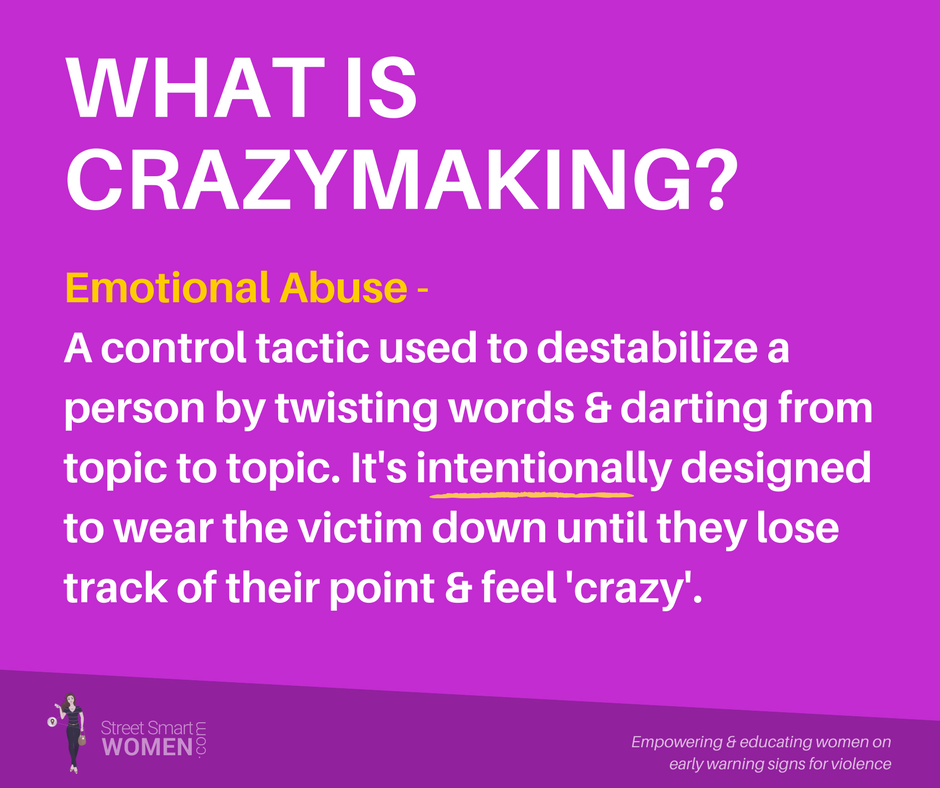
This information about crazy making is from the out of print book Stop! You're Driving Me Crazy! by Dr. George R. Bach. It fortunately has surfaced again and can be purchased as a used book for a small price at Amazon.com.
This is a coping method people use when they are afraid of rejection or confrontation. This results when our rights are not respected or honored. It is based on four basic rights: THE RIGHT TO KNOW, THE RIGHT TO FEEL, THE RIGHT TO HAVE IMPACT and THE RIGHT TO SPACE.
The ways that RIGHT TO KNOW are violated are when we are not given clear information as in underloading, overloading and fogging. In underloading they give us too little information so we are off balance and have shaky confidence about what we are learning to do or the person has left and it is only after they're gone that we realize we don't know anymore than before we asked them the question. At these times it requires the receiver of the information to assume or draw conclusions about the meaning of the incomplete information. This is also a time when mindreading comes into play. In order to survive this walking on eggshells the receiver of the message or silent treatment must use past references to know what the sender of the message might intend. In overloading it is just the opposite problem. The sender gives us too much information and we are in a confused state and a put off balance. We feel so defeated that we do not have the courage to set any boundaries or express any needs for clearer information.
THE RIGHT TO FEEL is violated when we are told how we are feeling i.e. "You're angry aren't you." or how we are going to feel or react i.e. "You're not going to like what I have to say." Or if we are given the message not to feel i.e. "Don't be angry" or "Don't cry". Or we are told what we should or shouldn't be feeling. i.e. "You don't really hate him or her, you just think you do" or You shouldn't feel that way about them.'
THE RIGHT TO IMPACT is where our insanity really shows up. It triggers so many old messages i.e. "You're not important, you're needs are important." And if we played the role of the LOST CHILD it just reinforces our sense of powerlessness and invisibility. We need to have assurance that we exist, that our existence makes a difference to people and situations. We know of our existence when we have IMPACT on others. One thing that really gets to us is when others claim to misinterpret or pick apart what we said in order not to have to comply with our request.
Thinging or objectifying is another way that they treat us as an objects as if we are only a piece of furniture in the room. They can be pictured putting their hand up to their ear and saying "Did I hear someone talking, is there someone else in the room?" COVERTLY HOSTILE or what ? Context-switching and derailing are great avoidance tactics. When you are confronting them on something they did or attempting to set boundaries, they switch the whole focus back to you, and thus put you on the defensive. Now the focus is on you and they slither away. This gets you way off derail track and off balance right where they want you--derailed. Clever huh, unless you are on the receiving end of this CRAZY MAKING. Role-playing is another very common way in which one or both parties avoids asserting themselves. This way the person can hide behind the role they see as the most comfortable, safe and powerful. i.e. referring to yourself as "Mommy" or "Daddy" "Mommy wants you to go to bed" Daddy wants you to come to the table." Or I'm the "boss" I'm the cook--he wife--the husband etc.etc. In this way the other person is put in a position where they almost need to respond in the "subservient" or weak or less powerful position or role i.e. the child, the worker, employer, the hungry one etc.etc.
The final CRAZY MAKING technique is to violate the RIGHT TO SPACE. This right can be violated in so many ways i.e. emotional, time, mental, physical. Without this right being respected we can lose perspective very rapidly and literally feel like we are going crazy. In setting boundaries we set ourselves against the others. It seems that when I am setting boundaries for myself I am violating another's perceived rights i.e. My right to have the radio volume up is a violation to right to have the volume down. My right to deny your request interrupts your right to make a request. It is almost always very MESSY. But our surrender of SPACE is a surrender of our SANITY.
SOURCE
Labels: bill of rights, crazy-making, feelings, impact, need to know, pity party, space
Friday, January 04, 2013
Common "games" between those with Borderline Personality Disorder (BPD) & 'Normals'
Common "games" between those with Borderline Personality Disorder (BPD) and those who do not have BPD
(note: BPD is similar in it's expression to Narcissism; but not the same disorder)
Feelings Create Facts
In general, emotionally healthy people base their feelings on facts. If your dad came home drunk every night (fact) you might feel worried or concerned (feeling). If your boss complimented you on a big project (fact) you would feel proud and happy (feeling).
People with BPD, however, may do the opposite. When their feelings don't fit the facts, they may unconsciously revise the facts to fit their feelings. This may be one reason why their perception of events is so different from yours.
Splitting: (I Hate You—Don't Leave Me)
People with BPD may have a hard time seeing gray areas. To them, people and situations are all black or white, wonderful or evil. This process of splitting serves as another defense mechanism. Peter, who has BPD, explains: "Dividing the world into good or evil makes it easier to understand. When I feel evil, that explains why I am the way I am. When you are evil, that explains why I think bad things about you."
Tag, You're It : A Game of Projection
Some people with BPD who act out may use a more complicated type of defense mechanism — we've named it "Tag, You're It"- to relieve their anxiety, pain, and feelings of shame. It's more complex because it combines shame, splitting, denial, and projection.
People with BPD usually lack a clear sense of who they are, and feel empty and inherently defective. Others seem to run away from them, which is lonely and excruciatingly painful. So borderlines cope by trying to "tag" or "put" these feelings onto someone else. This is called projection.
Projection is denying one's own unpleasant traits, behaviors, or feelings by attributing them (often in an accusing way) to someone else. In our interview with Elyce M. Benham, M.S., she explained that projection is like gazing at yourself in a hand-held mirror. When you think you look ugly, you turn the mirror around. Voila! Now the homely face in the mirror belongs to somebody else.
Sometimes the projection is an exaggeration of something that has a basis in reality. For example, the borderline may accuse you of "hating" them when you just feel irritated. Sometimes the projection may come entirely from their imagination: for example, they accuse you of flirting with a salesclerk when you were just asking for directions to the shoe department.
The BP's unconscious hope is that by projecting this unpleasant stuff onto another person-by tagging someone else and making them "it" like a game of Tag — the person with BPD will feel better about themselves. And they do feel better, for a little while. But the pain comes back. So the game is played again and again.
Projection also has another purpose: your loved one unconsciously fears that if you find out they're not perfect, you will abandon them. Like in the Wizard of Oz, they live in constant terror that you'll discover the person behind the curtain. Projecting the negative traits and feelings onto you is a way to keep the curtain closed and redirect your attention on the perfect image they've tried to create for themselves.
How can people with BPD deny that they are projecting when it is so obvious to everyone else? The answer is that shame and splitting may combine with projection and denial to make the "Tag, You're It" defense mechanism a more powerful way of denying ownership of unpleasant thoughts and feelings.
Some adults who enter into relationships with borderlines feel brainwashed by the BP's accusations and criticisms. Says Benham: "The techniques of brainwashing are simple: isolate the victim, expose them to inconsistent messages, mix with sleep deprivation, add some form of abuse, get the person to doubt what they know and feel, keep them on their toes, wear them down, and stir well."
Everything Is Your Fault
Continual blame and criticism is another defense mechanism that some people with BPD who act out use as a survival tool. The criticism may be based on a real issue that the person with BPD has exaggerated, or it may be a pure fantasy on the borderline's part.
Family members we interviewed have been raged at and castigated for such things as carrying a grocery bag the wrong way, having bed sheets that weighed too heavily on the BP's toes, and reading a book the BP demanded they read.
One exasperated non-BP said that if by some chance he didn't make an unforgivable error one day, his wife would probably rage at him for being too perfect.
If you object to the criticism or try to defend yourself, your loved one may accuse you of being defensive, too sensitive, or unable to accept constructive criticism. Since their very survival seems to be at stake, they may defend themselves with the ferociousness of a mother bear protecting her cubs. When the crisis has passed and the person with BPD seems to have won, they may act surprised that you're still upset.
Labels: blame, bpd, denial, fault, feelings, manipulation, projection, splitting