Sanctuary for the Abused
Sunday, February 18, 2018
CYBERSTALKING IN THE 21st CENTURY - PART FIVE
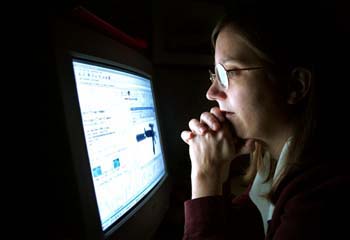
Victim says fighting back is vital
By Dave Breakenridge -- Sun Media
Calgary, Alberta (CANADA) -- It took her almost three years, but Jane was able to get justice against her stalker.
After months of endless phone calls, letters and being followed, Jane -- not her real name -- breathed a sigh of relief in 2002 when her stalker was sentenced to jail.
"I was so grateful -- I was so relieved when it was over," said Jane. "I had almost given up."
A restraining order didn't work -- her stalker kept coming. But he was eventually arrested, tried and convicted, and Jane has had more than two trouble-free years.
There have been no phone calls, no notes, not a peep.
But Jane is still careful.
Her phone number is unlisted, she has a new job, and she hopes to move to another part of town, just to be safe.
She wanted neither her name nor her stalker's name printed.
But she wants to see other women in similar situations follow her example of never giving up, and going to great lengths to protect themselves.
"They're dangerous even if they don't touch you, because you don't know what they're capable of doing," she said.
Information risk specialist Sharon Polsky says the key to staying safe from a stalker is protecting your personal information.
"Someone who is a stalker, they are determined and they usually have a target in mind," says Polsky, owner of Project Scopes Solution Group.
A target can prevent a stalker from learning more about her -- victims are overwhelmingly female -- by being protective about what information they give out in their day-to-day lives.
"Don't give real information on websites and don't give out your home number on websites, unless you're dealing with the government and you're required to," she said
Polsky also advises women to make sure their addresses aren't listed in the phone book, or to have a completely unlisted number.
"Also, get a shredder so your utility bill doesn't accidentally end up blowing down the alley in the breeze," she said.
It's also advised if a victim moves to escape a stalker, that she set up an alternate mailing address, such as a post office box.
The Canadian Resource Centre for Victims of Crime says the post office box should be a victim's primary address for licences, car registration, credit cards, bills, schools, voter records, and all medical records
And, as a general rule, people should not give out their Social Insurance Number to anyone other than banks and employers, because a SIN can be used to track someone.
In addition to protecting information given out on-line, Polsky said people need to protect their home and work computers by changing passwords and making sure they've been turned off before stepping away from them.
This would prevent stalkers, particularly intimate partner stalkers who might have access, from hijacking e-mail programs.
But Polsky said a persistent stalker will use any means to get information. "It's not the technology, it's the people," she said.
"Stalkers operate on base instincts -- it's very easy to get information from people just by asking."
Tracy Bahm, director of the Stalking Resource Centre at the National Centre for Victims of Crime, in Washington, D.C., said it's frightening what someone can find out with something as simple as an online background check.
"You're info gets passed around and put in more and more databases, so you need to protect it," she said.
Victims also need to keep a record of everything, Bahm said, no matter how minute the contact.
"It's multiple acts that make up stalking," she said. "A lot of it is keeping a log keeping record of how many phone calls or e-mails came in on a given day."
But even if victims are even able to protect themselves or gather enough evidence to take to the police, stalking still leaves a mark.
"It's that invasion into every part of your life that I think is really hard for victims -- unless that person dies, it never goes away," Bahm said.
"There's that fear element -- they just won't stop and I think that's pretty scary."
Bahm said people are aware technology is being misused but as it gets better, it becomes harder and harder to detect
That means victims and police have some distance to make up in the race to thwart the shadowy techno-stalker, with all eyes on his victim.
- - -
STALKING SURVIVAL GUIDE
If you or someone you know is being tormented , you can:
* Contact the police
* Keep a written record of the date and time of every contact with the stalker and keep the record in a safe place
* Tell friends, family or co-workers what's happening
* Get a peace bond under section 810 of the Criminal Code of Canada. They can have conditions of no contact, or order a person to stay a certain distance away from you
* Keep as much information as possible private , and change your mailing address to a post office box
* Keep the outside of your house well-lit, install an alarm, change the locks and keep doors and windows locked, even when you are home
* Change your phone number, using *67 to block your number or *57 to trace harassing calls
* A cellphone is recommended in case of emergency
* Keep emergency numbers next to the phone
* Seek out the help of victim services in your community
* Make trusted people in your workplace aware of the situation and tell others not to reveal your whereabouts to outsiders
* Have unnecessary information about you removed from your company's website
* Be well aware of your surroundings when you are out
* If you are being followed, drive directly to a police, gas or fire station, remain inside the vehicle and honk the horn until someone comes to your aid
* If a friend is being stalked, express concern about it to the victim and encourage them to turn to the police for help
* It is not advised to confront a stalker on a friend's behalf -- this can place you at risk of harassment and could place increased risk on the victim -- contact the police instead
-- source: Canadian Resource Centre for Victims of Crime
- - -
CREEPY CHARACTERISTICS
Some things a stalker may do:
* Follow his victim everywhere
* Make repeated, unwanted phone calls
* Damage the home, car or other property
* Send unwanted gifts, letters, cards or e-mail
* Monitor phone calls or computer use
* Make threats or commit other actions
While not all stalkers are the same, most of them share some common traits:
* Obsessive personality
* Above-average intelligence
* Extreme emotional needs
* Few personal relationships
* May be delusional
* Non-conformity to social norms
* Low self-esteem
* Substance abuse
While a stalker can pose a threat to his target, there are a number of warning signs the risk regarding the stalker is increasing:
* Escalation to more personal forms of conduct
* Closer geographical proximity of the stalking
* Prior criminal history
* Communicated threats are a strong indicator, especially direct, private, written threats very specific and severe in nature
Labels: cyberharassment, cyberstalking, lies, online stalking, spying, stalking, terrorism, threats


Saturday, February 17, 2018
CYBERSTALKING IN THE 21st CENTURY - PART FOUR OF A SERIES

Victims tell tales of terror
By Dave Breakenridge -- Sun Media
Calgary, Alberta (CANADA) -- Modern technology is bringing even more terror to stalking victims.
Lisa, a stalking victim who didn't want her real name used, said she started getting suspicious when her ex-boyfriend would show up wherever she went.
It didn't matter where: picking up clients or visiting the library, he would turn up.
He would phone her and ask where she picked up her two kids, and then fly into a rage when her answer didn't reflect the information he had.
And he was always right.
"He would appear in places he wouldn't otherwise know I was there," said Lisa.
Unbeknownst to her, Lisa's ex-boyfriend had attached a global positioning system device to her car.
"He is so smart with technology, he could put anything together," she said.
The pair's romance began three years ago.
Lisa said her ex seemed normal, smart and charming.
"He was a very nice guy, very nice -- all of the good things you look for," she said.
But their two-year relationship started to turn sour after he developed a drug addiction.
"It started affecting his brain and he would go days without sleeping," she said.
Repeated pleas to get him to stop went nowhere so Lisa was forced to issue an ultimatum.
"I warned him 'if I see you in that condition one more time, it's over,' " she said.
"He told me that he would quit and then he told me that he had already quit, but I had seen him in that state before, so I knew what to look for."
Knowing he was lying, Lisa tried to put an end to the relationship, causing him to fly into a rage.
"He broke things in his apartment, put holes in his walls," she said, adding he tried to contact her to arrange a meeting.
Lisa said he told her he would try to be calm.
"But as soon as he would hear the words break up, he would go crazy," she said.
After that meeting last February, the constant phone calls and e-mails began -- Lisa said he was begging just to hear her voice.
She said he would call in the middle of the night, unable to sleep, and ask her to talk about trivial things.
And then the threats started.
"He said 'it's me or no one else -- and if it's not me, then I'll kill you,' " she said.
Despite the threats, Lisa didn't go directly to the police and her ex wouldn't relent. He would hound her constantly, from the first conversation about breaking up, to when he was arrested six months later. His phone calls became even more incessant, Lisa said, using cell phones to tie up the lines where she worked and having her cellular service cut off.
And during this period the strange appearances started, terrifying her even more.
"I realized that he was totally sick and it was damaging not just for me, but for him, because he had lost his mind," said Lisa, who eventually found the GPS device he was using and called police, but she said an arrest wasn't made.
Frightened about his actions, she went with her two kids to stay at her sister's, because she was worried he would break in to her house.
Compounded with the further threats against Lisa and her home, the authorities were called into the case. Not long after, he was arrested and charged with stalking.
Lisa hopes she won't have to deal with him again, but the ordeal has damaged her.
"There's a sense of self-protection on me now -- I don't even want to get into a relationship," said the American woman.
"What I feel right now is not good, because what I lost is a belief in love."
But most off all, she still can't shake the feeling of having her movements watched.
The thought a victim could be tracked anywhere they go in such a fashion terrifies an Alberta stalking victim, who was terrorized for nine months after her romantic entanglement with her eventual stalker came to an end.
Jane, who also didn't want her real name used for fear of stirring up past demons, said because of the nature of the crime, anything is possible with a persistent stalker.
"That's terrifying -- I couldn't imagine that," Jane said of the possibility of being tracked with GPS.
"I'd be freaking out and if someone did that to me and I found out, the first thing I would try to do is get a new car."
Jane's stalker would skulk around her house and send her letters threatening to send lurid photos to her relatives.
He would try to be sweet, Jane said, but his mood would turn on a dime when she rebuffed his attempts to regain her affection.
"He would latch on to my car when I tried to drive away and he would show up at my door constantly causing trouble," she said.
Jane said he sent her letters to the front desk of her office, leave nasty notes in her mailbox, ring the doorbell and run away.
Jane said he supplemented his letters with constant phone calls, both to her home and her workplace, totalling nearly 50 every day.
"It was extremely frightening because you never knew what he was capable of," she said.
Eventually, Jane was able to get a restraining order against her stalker, followed by his arrest, charges and a jail sentence.
"I'm just trying to live my life, to get it out of my mind," she said.
"But if I see somebody that even remotely looks like him, my heart just stops."
Labels: cyberstalking, lies, spying, stalking, suspicious, terrorism
Friday, February 16, 2018
CYBERSTALKING IN THE 21st CENTURY - Part Three

High-tech gadgets give stalkers more power
By Dave Breakenridge -- Sun Media
It's a technology with the noblest of uses -- tracking kidnapped children or finding avalanche victims.
But like they've done with computers, stalkers have found a new use for global positioning systems (GPS).
Four recent cases in the U.S. have shown the dark side of the technology, all of them involving men attaching a GPS-enabled device to their exes' vehicles to aid them in their stalking behaviour.
Such gadgets use a constellation of satellites to pinpoint location and, using cellular networks, can send their co-ordinates to wireless handsets or computers.
Misuse of the devices allows a stalker precise information about the location of their target, making it easier to terrorize. Authorities involved in the cases have said the technology has created the brand of 21st century stalking.
Because of that, Pamela Cross of the Metropolitan Action Committee on Violence Against Women and Children and the Ontario Women's Justice Network in Toronto, said victims' groups, which deal with thousands of people every year, need to be more up to speed about what technology is being used by abusers.
"I would say so -- technology is almost the greatest gift to a persistent stalker," she said.
"The thing you have to remember is you're talking about people who aren't overly concerned that what they're doing is illegal."
She said stalkers are the type of people who will use any means necessary to achieve their goals.
Persistent stalkers, she said, are usually intelligent, manipulative people who seem to find a way to get information from the people who have it.
With the case of technology, the intelligent, persistent stalker manipulates it to his own advantage.
"I think the GPS stories are disheartening -- it's so insidious because even things like MapQuest and other similar services can give you directions right to a person's house," Cross said.
"The other thing that exists that I find quite bizarre are these 'I Spy' software programs that advertise ways to track someone down electronically."
Edmonton-based Crown prosecutor Val Campbell, also the co-ordinator of the family violence initiative for Alberta Justice, said technological means are just another way for an abuser to exert control over a victim.
"The GPS thing is pretty frightening," Campbell said, adding it's likely just a matter of time before a Canadian stalker starts using tracking technology.
"For sure, if it isn't happening already."
But Cindy Southworth, director of technology at the National Network to End Domestic Violence in Washington, D.C., said in all likelihood, there's an obsessed ex somewhere in Canada, watching in real-time his computer monitor.
"I believe strongly that Canadians are incredibly tech-savvy ... it's possibly not being reported," Southworth said.
"When you look at societies that have high technology use, there are going to be situations where technology is used in violent incidents."
Southworth, who started training law enforcement more than four years ago, has co-ordinated her efforts in Washington with Tracy Bahm of the Stalking Resource Centre.
"She and I are seeing lots and lots of technology showing up in stalking and domestic violence cases," Southworth said.
In addition to the GPS cases, tech-savvy stalkers are turning to devices such as spyware to monitor their targets' computer use, and putting hidden video cameras to a wide variety of prying-eye uses, including keeping tabs on who an ex might be inviting into the bedroom.
Australian and British law enforcement agencies are sounding the alarm over camera-equipped cell phones as a new form of stalking, something which would fall under Canada's proposed anti-voyeur law, should it be passed.
"Secret webcams in dorm rooms, upskirt photos and posting photos to the Internet to hurt someone, that's all going to be illegal," said Crown prosecutor Steve Bilodeau, who specializes in cybercrime.
Though the technology is new, GPS devices have been commercially available for about five years and Southworth said every advancement in technology has brought about new misuses by stalkers.
"When caller identification was first introduced, abusers would monitor the caller ID box," she said.
"As technology advances, it's going to be almost impossible for victims to flee and get to safety."
But she said there are always signs.
"Trust your instincts -- if your ex knows too much about your activities or things you only told a few people, you might be under surveillance," she said.
An even stronger sign is if the stalker follows his target to places the victim has never been before.
That was the tip-off for Connie Adams, a Wisconsin woman who in 2002 was stalked by her ex-boyfriend with a real-time GPS tracker.
He showed up while she was at a particular bar for the first time.
"He told me no matter where I went or what I did, he would know where I was," Adams testified at her ex's hearing.
Police say Paul Seidler put a global positioning tracking device between the radiator and grill of Adams' car.
He was handed nine months in jail in 2003 for stalking.
Southworth also said an ex with a history of controlling behaviour and who is fairly comfortable with technology could resort to technology to track and torment.
But sometimes stalkers will identify how they're keeping tabs on their victims.
"Follow the patterns," she said.
"If it's every time you call or e-mail someone your stalker is calling you asking specifics about the conversation you just had, or where you've been, then that's a pretty strong signal.
"That's one of the ways they tip their hand: They taunt their victims with information they're not supposed to know."
For victims who think someone might be using a GPS unit to follow them, or using a camera to secretly videotape them, as long as the device is transmitting a radio frequency, it can can be detected.
The devices that scan for signals can be expensive, but for some, the peace of mind would far outweigh the cost.
People worried about the cost can look at various places on their vehicles, including under the bumper or under the front and rear dashboards.
Southworth's group advises if anything is found, it should be kept, photographed, but not removed from where it is.
That's a task best left to the police, who should be contacted immediately.
Labels: cyberstalking, gadgets, high-tech, predators, snooping, spying, stalking
Thursday, February 15, 2018
CYBERSTALKING IN THE 21st CENTURY - PART TWO

Access to your life a mouse click away
By Dave Breakenridge -- Sun Media
CALGARY -- With the advent of high-technology, stalking has become a greater threat than ever before. In our five-part series, the Sun Media's Dave Breakenridge looks at the scourge of stalking in the 21st Century.
It used to be stalkers would have to make personal efforts to get their targets' attention, leaving notes or keeping watch outside their homes.
But now, stalkers are getting their threats right into where their victims live -- volleys of love or hate, or both -- landing squarely and repeatedly in e-mail inboxes, websites, blogs about the victims & their families or instant message windows.
Two-thirds of Canadian homes have a computer, and nearly that many have at least one person using the Internet from work, home or school, making the computer an easy-to-access tool of terror.
These cases where a computer is used to torment are becoming more common, said Det. Brad Martin of the Calgary Police Service technological crimes unit.
"It now happens on a pretty regular basis where the Internet is used to harass, embarrass or make life difficult for people," he said.
"The most common stuff we see is e-mail, instant messages to cell phones, websites hosted with private pictures or personal information and registration at seedy websites in that person's name."As Canada becomes more plugged in, and computers are used more frequently for everything from keeping in touch to balancing the family books, increased computer use by all kinds of crooks is a natural evolution.
In the case of stalking, Martin said, that includes software originally designed as a safety tool for parents.
Things like spyware marketed for parents to monitor a child's computer use, can be used by a stalker to access information which could further the harassment.
"When they're used, the way they're designed to be used they have an important role in the use of computers," Martin said.
"But the dark side is always there and people are going to use good stuff for bad things."
Despite the perceived anonymity of the computer, Martin said cyberstalkers can be caught.
"The technology is there that whoever you are, your communication can be traced back to the sending computer," Martin said, adding the onus in most cyber-cases rests with the victim.Because they are the target of the communication, victims need to keep as much of it as they can to help build a strong case.
Technology has become so interwoven with criminality, Martin said his unit could have double its four current members and still have an overflowing case load -- adding half of his cases involve child pornography.
"When you're getting harassed with e-mails, don't reply, and save the e-mails -- if you reply you increase the problem and it sort of encourages the activity to continue," Martin said, adding if the behaviour continues, the police should be contacted. Saving the suspect e-mails is important because it gives the police evidence to work with, Martin said.
He also said Internet service providers are, for the most part, co-operative with law enforcement, some more than others.
While e-mail may be the most common electronic tool for stalkers, Edmonton-based Crown prosecutor Steven Bilodeau -- who specializes in cybercrime -- said there are myriad electronic means for a stalker to harass and torment his victim.
"Cyberstalking can take on whole other aspects ... it can be things like hijacking someone's e-mail password or going into a sex forum pretending to be that person," he said.Calgary police Det. Gordon Robertson said he's worked a number of cases where a computer was used as part of a pattern of controlling and intimidating behaviour.
One case sticks out in his mind as being particularly frightening for the victim.
Roughly a year after his marriage dissolved, a man went to his ex-wife's house while she was asleep and told his son he'd come over to get something he left at the house.
While there, he installed an insidious trojan program -- used to take remote control of the computer -- on his ex's PC.
The woman then started getting e-mails from her former hubby asking about the new guy she's been seeing -- with quotes lifted right from messages she'd sent friends.
"He'd been monitoring her e-mails and computer activity," Robertson said.
Whether it be data storage, communication, hacking, identity theft, or using the Internet to exploit children, Martin said the misuse of technology is just a natural, but unfortunate, evolution.
"The way that criminality is going is crooks are switched onto technology now
and they are using these communication devices more," Martin said.
"They know what's going on and they're not encumbered by the cost of things because they take the profit from their crimes and they invest it in that cost."
Labels: cyberstalking, emotional rape, evil. predators, intimidation, intruder, psychopath, spying, stalking, threats