Sanctuary for the Abused
Tuesday, August 07, 2018
How to Help An Abused Woman

Know the facts about woman abuse.
Assure her that you believe her story.
Listen and let her talk about her feelings.
Do not judge or give advice. Talk to her about her options.
Physical safety is the first priority. If you believe she is in danger, tell her.
Help her plan an emergency exit.
Respect her right to confidentiality.
Let her know you care and want to help.
Allow her to feel the way she does and support her decisions. Let her talk about the caring aspects of the relationship as well. Don't try to diminish her feelings about her partner. Don't criticize her for staying with him, but share information on how abuse increases over time without intervention.
Give clear messages, including:
Violence is never okay or justifiable.
Her safety and her children's safety are always the most important issues.
Wife assault is a crime.
She does not cause the abuse.
She is not to blame for her partner's behaviour.
She cannot change her partner's behaviour.
Apologies and promises will not end the violence.
She is not alone.
She is not crazy.
Abuse is not loss of control, it is a means of control.
Discuss how the violence affects the children.
Be encouraged that every time she reaches out for help she is gaining the emotional strength needed to make effective decisions. She may be too fearful and immobilized or confused to take any step immediately.
Although police can be asked to accompany a woman going back home to retrieve personal belongings, encourage her to be prepared for the possibility of leaving home in a hurry. She should have necessary documents or photocopies ready, as well as important items such as:
credit cards, cash, bank books, passport, birth certificates, citizenship papers, house keys, medications, children's favourite toy, clothing, etc.
An abused woman needs our support and encouragement in order to make choices that are right for her. However, there are some forms of advice that are not useful and even dangerous for her to hear:
Don't tell her what to do, when to leave or when not to leave.
Don't tell her to go back to the situation and try a little harder.
Don't rescue her by trying to find quick solutions.
Don't suggest you try to talk to her husband to straighten things out.
Don't place yourself in danger by confronting the assaultive man.
Don't tell her she should stay for the sake of the children.
Never recommend joint family or marital counselling in situations of emotional or
physical abuse. It is dangerous for the woman and will not lead to a resolution that is in her interest.
Encourage separate counselling for the man and woman, if they want counselling.
How to Help Children Who Witness Abuse
For Mothers
Understand that there is a reason for the child's behaviour, and acknowledge that in words for her. Children will work out reasons of their own for the turmoil, often blaming themselves, unless you discuss what is going on.
Let your children know that the fighting is not their fault.
Give them permission to talk about the abuse. Information, and talking about feelings helps to sort out what is going on. If you are not able to handle talking with your child, make sure she knows one or two other people that you feel comfortable having her talk to.
Help them to work out a safety plan: a safe place to go when there is fighting, numbers they can call, and make sure they know it is not safe to get in between fighting adults.
Acknowledge the mixed feelings they may have toward their dad; it is still okay to love him, and hate what he does.
Make sure your child knows that keeping silent about abuse at home sometimes leads to keeping silent about other negative experiences.
Help the child to identify feelings other than anger, and help them find safe ways to express those feelings. Try to notice and comment on what your child is doing right.
Be as specific as you can about what is going to happen in everyday life. Children who live with abuse need information ahead of time about where they will be, and how long they will stay. If your child has a hard time separating from you, reassure him, and tell him you will be safe and when you will be back.
Get support for yourself. It takes extra patience to cope with a child who is acting out because of witnessing abuse.
For Teachers and Child Care Workers
Try to incorporate into daily activities a discussion of feelings and how to express them and recognize them in other people. Some children who witness violence only recognize and express anger: a feeling vocabulary helps them to express what they are experiencing.
A child who witnesses abuse often has a short attention span, as a result of being constantly on edge at home. Try to avoid focusing excessive negative attention on this behaviour, and if possible, support the child in redirecting his energy.
Try to discuss behaviour in terms of "safe and not safe", rather than "bad, good, nice, not-nice". The child may already be suffering with very low self-esteem and will tend to identify with the aggressor in her family, if she hears at school that she is not nice.
Consistency, routine and follow-through are very helpful in assisting a child who is coping with violence. Try to create a feeling of safety and predictability in the child's environment, using visual cues like clocks whenever possible. Self-esteem words and phrases that identify concrete examples of positive behaviour (helpful cleaning up, shared his snack) go a long way to counter feelings of worthlessness and helplessness, especially when written down.
Be as clear as possible about rules, and consequences. Try to avoid the appearance of arbitrary punishments or decisions. Children who witness violence often have a very keen sense of justice.
Offer limited choices. This increases a child's sense of control over her world.
Try to be patient with decision making: it may be an unusual experience for her.
Give a time limit.
School-age children can benefit from discussions of gender stereotyping. Boys especially need to know that the abuser in their family is not the only way to be male.
Challenge stereotypes in popular culture that show helplessness and aggression.
Identify other ways of coping with problems.
Help the child identify her "support systems": safe family members or adults that can help a child by listening.
Know that the child's mother is doing the best they can under the circumstances. Be aware of the issues she is facing, and try not to judge her for what may look like poor parenting practices in your view. If you have noticed routines or patterns that seem to help or hinder the child, share them with his mother, but be aware that she may not always be able to act on the information immediately or consistently.
Labels: abused, assaulted, believe, help, listen, trust, women


Tuesday, May 08, 2018
The Huge Hurt: Betrayal

by Ann Bradley
Betrayal, when realized, is a phenomenal existential feeling. Suddenly, your world is no longer the one you believed in. You question reality, but most of all you question yourself. How, you wonder, could I have been so naive, stupid, blind, trusting, unseeing, unknowing?
It may be difficult to believe, but these questions are good. YOU are the normal person, the one who aligns reality (he was so nice to me, he was my friend) with a cognitive belief: he ACTS as if he likes me, he TELLS me he likes me, I see no reason not to believe him because in my past, people who act and speak this way, CAN be trusted. There is congruency. But not now.
Suddenly, you learn that someone trusted - a spouse, lover, family member, close friend - has been putting you down, lying, manipulating others against you, and yet maintaining a stance of intimacy with you. The world is not clear, the ground you stand on is wobbly. You will never feel good about this.
But you CAN get over it. You can do so by realizing that no matter how awful the betrayal, YOU are the normal person and this betrayal comes from rage. This person envies you, is enraged about it, and MUST put you down behind your back. They MUST harm you. They have no choice.
But you do. In the world of normals, after we get over the shock, we can use this experience to become stronger, to help others, to learn to avoid this particular toxin, and to calm ourselves that the higher moral ground is ours. It's too bad this person acted as he did, we wish he did not, but we are NOT diminished by their pathology. Wiser, sadder, but never diminished.
SOURCE
Labels: beliefs, betrayal, harm, lies, shock. smear campaign, trauma, trust
Monday, April 23, 2018
BETRAYAL: THE FEELING OF BEING BROKEN

.. AND THE RECOVERY
They were in love. Everything was wonderful. They'd been together for twelve years. They were expecting their second child and they were delighted. And then came the unexpected telephone call. The phone call from the 9-year old boy asking to speak to his "Daddy."
BETRAYAL.
The trust, the dreams and the hopes all shattered in an instant with the revelation that her husband of twelve years had a secret relationship and a secret child for nine years!
"I love you baby. You know I would never hurt you. My job is to protect you always and I will always do that. You just need to keep our secret safe. Don't tell Mommy what we're doing ... she won't understand that I need to show you how to love ..."The child who trusts the adult not to hurt him/her is betrayed by the abusing or neglectful adult.
The mere word, "betrayal," evokes enormous feelings. It’s one thing to be disappointed, saddened, and unhappy; but it’s altogether another to feel BETRAYED.
…Lied to in a way that feels humiliating. Defiled by someone whom you trusted; someone in whom you placed your belief, your hopes, perhaps your love. Perhaps it is in the enormity of the truth not told, or the complexity of the subterfuge, or the completeness with which the trust was given…that the pain grows to feel so huge.
Another common experience in the moment of discovered betrayal is deflated self-esteem. It is so very important to remember that trust given and trust broken is at the core of the betrayal issue. Trust is a gift. If you gave and it was not well and honestly received – YOU have no blame. That you would trust and honor you both with one of the greatest gifts one human can offer to another, makes the betrayer the person who is sorely lacking. You must not diminish the magnitude and beauty of your gift – by belittling yourself for having given.
There are many times when one can experience betrayal:
Betrayal by parents:
A parent who abused you.
A parent who lied to you.
A parent who neglected you.
Betrayal by a lover:
A lover who has conducted another relationship(s) while with you.
A lover who has told you things and presented a picture of themselves that was false.
A lover who has taken all your money without your knowledge.
A lover who has transmitted a disease you never knew about.
Betrayal by society:
A promise for full employment that never gets met.
A promise of social security – that may not be there.
Quality healthcare – available only to a few.
Betrayal by your body:
A chronic illness when you’ve done "everything right."
A disease of body image – and you feel hopeless and helpless.
Aging.
Betrayal by a friend:
A closely guarded secret --- exposed…
An important promise --- broken….
A person you trusted who acted with no regard for your feelings...
A friend you put yourself on the line for – who left you high and dry.
Betrayal of self:
Lies to self.
Denial of a personal medical condition.
Participation in a disrespectful relationship.
In all these instances – it is the quality of the perceived connection between the parties that determines whether the injustice feels like a betrayal or simply an unpleasant event or behavior.
If someone you feel no particular connection to – promises a gift – and fails to follow-through; perhaps you are upset, disappointed, even angry. The rage and despair often associated with betrayal comes only when the experience is one of a profound, wrenching violation of your faith in another. The establishment of trust is a tremendous commitment you make. It only makes sense that when the commitment is dismissed – the magnitude of that dismissal can feel overwhelming. Whether the betrayal is experienced at the hands of another or is perceived to be experienced at the hands of self – the initial shock and anger can be quite draining; sometimes frightening.
The sense of betrayal can be accompanied by a self-anger, a new/renewed distrust of self, a new/renewed fear of self, and the decision-making skills you possess. With the feeling of betrayal can come the feeling of a psychic implosion. At the moment, you do not feel whole. Many begin to fear they will never feel whole again.
If you are struggling with a feeling of having been betrayed – there are many things you are likely to experience including: (1) shock (2) denial (3) anger (4) extreme hurt/sadness (5) anxiety (6) emotional lethargy (7) social lethargy (8) changes in daily living activities; in other words, many of the symptoms of depression. This is quite normal – but if these symptoms persist for more than two weeks, it is important to meet with a mental health professional for an evaluation for therapy – possibly short term, medication, etc., etc.
As you begin to understand the nature of your feelings and look for ways to proactively heal…you will be on …the road to recovery … In doing this, many may discover that the betrayal, the loss, the anger, and all the other feelings involve not only the immediate betrayal but any other betrayals experienced over your lifetime. Previous experiences of betrayal – whether from infancy / childhood or from adulthood last week can complicate the way in which you experience the betrayal and heal from the betrayal.
Betrayal by another does not have to mean that you have to betray yourself. It does not mean that you are unworthy and unfit. It does not mean that you deserved the treatment you received, nor is it a guarantee that you will be treated the same way again. If you feel betrayed by yourself - you may have to work with someone professionally or in a support group to understand the feelings of betrayal and how you can heal.
Tips for healing…
Acknowledge your pain, anguish…and every other feeling you have.
Surround yourself with supportive friends/ family.
If you are choosing to end the relationship, writing a letter to allow your own release will be important for you. (This is a letter that you will very likely not send.)
If you are choosing to continue the relationship, make sure you set clear and specific limits for future interactions.
Make sure to interact with at least one positive force in your life every day.
Allow yourself time to heal and learn.
Forgiveness of YOURSELF frees YOU from YOUR pain.
It is critical to remember during this healing time that…
Your trust has been abused…this is a very big deal. Recovery will take time.
You are NOT responsible for the betrayer’s decisions. (If you see self as the betrayer of self– recognize that your choices were propelled by choices you felt were reasonable at the time.)
You CAN heal.
You are NOT alone.
You are NOT "stupid."
YOU did not create the betrayal.
You do NOT need to understand the betrayer’s actions in order to heal. You DO need to get lots more information if you are going to remain in the relationship.
You may never understand the betrayer’s motivations – you do not have to in order to heal. You DO have to if you choose to resume/ continue the connection.
If you choose to continue the relationship, you MUST see ACTIVE change in the betrayer towards a new, healthy, HONEST communications style.
By Pamela Brewer, MSW, Ph.D., LCSW-C
Labels: betrayal, broken, healing, honesty, low self-esteem, trust
Monday, December 18, 2017
Emotional Boundaries in Relationships
A successful relationship is composed of two individuals each with a clearly defined sense of her or his own identity. Without our own understanding of self, of who we are and what makes us unique, it is difficult to engage in the process of an ongoing relationship in a way that is functional and though not always smooth is a safe environment that generally enhances each of the partners. We need a clear sense of self in order to clearly and unambiguously communicate our needs and desires to our partner. When we have a strong conception of our own identity, we do not feel threatened by the intimacy of the relationship and can appreciate and love those qualities in our partner that make him or her a unique person. When two people come together, each with a clear definition of her or his own individuality, the potential for intimacy and commitment can be astounding. The similarities between two people may bring them together, but in an ideal partnership, sometimes called interdependent, their differences are respected and contribute to the growth of their relationship which aids in the growth of the individuals in that relationship.
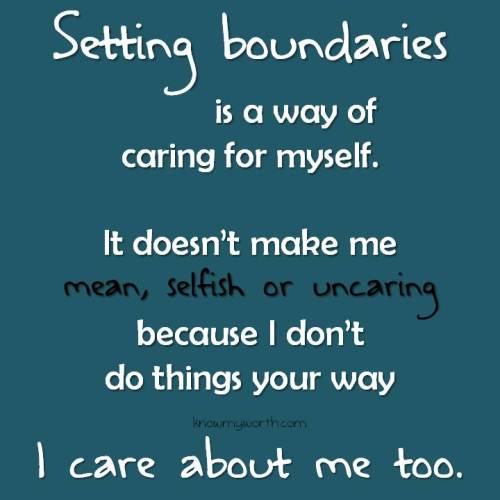
One feature of a healthy sense of self is the way we understand and work with our emotional boundaries. Personal boundaries are the limits we set in relationships that allow us to protect our selves from being manipulated by, or enmeshed with, emotionally needy others. Such boundaries come from having a good sense of our own self-worth. They make it possible for us to separate our own thoughts and feelings from those of others and to take responsibility for what we think, feel and do. Boundaries are part of the biological imperative of maturation as we individuate and become adult people in our own right. We are, all of us unique, and boundaries allow us to rejoice in our own uniqueness. Healthy intact boundaries are flexible, they allow us to get close to others when it is appropriate and to maintain our distance when we might be harmed by getting too close. Good boundaries protect us from becoming engulfed in abusive relationships and pave the way to achieving true intimacy the flipside of independence, as we grow to interdependence the relationship of two mature individuals. They help us take care of ourselves and if we can receive it, to respect the selves of others.
Unhealthy boundaries are generally as a result of being raised in dysfunctional families where maturation and the individuation process was not properly understood nor the child respected as an individual. In these types of families the unmet needs of parents or other adults are sometimes so overwhelming that the task of raising children is demoted to a secondary role, and dysfunction is the likely result. Consider the role of the father or mother who screams at his/her children or becomes physically, verbally or emotionally abusive with them as a self-centred way of dealing with his/her own stored up anger/grief from their own traumatic childhood. The emotional fallout of these unmet developmental needs, which, depending on the severity of the original pain, is often close to the surface and can be triggered by totally unrelated present circumstances. The pain of their own childhood experiences repressed for so long is felt again, insisting that these experiences be dealt with, relegating the present needs of the children for safety, security, respect and comfort to second place at best. But sometimes because of what they represent and the negative self worth of the parent the child can be perceived as the 'enemy' and so dysfunction is passed on from one generation to the next. This is not to say that the childhood experiences of the parent were necessarily horribly abusive, it is just that what may have been acceptable parenting practices in their family of origin for generations were abusive. More often than not these practices and their underlying attitudes were based on false or abusive religio-cultural premises. What the children are likely to learn in this situation is that boundaries don't matter, that indeed they, as individual human beings, don't matter except where they are useful for the emotional needs of others. As they grow up in their families of origin, they lack the support they need from parents or caregivers to form a healthy sense of their own identities. their own individuality. In fact, they may learn that to get their needs met they must get their way with others. To do this they need to intrude on the emotional boundaries of other people just as their father or mother may have done. They would in all likelihood grow up with fluid boundaries, that cause them to swing between feelings of engulfment on the one hand and abandonment on the other inevitably leading to dysfunctional relationships later on in life. They would have at best, a hazy sense of their own personal boundaries, not able to properly define where they end and the other begins. Conversely, they may learn that rigid and inflexible boundaries might be the way to handle their relationships with other people. They wall themselves off in their relationships as a way of protecting their emotional selves, and, as a consequence, will, in all likelihood find it difficult to form lasting close interpersonal bonds with others in adulthood as they are still trying to individuate from their parents. The exception in this is of relationships predicated on the same rigid rule based structure as their family of origin where nothing came into the family or out from it, but in this case the bond is likely to be enmeshment.
The following are some ways in which unhealthy boundaries may show themselves in our relationships, along with some remedies:
Lack of a Sense of Identity
When we lack a sense of our own identity and the boundaries of the self that protect and define us as individuals, we tend to draw our identities, our sense of self worth from our partner or significant other as we did in the earliest stage of our biological growth in our family of origin, drawing our sense of worth from their perceptions of us. The structure of the relationship in this case is not that of equals in a partnership but that of parent and child. Leading in some cases to that most unequal of relationships, master and slave. It is quite possible that children developing in a family where the important relationship of the parents is an unequal one will be forced to take on roles as either surrogate spouse and/or adopt roles that it is hoped will restore dignity to the family and balance to the system. If we can't imagine who we would be without our relationship, chances are we come from a dysfunctional family of origin and have learned co-dependent behaviour patterns. Unable to find fulfilment within ourselves we look for such fulfilment in others and are willing to do anything it takes to make the relationship work, just as we may have done in our enmeshed family of origin, even if this means giving up our emotional security, friends, integrity, sense of self-respect or worth, independence, or employment. We may even endure objectification, (an attitude in which we are no longer perceived as feeling human-being but just an object, a part of the family system), in the form of physical, emotional or sexual abuse just to save the relationship.
The more rational alternative is to find out who we are and what makes us unique, and we will rejoice in the freedom of this discovery. We will come to realise that our value and worth as a person is not necessarily dependent on having a significant other in our life, that we can function well as an independent person in our own right. When we move into accepting ourselves for who we really are warts and all, we will be able to accept others for who they are; our relationships and ourselves will actually have a chance to grow into emotionally mature adults able to give freely out of choice and flourish in our new found freedom. This journey of self-discovery can be challenging and painful but highly rewarding. Working with a trained therapist or as part of a support group or a combination of both can provide the structure and support we need to take on this task. But whatever way we may choose the first step is to acknowledge to ourselves, God and possibly another person that our lives as we have tried to control and manage them have become unmanageable. The second is to give ourselves over to the cleansing and renewal processes.
Settling for Second Best
We may cling to the irrational belief that things are good enough as they are, we feel a measure of security in the relationship, that change is a difficult and fearful prospect, or that we don't deserve any better, our life has always been a sacrifice of the self, and that this is as good as it's likely to get. In the process, however, we give up the chance to be the person we were meant to be and to explore our sense of personal fulfilment in life. We give up not only our own life dreams but our sense of worth in order to maintain the security of a relationship.
A healthy relationship is one in which boundaries are not only strong, but flexible enough, to allow us to flourish with our own uniqueness, but are also known to and respected by each other. There is a sense of respect on the part of both partners that allows each to live as full a life as possible and to explore their own personal potential. We don't have to give up ourselves for a relationship but can become interdependent. Healthy boundaries allow trust and security to develop in a relationship because they offer an honest and reliable framework by which we can know each other. But if we don't know where our self ends and the other begins it is impossible.
Over-Responsibility and Guilt
One characteristic of growing up in a dysfunctional household is that we may learn to feel guilty if we fail to ensure the success and happiness of other members of the household. We may feel responsible or be made to feel responsible for the failure or unhappiness of others. Thus, in adulthood, we may come to feel or be made to feel responsible for our partner's failures. The guilt we feel when our partner fails may drive us to keep tearing down our personal boundaries so that we are always available to the other person. When we feel the pain, the guilt, the anger of being overly responsible for another person's behaviour or life experiences, we may seek alleviate this feeling by rescuing them from the consequences of their behaviour as we learned in our family of origin. Thereby depriving them of one of the most important features of an independent, healthy and mature life, the ability to make our own life choices, accepting the responsibility for and the consequences of our/their decisions. Or we may bear the burden of their unacceptable behaviour for many years.
A healthier response is to show our partners respect by allowing them to succeed or fail on their own terms. You, of course, may choose to support your partner's fulfilment of life goals but it is unhealthy to rescue them from all of life's consequences. When you do agree to help ask yourself two questions is it something they can do for themselves? and, do I resent the giving of my own resources (self, time, money, etc.)? This may be a difficult choice if we have confused love with rescue. You can be there to comfort or encourage your partner when times become difficult, and you can rejoice with them when success is the outcome. When boundaries are healthy, you are able to say, I trust and respect you to make your own life choices. As my equal partner, I will not try to control you by taking away your choices in life.
The Difference Between Love and Rescue
People who grow up in a dysfunctional family may fail to learn the difference between love and sympathy. Children growing up in these conditions may learn to have sympathy for the emotional crippling in their parents lives and feel that the only time they get attention is when they show compassion for the parent. They feel that when they forgive, they are showing love. Actually, they are rescuing the parent and enabling abusive behaviour to continue. They learn to give up their own protective boundaries in order to take care of the dysfunctioning parent, becoming a surrogate co-dependent spouse. In adulthood, they carry these learned behaviours into their own relationships. If they can rescue their partner from the consequences of their behaviour, they feel that they are showing love. They get a warm, caring, sharing feeling from helping their partner, a feeling they call love. But this may actually encourage their partner to become needy and helpless enabling the negative behaviour to continue. An imbalance can then occur in the relationship in which one partner becomes the rescuer or enabler and the other plays the role of the helpless victim. In this case, healthy boundaries which allow both partners to live complete lives are absent. Mature love requires the presence of healthy, flexible boundaries.
Sympathy and compassion are worthy qualities, but they can be confused with love, especially when boundaries have become distorted or are virtually non existent. Healthy boundaries lead to respect for the other and equality in a relationship, an appreciation for the aliveness and strength of the other person, and a mutual flow of feelings between the two partners, all features of mature love. When one partner is in control and the other is needy and helpless, there is no room for the give-and-take of a healthy relationship.
Fantasy vs. Reality
Children from highly dysfunctional households often feel that things will get better someday, that a 'normal' life may lie in the future. Indeed, some days things are fairly 'normal', but then the bad times return again. It's the normal days that encourage the fantasy that all problems in the family might someday be solved. This is a common cycle in highly dysfunctional families. When they grow up, these adults carry the same types of fantasy into their relationships. They may portray to others the myth that they have the perfect relationship and they may believe, to themselves, that someday all of their relationship problems will somehow be solved. They ignore the abuse, manipulation, imbalance and control in the relationship. By ignoring the problems, they are unable to confront them and the fantasy of a happier future never comes to pass.
Unhealthy boundaries, where we collude with our partner in believing the myth that everything is fine, make it difficult to come to terms with the troubles of the relationship.
Healthy boundaries allow us to test reality rather than rely on fantasy. When problems are present, good boundaries allow us to define the problems and to communicate with our partner in finding solutions. They encourage a healthy self-image, trust, consistency, stability and productive communication.
http://www.hiddenhurt.co.uk/Default.htm
Labels: abuse, boundaries, control, enable, flexible, respect, sympathy, trust