Sanctuary for the Abused
Tuesday, May 22, 2018
PTSD
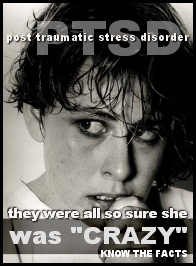
POST-TRAUMATIC STRESS DISORDER
What Is It?
Post Traumatic Stress Disorder (PTSD) is classified as a type of anxiety disorder, but is actually much more than that. It is a debilitating disorder that often develops after highly traumatizing events, such as natural disasters, personal assaults and combat. In fact, PTSD was first called "shell shock" or "battle fatigue" because it was noticed primarily in combat veterans. Over the years, however, professionals have recognized that PTSD often develops in people who experience a wide variety of traumatizing events. These include car and plane wrecks, earthquakes and floods, rape and other assaults, abuse or being held captive. The person experiencing PTSD may have felt personally threatened or may have felt that the life of someone close to him or her was threatened. It even occurs among professionals such as paramedics and firefighters who respond to plane crashes and natural disasters.
Typically, people experiencing PTSD report persistent and frightening memories of the event and feel emotionally numb and unresponsive. There is a mixture of anxiety related symptoms as well as depression and emotional numbing. Intrusive thoughts and memories of the event are hallmarks of this disorder. This combination of reactions is the key to PTSD.
The traumatic event is relived again and again. Nightmares are common. In some cases, the person suffering from PTSD will feel like he or she is reliving the event. This can include such extremes as illusions, hallucinations and dissociative flashbacks. One Vietnam veteran came to the emergency room of the base hospital, wearing jungle combat fatigues and carrying a rifle. He believed he was in Vietnam and that the year was 1968. In reality, it was Las Vegas in 1985. (No one was hurt in that incident and the veteran was sent for treatment of PTSD.) When the sufferer is exposed to things that remind them of the trauma, there is much distress and this may trigger the "flashback." The sound of helicopters often triggers reactions in Vietnam veterans.
The emotional numbing includes efforts to avoid thoughts, feelings and conversations related to the event. "I just don't want to think about it," is a common reaction and often extends to the avoidance of activities, places and people that might remind the sufferer of the trauma. This avoidance of the trauma may include actual "forgetting" of important aspects of the trauma. People with PTSD find it difficult to enjoy the things they used to find pleasurable. They feel detached from others ("No one can understand"). They find it difficult to experience positive feelings and often believe that their futures are limited.
The anxiety reactions include difficulty falling or staying asleep, irritability and outbursts of anger, difficulty concentrating, startle responses and being constantly on the look out for threats. Some people, including professionals, may interpret these behaviors as "paranoid," when in fact, they are symptoms of PTSD.
Who Experiences PTSD?
PTSD can strike anyone. Children also experience PTSD.3 People who experience PTSD do not have a history of emotional problems, nor are they from particularly "dysfunctional" families. It can happen to anyone, including professionals. The key is the experience of a traumatizing event, not some "predisposing" factor in the person. On the other hand, different people have differing abilities to cope with catastrophic events. Some people exposed to traumatic events do not develop PTSD.
PTSD typically develops shortly after the traumatizing event usually within three months, but it may be delayed for months or years. When it is delayed, there is often a triggering event that recalls the threat from long ago.
According to the National Institute of Mental Health approximately 3.6 percent of U.S. adults between the ages of 18 and 54 (5.2 million people) have PTSD during the course of a given year. About 30 percent of the men and women who have spent time in war zones experience PTSD. It is estimated that one million veterans of the Vietnam War developed PTSD. PTSD has also been detected among veterans of the Persian Gulf War, with some estimates running as high as 8 percent. 4
What is the Course of the Illness?
PTSD can become chronic, lasting for years or even decades. Sometimes it lasts a lifetime. In patients with chronic PTSD, there is often a waxing and waning of symptoms over the course of time. Even in cases where the PTSD seems to be resolved and no longer a problem, certain behaviors and reactions can persist. For example, a woman who was awoken with an intruder in her home in the middle of the night, even after nearly 20 years, can no longer sleep in a totally darkened room. This difficulty rarely causes problems in her daily life and is something she now accepts.
Other forms of mental illness often go along with PTSD. Substance abuse is common. It is possible that the substance abuse develops in an attempt to "self-medicate" for the distressing symptoms of PTSD. Major depression and various other anxiety disorders are often seen. The overlapping diagnostic criteria of the Diagnostic and Statistical Manual 4th edition (DSM-IV)1 may contribute to the multiple diagnoses of sufferers of PTSD.2 Misdiagnosis is also possible if the traumatized person fails to reveal the history of the traumatizing event.
Treatment
The most successful interventions have been Cognitive/Behavioral therapy (CBT) and medications. "Exposure" through detailed recall of the traumatizing event and cognitive restructuring have been particularly helpful. This may be highly distressing to the patient, but in the long run, it is quite helpful in helping to diffuse the trauma of the event.
Various medications are often prescribed. Sertraline (Zoloft) is a selective serotonin reuptake inhibitor (SSRI) that has been approved by the FDA as an indicated treatment for PTSD.2 Psychiatrists often also prescribe a variety of tranquilizers as well as (in some cases) antipsychotic medications. The effectiveness of these medications is less clear.
Another form of treatment that has had some success is Eye Movement Desensitization and Reprocessing (EMDR), but it is not clear if this treatment is as effective as CBT.
Group therapy is probably the best approach for mild to moderate PTSD. This has been shown in studies of combat veterans as well as survivors of natural disasters. In these settings, the sufferers can share their memories and difficulties with others who have gone through the same thing. This helps break down the isolation experienced by many people with PTSD.
References:
1. Diagnostic and Statistical Manual-IV, American Psychiatric Association, 1994.
2. National Center for PTSD..
3.National Institute of Mental Health, PTSD Info.
4. National Institute of Mental Health: Facts about PTSD.
Cathy A. Chance, Ph.D.
Labels: abuse, emotional, manipulation, memories, psychological, ptsd, trauma, verbal abuse


Wednesday, January 17, 2018
Attachment to the Perpetrator

Colin A. Ross, M.D.
Over the last few years I have come to believe that a core problem in the psychotherapy of dissociative identity disorder is the problem of attachment to the perpetrator. This is also true for survivors of severe chronic childhood trauma who do not have D.I.D. The treatment that follows from this new model is different from the treatment of the ‘90s which focused more on memory recovery and abreaction. My sense of things is that the dissociative disorders field as a whole is shifting in this direction, away from “memory work” as such.
Memories are still a major element of therapy, and the trauma of the past is still talked about a lot. It’s a matter of a shift in emphasis rather than a change to a whole new way of providing therapy.
In the old model, which goes back to Pierre Janet in the nineteenth century, the idea was that the blocked memories were driving the symptoms – uncover the memory, process it and the symptoms go away. The key thing was to recover the information about what happened and all the feelings that go along with it. The old model was not wrong, it just wasn’t complete. For one thing, recovery involves learning a lot of new skills, not just abreacting trauma.
In this new model, the core problem is attachment, not dealing with memories and feelings as such. All baby birds and mammals must attach to a caregiver in order to survive. The attachment systems that control the behavior of mother and child (also father and child) are built-in genetically. The baby bird does not decide to chirp for food, and the mother bird does not decide to go out collecting food. All this just happens. The same is true for human children. A baby does not conduct rational adult analysis of human interaction patterns and then decide that crying has positive survival advantage. The baby just cries.
Similarly, the nursing mother who has a letdown reflex when her baby cries does not consciously decide to release more oxytocin from her brain in order to make her milk flow. Her body just does that for her. There are countless attachment behaviors that are built-in biologically. The parents also make conscious decisions about how to take care of the child for which they are responsible as adults. But the little child just attaches naturally in order to survive.
The basic goal is survival. Attachment serves that goal. This is true biologically, emotionally, humanly, spiritually, however one wants to look as it. To thrive and grow the child must attach to its caretakers. Separation and individuation from these caretakers is a task that is down the road developmentally, from the perspective of the newborn baby.
In a reasonable, healthy family this works out reasonably OK. The parents are imperfect and everybody has the usual neurotic conflicts about not having gotten all the love and nurturance that would have been ideal and perfect. We all have ambivalent attachment to our parents to some degree; we all are faced with the task of separation and individuation and none of us are complete successes.
In a family with active physical, sexual, or emotional abuse, however, things are different. The young child in this family – say it is a girl – must attach to her father for her survival. She cannot run away from home, get married, or go away to college because she hasn’t even gone to kindergarten yet. She depends on her parents for food, clothes, a roof, and her basic survival needs. She also needs her parents for her emotional and spiritual development. The problem is that the father she must attach to, in order to survive, is also the perpetrator who is abusing her.
Just as love, approach and attachment to parents are built-in biologically, so is the recall reflex. If you touch a hot stove by mistake, your brain pulls your hand away even before you consciously experience the pain. Your biology does this for you, without any conscious analysis or decision-making. Similarly, your body goes into recoil mode from child abuse automatically. You just automatically withdraw, pull back, and shut down.
One way to cope with the abuse would be to go catatonic. This would be developmental suicide. Except possibly in rare cases (which therapists never see in their offices) the body will not allow permanent catatonia – the attachment systems must be kept up and running for the organism to survive whether it is a child, a kitten, a bird, or a rabbit. There must be an override of the withdrawal reflex.
How can this be accomplished? By dissociation. The fundamental driver of the dissociation, in this way of looking at things, is the problem of attachment to the perpetrator. In order to survive, the child must attach to the person who is hurting her. There is no escape and no other option. In order to maintain the attachment systems up and running, they cannot be contaminated by the traumatic information coming in through the sense; that reality must be dissociated.
What difference does this model make in therapy? First, the focus of therapy is not on the content of the memories – the target is the ambivalent attachment. This ambivalent attachment is visible in current relationships and in the structure of the internal world.
This is true whether the diagnosis is DID, PTSD, DDNOS or borderline personality disorder. Borderline personality is an inevitable consequence of the problem of attachment to the perpetrator and is a biologically normal human response to severe chronic childhood trauma.
A focus on the problem of attachment to the perpetrator sidesteps most of the controversy about false memories since the content of the memories is not the main concern. If the memories are accurate, they explain how the problem of attachment to the perpetrator arose; if they are inaccurate, they symbolize that problem. Either way, the ambivalent attachment is the focus, not the content of the memories.
In the new model, there is much, much less abreaction in therapy, if any. By this I mean, the kind of full-tilt abreaction where the person is back in the past, reliving the trauma as if it is happening all over again. Within the new model, abreaction is unnecessary and retraumatizing. What does occur is what I call intense recollection. The description of the trauma is still intense, vivid, and difficult, but it is grounded. Even in relatively pure cognitive therapy, as I do it, there is lots of intense feeling.
The first goal of therapy is to hold both sides of the ambivalent attachment in consciousness at the same time – to feel both the love and the hate. The love is always there, somewhere. I believe it is biologically impossible to extinguish your love for your parents, no matter how abusive they were.
Therapists can make a mistake by identifying with and supporting one side of the ambivalent attachment only. A not uncommon error is to validate and identify with only the anger, and push the love, attachment and approach underground. A pseudo-resolution of ambivalent attachment can occur when there is an artificial complete separation from the parents – this can be just a cover for unresolved ambivalence.
This error by therapists is a fertile ground for false memories.
In some situations, the parents are in fact so manipulative and abusive in the present day that complete separation is the only healthy option. That’s not what I’m talking about. I am thinking of people whose parents are semi-OK in the present and who are missing out on a limited positive relationship in the present because they have shut down the positive side of their attachment.
Once both sides of the ambivalent attachment are held in conscious awareness at the same time, and processed a bit, the next step is grief work. One must mourn the loss of the parent one never had. The task is to dissolve the unrealistically all-good or all-bad parent, deal with the actual disappointment and loss, and complete the task of separation and individuation. This is a job we are all working on. Those who were not severely physically, sexually, or emotionally abused as children have a much easier time because they did not have to dissociate in an extreme way to survive extreme conditions.
One reason I like this model is because it makes the extreme nature of the trauma clear, but emphasizes the fact that the core of therapy is a common human problem.
Labels: abuser, childhood abuse, memories, reactive attachment disorder, repetition compulsion, stockholm syndrome, trauma
Sunday, December 17, 2017
Psychopathic Bullying

One of the most common misconceptions relating to the pathology is that psychopaths are deep down inside self-loathing and they project their inner hatred of themselves onto their victims. Nothing could be further from the truth. To imply this is to suggest that psychopaths are somehow self-reflective of their own pathology - as they would have to be, in order to come to this conclusion. The fact is that psychopaths adore themselves, period. What is being classified as self-loathing is in reality more akin to resentment and jealousy. They do not feel inferior to other people who enjoy the relationships, social life, careers and material goods which the psychopath covets - they just want to take these things away from the victims for the sake of it. A sick game of one-upmanship which can destroy another person’s life for a brief rush of energy in the psychopath.
This resentment is most commonly seen when psychopaths bully other adults, having first developed their craft as children. They begin to realise the value of bullying while still in school - however, they will continue to do this for the rest of their lives as bullying pays off for the psychopath on many levels towards their relationship, social and employment ambitions. Although a psychopath will implement a smear campaign or bullying campaign against another person at work or in an organisation in order to take over that person’s position - the underlying thrust is that the position the victim holds is what the psychopath desires for themselves. It’s nothing really personal against the victims as such - they just have to give up to the psychopath what they have. If this leads to the bullied victim resigning, transferring to another department or even killing themselves (murder-by-suicide) then so be it. Once they give up what the psychopath wants from them, they do not care one iota how the victim chooses to undertake this.
In his paper, Intelligence as a Person-Situation Interaction, Dr. Robert Sternberg lists five fallacies of thinking. He states, "There is another dimension to person-situation interaction: the extent to which particular situations elicit ’stupid’ thinking in intelligent people." All of his five fallacies which range from a sense of godlike indestructibility to extreme hubris occur mainly in the context of perceived power or dominance over others. Dr. Sternberg is one of many scientists who have discovered that the enjoyment of power and control over other people changes brain chemistry and behaviour. Some people are more prone than others to these effects of power and positions of influence - depending on personality type along with social and environmental factors. Psychopaths know no other way to live other than to gain and hold power over others constantly - similar to an addict seeking a drug fix - they are likewise subject to the above fallacies all the time and for all of their lives.
Neuroscientists have established that the human brain continues to grow and change long after the rapid developmental stage of early childhood. It is now well established that people who have been bullied as children by a psychopathic parent or another student at school, or as an adult at work - are much more likely to be depressed, anxious, and suicidal. The psychological torment that bullying victims experience is emotionally ravaging and visceral. Contemporary research into the psychological effects of bullying is now underpinning its emotional and psychological scarring as something with very real negative consequences for the victims. Bullying has now been shown to leave a lasting effect on a young person at a time when their brain is still developing - actually leading to reduced electrical connectivity within the brain, along with destroying the growth of new neurons. This very real neurological damage is identical to what is also seen in those who have been physically and sexually abused in childhood.
In the July 2010 edition of the American Journal of Psychiatry, in a paper by Martin Teicher, a neuroscientist studying the effects of children being verbally abused by adults and their peers presented some unsurprising data, which finally gave scientific legitimacy to what victims of psychopathic bullies have long known. In his study of more than 1,000 young people, he discovered that words were indeed as hurtful as "sticks and stones". Teicher’s participants varied in how much taunting, ridicule, criticism, shouting, and bad language they had been subject to in the past. What was uncovered found that victims of bullying had higher incidences of depression, anxiety, and other psychiatric disorders than the subjects who had not experienced bullying.
Those subjects who reported having been bullied by their peers had observable abnormalities in a part of the brain known as the corpus callosum which connects the right and left hemispheres of the brain, vital for visual processing, and very significantly from a psychopathic standpoint, clarity of memory. Victims of psychopathic relationships always have trouble recalling memories from the time their relationship with the psychopath commenced. Psychopaths will often say to their victims. "Do you recall when you said this…?" and so forth and the victim will often reply that they have no memory of doing and saying certain things which the psychopath claimed they said and did. Victims memories are impaired and this allows the psychopath to invent a fake past event(s) which the victim cannot readily dispute. This is why it is very common for psychopaths to target people who were victims of childhood abuse and bullying.
In another study Tracy Vaillancourt, a psychologist at the University of Ottawa, discovered that being bullied as a child can alter levels of cortical in victims - a hormone produced during times of stress. Vaillancourt’s findings showed that boys who have been bullied have higher levels of cortisol than normal - while bullied girls have abnormally low levels of cortisol. Weakening the victim’s immune system, sometimes destroying neurons leading to memory problems.
With verbal bullying, more and more studies are finding it is more akin to physical and sexual abuse than had been previously assumed. As psychopaths perform all three on their victims it becomes very apparent how a skilled psychopath can break down and psychologically destroy even the most rational and emotionally balanced person. If the target has been bullied as a child this creates a perfect opportunity for the psychopath to implement techniques such Gaslighting more effectively and much sooner into the relationship. The psychopathic child who is bullying other children at school, or the psychopathic parent bullying his/her own children can be viewed in the same context as a farmer planting an apple orchard to be harvested later on in life.
Labels: autoimmune, brain development, bullies, bullying, gaslighting, harassment, jealousy, memories, polite. psychopaths, projection, smear campaign