Sanctuary for the Abused
Wednesday, March 14, 2018
Law Enforcement & the Abuser
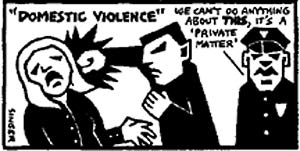
HOW ABUSERS INTERACT WITH LAW ENFORCEMENT
WHEN THE POLICE COME, THEY MAY DO THE FOLLOWING:
*Denial and Minimization
* Refusing to admit their violent behavior. Makes statements such as:
o "I didn't do anything."
o "She just bruises easily."
o I had my fist out and she ran into it."
* Admitting less than actually happened in the incident or making the assault sound trivial.
o "It was only a love tap."
o "I just gave her a little push."
o "Her ribs are just a little bruised (not broken)."
* Effective Police Response: Inform the offender that he has already broken the law and explain how his/her behaviors met that criteria. Get a detailed account of the scope of the violence by conducting a partner contact interview and by using police reports and hospital records.
~~~
*Focusing on Intentions
* Defending one's behavior by pointing to good goals.
o "I was trying to keep her from hurting herself."
o "She was hysterical and yelling nonstop so I slapped her to calm her down."
* Effective Response: Point out the effects of violence: terror, fear, distrust, pain, injury, destruction, etc. Even if his intentions are good, violence not justified and it is illegal.
~~~~
*Victim Blaming
* Most popular of the excuses, the offender will make the case that the victim is a bad person and the abuse is deserved. The offender hopes you will focus on the victim's behavior rather than abuser misconduct. If you begin to criticize the victim, you become allied with the batterer.
o "I found her with another man."
o "She is a drunk (alcoholic, drug addict, bad mother, thief etc.)."
o "She assaulted me."
* Effective Response: A woman doesn't have to be Betty Crocker (a perfect mother or housewife) in order to deserve not to be beaten. People do not have to earn the right to be free from violence and fear. The act of battering is illegal, just like bank robbery is illegal even if you are very poor.
~~~~
*Loss of Control
* Batterer doesn't take responsibility for what happened.
o "I exploded but it wasn't really me."
o "I lost it and the next thing I knew, she was down on the floor bleeding and screaming."
o "I saw a white (blue, red, yellow etc.) light and I just blacked out. When I came to she was lying on the ground."
* Effective Response: If you're convinced you have no control, then we should surrender you now since treatment will be totally useless. Do you get violent the same way whenever someone gets you really upset? With your boss? Getting violent with someone is not an automatic response once you get upset with another person.
~~~~~
*Provocation
* The offender claims the other person drove him/her over the edge so they don't take responsibility for what occurred.
o "She made me do it."
o "She knew it was coming and she pushed me into it."
* Effective Response: No one can make you violent. People may hurt, frustrate or anger you but there are many alternative ways to respond that don't involve violence.
~~~~
*Lack of Time and Money
* Offender cannot attend treatment because of work and cannot afford it.
* States that they have changed, victim no longer feels threatened by them or that the counselor's no longer feel treatment is necessary.
* Effective Response: Most batterer programs have a sliding scale fee system. Reinforce that the abuser must make time for treatment. If you are a probation officer, it is important to communicate frequently with the treatment program and the victim to avoid confusion and manipulation.
~~~~
OTHER MANIPULATIONS ABUSERS USE
* Pretend they are sleeping when the officers arrive.
* Will be apologetic, friendly, polite and very courteous to the officers.
* Will express frustration/sadness over their inability to get the "alcoholic" and/or "drug addicted" victim help for their problem.
* Will attempt to get sympathy by presenting themselves as a "victim" to their partner's nagging and/or verbal abuse.
* Will attempt to get the officers to relate to their situation. For example, "You know how those women are."
Labels: abusers, charming, inadequate police response, lie, manipulate, narcissists, police, polite. psychopaths


Sunday, December 17, 2017
Psychopathic Bullying

One of the most common misconceptions relating to the pathology is that psychopaths are deep down inside self-loathing and they project their inner hatred of themselves onto their victims. Nothing could be further from the truth. To imply this is to suggest that psychopaths are somehow self-reflective of their own pathology - as they would have to be, in order to come to this conclusion. The fact is that psychopaths adore themselves, period. What is being classified as self-loathing is in reality more akin to resentment and jealousy. They do not feel inferior to other people who enjoy the relationships, social life, careers and material goods which the psychopath covets - they just want to take these things away from the victims for the sake of it. A sick game of one-upmanship which can destroy another person’s life for a brief rush of energy in the psychopath.
This resentment is most commonly seen when psychopaths bully other adults, having first developed their craft as children. They begin to realise the value of bullying while still in school - however, they will continue to do this for the rest of their lives as bullying pays off for the psychopath on many levels towards their relationship, social and employment ambitions. Although a psychopath will implement a smear campaign or bullying campaign against another person at work or in an organisation in order to take over that person’s position - the underlying thrust is that the position the victim holds is what the psychopath desires for themselves. It’s nothing really personal against the victims as such - they just have to give up to the psychopath what they have. If this leads to the bullied victim resigning, transferring to another department or even killing themselves (murder-by-suicide) then so be it. Once they give up what the psychopath wants from them, they do not care one iota how the victim chooses to undertake this.
In his paper, Intelligence as a Person-Situation Interaction, Dr. Robert Sternberg lists five fallacies of thinking. He states, "There is another dimension to person-situation interaction: the extent to which particular situations elicit ’stupid’ thinking in intelligent people." All of his five fallacies which range from a sense of godlike indestructibility to extreme hubris occur mainly in the context of perceived power or dominance over others. Dr. Sternberg is one of many scientists who have discovered that the enjoyment of power and control over other people changes brain chemistry and behaviour. Some people are more prone than others to these effects of power and positions of influence - depending on personality type along with social and environmental factors. Psychopaths know no other way to live other than to gain and hold power over others constantly - similar to an addict seeking a drug fix - they are likewise subject to the above fallacies all the time and for all of their lives.
Neuroscientists have established that the human brain continues to grow and change long after the rapid developmental stage of early childhood. It is now well established that people who have been bullied as children by a psychopathic parent or another student at school, or as an adult at work - are much more likely to be depressed, anxious, and suicidal. The psychological torment that bullying victims experience is emotionally ravaging and visceral. Contemporary research into the psychological effects of bullying is now underpinning its emotional and psychological scarring as something with very real negative consequences for the victims. Bullying has now been shown to leave a lasting effect on a young person at a time when their brain is still developing - actually leading to reduced electrical connectivity within the brain, along with destroying the growth of new neurons. This very real neurological damage is identical to what is also seen in those who have been physically and sexually abused in childhood.
In the July 2010 edition of the American Journal of Psychiatry, in a paper by Martin Teicher, a neuroscientist studying the effects of children being verbally abused by adults and their peers presented some unsurprising data, which finally gave scientific legitimacy to what victims of psychopathic bullies have long known. In his study of more than 1,000 young people, he discovered that words were indeed as hurtful as "sticks and stones". Teicher’s participants varied in how much taunting, ridicule, criticism, shouting, and bad language they had been subject to in the past. What was uncovered found that victims of bullying had higher incidences of depression, anxiety, and other psychiatric disorders than the subjects who had not experienced bullying.
Those subjects who reported having been bullied by their peers had observable abnormalities in a part of the brain known as the corpus callosum which connects the right and left hemispheres of the brain, vital for visual processing, and very significantly from a psychopathic standpoint, clarity of memory. Victims of psychopathic relationships always have trouble recalling memories from the time their relationship with the psychopath commenced. Psychopaths will often say to their victims. "Do you recall when you said this…?" and so forth and the victim will often reply that they have no memory of doing and saying certain things which the psychopath claimed they said and did. Victims memories are impaired and this allows the psychopath to invent a fake past event(s) which the victim cannot readily dispute. This is why it is very common for psychopaths to target people who were victims of childhood abuse and bullying.
In another study Tracy Vaillancourt, a psychologist at the University of Ottawa, discovered that being bullied as a child can alter levels of cortical in victims - a hormone produced during times of stress. Vaillancourt’s findings showed that boys who have been bullied have higher levels of cortisol than normal - while bullied girls have abnormally low levels of cortisol. Weakening the victim’s immune system, sometimes destroying neurons leading to memory problems.
With verbal bullying, more and more studies are finding it is more akin to physical and sexual abuse than had been previously assumed. As psychopaths perform all three on their victims it becomes very apparent how a skilled psychopath can break down and psychologically destroy even the most rational and emotionally balanced person. If the target has been bullied as a child this creates a perfect opportunity for the psychopath to implement techniques such Gaslighting more effectively and much sooner into the relationship. The psychopathic child who is bullying other children at school, or the psychopathic parent bullying his/her own children can be viewed in the same context as a farmer planting an apple orchard to be harvested later on in life.
Labels: autoimmune, brain development, bullies, bullying, gaslighting, harassment, jealousy, memories, polite. psychopaths, projection, smear campaign