Sanctuary for the Abused
Thursday, January 19, 2023
Bill of Rights for Domestic Violence Victims

Domestic Violence Victim Bill of Rights
* You have the right NOT to be abused.
* You have the right to anger over past abuse.
* You have a right to choose to change the situation.
* You have a right to freedom from fear of abuse.
* You have a right to request and expect assistance from police or social agencies.
* You have a right to share your feelings and not be isolated from others.
* You have a right to want a better role model of communication for yourself and your children.
* You have a right to be treated like an adult.
* You have a right to leave the abusive environment.
* You have a right to privacy.
* You have a right to express your own thoughts and feelings.
* You have a right to develop your individual talents and abilities without harrasssment.
* You have a right to legally prosecute the abusing spouse.
* You have a right not to be perfect.
(Adapted from; Victimology: An International Journal., Vol. 2 1977-78, No. 3-4, p.550)
Labels: abuse, anger, bill of rights, domestic violence, fear, support


Sunday, April 08, 2018
Men As Victims of Domestic Violence

Men are victims of domestic violence at the hands of both female and male partners.
I feel like the only one
You may feel as if you're the only man who has ever experienced domestic violence but you're not alone. Although research shows that it is mainly women, this doesn't mean that men don't suffer too.
Figures on the extent of male victims vary considerably so it's difficult to state with any accuracy the true extent. However, the 2001/02 British Crime Survey (BCS) found 19% of domestic violence incidents were reported to be male victims with just under half of these being committed by a female abuser.
It may be hard to admit to yourself and to others that this is happening to you but it's not your fault and you can get help.
Are there differences in how men and women experience domestic violence?
There are both similarities and differences. Some of the responses to violence from a partner are the same. Whoever you are, being hurt by someone you love and trust can be devastating. You may feel bewildered and confused. You may wonder if it's your fault. You may feel too ashamed or embarrassed to tell anyone. If you do tell, you may find that you are not believed or that your abuse is trivialised. For all victims of abuse, the message is the same...
You are not alone.
It is not your fault.
Help is available.
It is not your fault.
Help is available.
If you don't find the right help immediately, it's important that you keep looking until you find someone who can support you at this difficult time. It doesn't make you weak to ask for help.
There are also important differences that can often be lost when we assume that what we know about women experiencing domestic violence automatically applies to male victims too. For example, many abused men may feel that they aren't 'real men' if they admit to having experienced abuse.
What help is available?
Men have exactly the same rights as women to be safe in their own homes. All statutory services (such as the Police, Crown Prosecution Service, Housing Department and Social Services) have a duty to provide services to all - male or female.
Men are protected by exactly the same laws as women - anyone who has assaulted another person, regardless of the gender of either, can be prosecuted. If you are a man experiencing domestic violence and you need emergency help you can call the Police.
Seek legal advice to clarify your position.
What about my children?
The family courts deal with all child contact disputes on a case by case basis. Evidence of domestic violence will be taken into account and decisions about residence and contact made accordingly.
SOURCE
Labels: abuse, bill of rights, child support, domestic violence, female abuser, men, shame, victims
Thursday, December 07, 2017
CRAZY MAKING
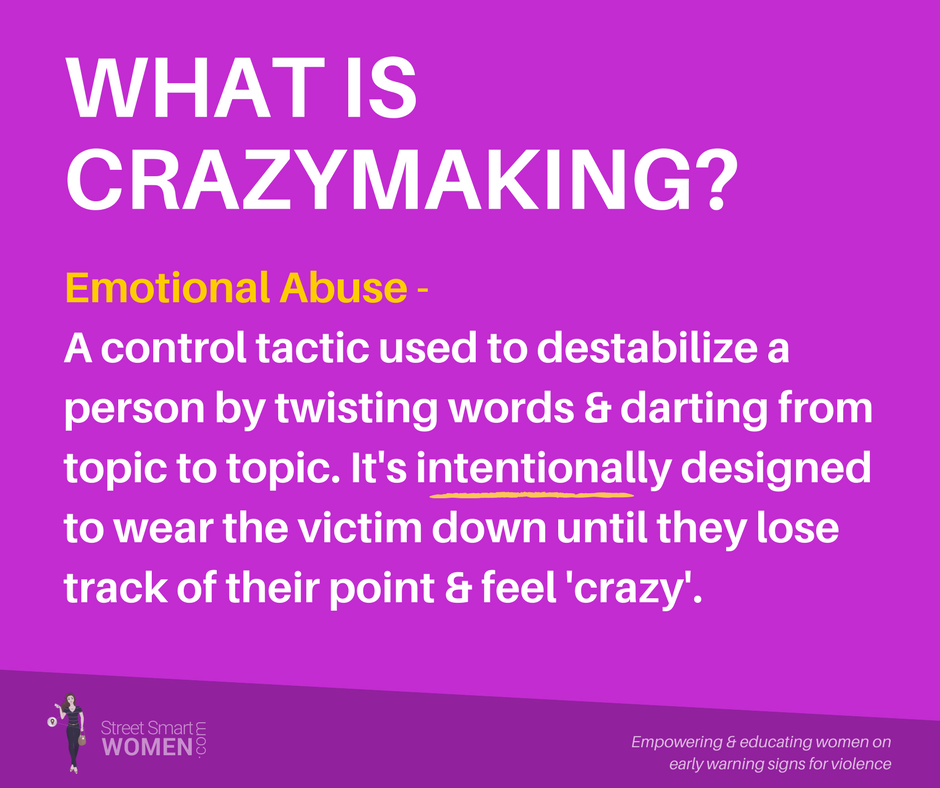
This information about crazy making is from the out of print book Stop! You're Driving Me Crazy! by Dr. George R. Bach. It fortunately has surfaced again and can be purchased as a used book for a small price at Amazon.com.
This is a coping method people use when they are afraid of rejection or confrontation. This results when our rights are not respected or honored. It is based on four basic rights: THE RIGHT TO KNOW, THE RIGHT TO FEEL, THE RIGHT TO HAVE IMPACT and THE RIGHT TO SPACE.
The ways that RIGHT TO KNOW are violated are when we are not given clear information as in underloading, overloading and fogging. In underloading they give us too little information so we are off balance and have shaky confidence about what we are learning to do or the person has left and it is only after they're gone that we realize we don't know anymore than before we asked them the question. At these times it requires the receiver of the information to assume or draw conclusions about the meaning of the incomplete information. This is also a time when mindreading comes into play. In order to survive this walking on eggshells the receiver of the message or silent treatment must use past references to know what the sender of the message might intend. In overloading it is just the opposite problem. The sender gives us too much information and we are in a confused state and a put off balance. We feel so defeated that we do not have the courage to set any boundaries or express any needs for clearer information.
THE RIGHT TO FEEL is violated when we are told how we are feeling i.e. "You're angry aren't you." or how we are going to feel or react i.e. "You're not going to like what I have to say." Or if we are given the message not to feel i.e. "Don't be angry" or "Don't cry". Or we are told what we should or shouldn't be feeling. i.e. "You don't really hate him or her, you just think you do" or You shouldn't feel that way about them.'
THE RIGHT TO IMPACT is where our insanity really shows up. It triggers so many old messages i.e. "You're not important, you're needs are important." And if we played the role of the LOST CHILD it just reinforces our sense of powerlessness and invisibility. We need to have assurance that we exist, that our existence makes a difference to people and situations. We know of our existence when we have IMPACT on others. One thing that really gets to us is when others claim to misinterpret or pick apart what we said in order not to have to comply with our request.
Thinging or objectifying is another way that they treat us as an objects as if we are only a piece of furniture in the room. They can be pictured putting their hand up to their ear and saying "Did I hear someone talking, is there someone else in the room?" COVERTLY HOSTILE or what ? Context-switching and derailing are great avoidance tactics. When you are confronting them on something they did or attempting to set boundaries, they switch the whole focus back to you, and thus put you on the defensive. Now the focus is on you and they slither away. This gets you way off derail track and off balance right where they want you--derailed. Clever huh, unless you are on the receiving end of this CRAZY MAKING. Role-playing is another very common way in which one or both parties avoids asserting themselves. This way the person can hide behind the role they see as the most comfortable, safe and powerful. i.e. referring to yourself as "Mommy" or "Daddy" "Mommy wants you to go to bed" Daddy wants you to come to the table." Or I'm the "boss" I'm the cook--he wife--the husband etc.etc. In this way the other person is put in a position where they almost need to respond in the "subservient" or weak or less powerful position or role i.e. the child, the worker, employer, the hungry one etc.etc.
The final CRAZY MAKING technique is to violate the RIGHT TO SPACE. This right can be violated in so many ways i.e. emotional, time, mental, physical. Without this right being respected we can lose perspective very rapidly and literally feel like we are going crazy. In setting boundaries we set ourselves against the others. It seems that when I am setting boundaries for myself I am violating another's perceived rights i.e. My right to have the radio volume up is a violation to right to have the volume down. My right to deny your request interrupts your right to make a request. It is almost always very MESSY. But our surrender of SPACE is a surrender of our SANITY.
SOURCE
Labels: bill of rights, crazy-making, feelings, impact, need to know, pity party, space
Tuesday, October 24, 2017
The Victim's Bill of Rights

YOUR BILL OF RIGHTS
You have the right to be you
You have the right to put yourself first
You have the right to be safe
You have the right to love and be loved
You have the right to be treated with respect
You have the right to be human - not perfect
You have the right to be angry and protest if you are treated unfairly and abusively by anyone
You have the right to your own privacy
You have the right to your own opinions, to express them, and be taken seriously
You have the right to earn and control your own money
You have the right to ask questions about anything that affects your life
You have the right to make decisions that affect you
You have the right to grow and change, this includes changing your mind
You have the right to say no
You have the right to make mistakes
You have the right to not be responsible for other adult's problems
You have the right to not be liked by everyone
SOURCE
Labels: anger, bill of rights, opinion, privacy, treatment, victims