Sanctuary for the Abused
Friday, August 30, 2019
Inside the Mind of an Abuser

What you Need to Know
by Mary M. Alward
Abusers use warped logic to brainwash their victims. They use methods very similar to those of prison guards, who know that to control prisoners they have to have full co-operation. Subversive manipulation of the mind and destruction of the victim are perfect tools to enable abusers to succeed.
The Logic of Brainwashing
Abusers use warped logic to brainwash their victims. Subversive manipulation of the mind and destruction of the victim are the perfect tools to enable abusers to succeed.
The Process of Brainwashing
The abuser uses several methods of coercion to brainwash his victim. They are as follows:
Isolation
Abusers deprive their victims of social interaction with family members and friends. This is necessary to gain control over the victim.
Resistance
The abuser manipulates his victim to become mentally and physically dependent upon him, which reduces the ability of the victim to resist his abuse.
Threats
Abusers use threats to cultivate anxiety, despair and the ability to resist. Most often they threaten children, family members or friends with harm if the victim doesn’t comply with his demands.
Indulgences
Occasionally the abuser will comply with the wishes of the victim in order to provide motivation to comply with his every demand.
Omnipotence
The abuser suggests to the victim that it is futile to resist his demands.
Trivial Demands
Abusers strictly enforce trivial demands in order to create a habit of compliance in his victim.
Degradation
Abusers degrade their victims in order to damage their self esteem and make them think they are unable to face life on their own. Self esteem can be damaged beyond repair and the victim is often reduced to animal level concerns.
About the Abuser
The methods that abusers, both male and female, use to manipulate their victims are a natural part of their personalities. Abusers all share behaviors and thinking patterns. This labels them as dysfunctional, insecure and unable to have a relationship unless they are in complete control.Abuser’s Tactics
Abusers keep their victims in the dark about events that are taking place. They are most always in control of the finances, talk about the victim behind their back in order to cause them to become isolated and make plans that include the victim without consulting them. The abuser’s goal is to monopolize the victim’s time and physical environment and suppress their behavior. An abusive partner tells you what social events you can attend and who you can go with. He may insist you quit work and remain at home where he can keep an eye on you, or he may tell you that you can no longer participate in hobbies. Abusers often insist you move to a location away from family members, friends and other contacts that will give you support.
Abusers do their best to instill feelings of fear, powerlessness and dependency in their victim. Both verbal and emotional abuse heightens these feelings and they grow more pronounced as time passes.
The abuser’s system of logic is closed. She doesn’t allow her partner to voice opinions or criticize her in any way. She lets you know, without a doubt, that her word is law
There’s a wide range of tactics that the abuser uses to debilitate the victim. If you recognize any of these tactics, a red flag has been raised.
DominationLiving with a person who has unpredictable response is difficult, stressful, nerve wracking and it causes a great deal of anxiety that can lead to health problems. The victim lives with fear and security and has no sense of balance in their life. Abusers who drink excessively are alcoholics or drug abusers often have unpredictable responses to trivial events.
Abusers are extremely dominating to the point that they want to control everything that the victim does. If they don’t get their way, they act like spoiled children. On top of that, they use threats to get what they want. If you allow your abuser to dominate you, you will lose your self respect.
Verbal Assault
The abuser tends to verbally assault their victim by calling names, degrading, screaming, threatening, criticizing, berating and humiliating. They will center their victim out in front of family and friends by taking small personality flaws and embellishing them to the extreme. They make snide remarks and use sarcasm to erode the victim’s sense of self-worth and self confidence. Making the victim look bad in front of others is an attempt to isolate the victim and keep them at their mercy. Then, the abuse worsens.
Gaslighting
Gaslighting is a slang term from the 1950’s but is the perfect word to describe one tactic of the abuser. The dictionary definition of gaslighting is to drive someone crazy. This is used to keep the abuser’s victim under control. The abuser will swear that events never occurred and that certain things were never said. The victim knows better, but over time will begin to question their sanity. Be alert to gaslighting tactics that can beat you down and make you think you are going insane.
Blackmail
The abuser uses emotional blackmail to get what they want by pushing your buttons. He plays on his victim’s sense of compassion, fears, sense of guilt and values in order to get his own way. He may refuse to talk to his victim or threaten to end the relationship or withdraw financial support if the victim is dependent on him for basic living necessities. Emotional blackmail is the act of working on the victim’s emotions so the abuser can get what he wants.
Constant Chaos
An abuser will keep the household and his victim’s emotions in total chaos by starting arguments and constantly being in conflict with other family members.
Abusive Expectations
This happens when the abuser makes unreasonable demands on their victim. They may expect their partner to reject everything in their life to tend to the abuser’s needs. Included can be frequent sex, forcing the victim to perform sexual acts that are against their will, demanding all of the victim’s attention or demanding that the victim spend all free time with the abuser. No matter how hard the victim tries to please the abuser, she will always demand more. The victim, whether male or female, will be constantly criticized and berated because they are unable to fulfill the abuser’s demands.
Unpredictable Responses
This includes emotional outbursts and extreme mood swings on the part of the abuser. If you partner likes something you do today and hates it tomorrow, or reacts to the extreme at an identical behavior by the victim, this is an unpredictable response. This behavior damages the victim’s self esteem, self confidence and mental well-being because they are constantly on edge, wondering how their partner is going to respond to their every move.
Inside the Abuser’s Mind
Abusers have a tendency to feel they are unique individuals (narcissistic) and shouldn’t have to live under the same rules as everyone else. However, the opposite is true. Abusers share many of the same thinking patterns and behaviors and use the same tactics to keep their victims under their control.
Blaming
Abusers tend to shift responsibility for their actions to their victims and become angry because the person caused them to behave inappropriately. The abuser might say, “If you hadn’t talked back to me, I wouldn't have had to hit you.” Don’t fall for it. The abuser did the hitting and no matter what you did, you are not to blame. He is blaming you for his shortcomings and do not believe that you are the one to blame for even one second.
Making Excuses
Abusers seldom take responsibility for their actions, but try to justify their behavior by making excuses. They may blame the abuse on a difficult childhood or a hard day at the office. Their mind-set tells them that they are never to blame for any negative behavior.
Fantasies of Success
Abusers believe that they would be famous and rich if the victim and other people weren’t holding them back. Because he believes his failure in life is due to others, he feels he is justified in retaliating in any way he can, including physical and emotional abuse. He belittles, berates and puts others down, including the victim, to make himself feel more powerful.
Manipulation
Abusers combine manipulative tactics, such as upsetting people to watch their reaction, lying and provoking arguments and fights among family members and his peers. He charms his victims and other people who he wishes to manipulate by professing that he cares and is interested in their well-being, when all he is doing is opening the door for a deeper level of abuse.
Redefining
The abuser will often redefine situations to blame others for his troubles. Abusers will seldom admit that they are wrong, or for that matter, less than perfect. It’s always someone else’s fault when they act inappropriately.
Assuming
An abuser’s thought patterns lead them to believe that they know what others, including their victim, is feeling and thinking. They use this warped logic to blame these people for their behavior. For instance, an abuser might say, “I knew you’d be angry about that, so I went for a few drinks after work to enjoy myself. Why should I come home to listen to you nag?”
Dependence
Believe it or not, abusers are emotionally dependent on their victim. This causes an inner rage that encourages the abuser to lash out. Because he is so dependent, he takes control of his victim’s life. This is the way they deny their weaknesses and make themselves feel powerful.
Symptoms of Emotional Dependency
Symptoms of emotional dependency include, but are not limited to, excessive jealousy, jealous rages and possessive actions that are usually sexual in nature. Abusers spend an excessive amount of time monitoring the action and movements of their victims. Often, abusers have no support network and lack those supportive roles that others depend upon. Another sign of emotional dependency is the extreme affect the abuser suffers if his victim leaves. He will go to any lengths to get the victim to return.
Rigid Gender Attitudes
Abusers in a domestic atmosphere tend to have extremely rigid attitudes about the role that their spouse should play in a marriage or common law situation. Wives may expect their husbands to fulfill all of the family’s chores, such as repairs and hold up his role as a father. Husbands may expect their wives to hold down a full time job, keep the house spotless, the laundry caught up, meals made on time and also tend to the kids’ every need. All of these examples are things that should be shared in a normal relationship.
Lying
Most abusers are liars. They lie to manipulate their victim by controlling information. They also lie to keep their victim, and others, off balance psychologically. This enables the abuser to gain control of every situation.
Withdrawal
Abusers have a tendency to put up emotional walls and never give out personal information freely. He keeps his real feelings to himself and is not interested in what others think of him. Abusers like secrets and are righteous and close-minded. An abuser always feels she is right in every situation.
Drama
Abusers, either male or female, can’t seem to develop close, satisfying relationships, or even bad relationships that last. They replace closeness with drama in order to make their life more exciting. They love watching others argue and fight and often do things to keep those around them in a state of constant chaos and upheaval.
Minimizing Actions
Abusers always minimize their actions and refuse to accept their mistakes. An abuser might tell his spouse who has a black eye, “I didn’t hit you hard enough to give you a black eye.”
Ownership and Possession
Abusers are extremely possessive and believe that they should get everything they want. They also feel they can do whatever they wish with their possession and abusers see their partner or spouse as something they own. They feel they are justified in hurting their victim by taking their possessions, attacking them mentally and physically and controlling all aspects of their life.
Anger Management
Most abusers have had a violent and abusive childhood in a dysfunctional family setting. These children are very likely to grow up into spousal abusers. They are taught from the time they are babies that violence is a way to settle disputes and get their own way. It’s a way to settle differences of opinion and they see abuse as normal. As adults, they won’t be able to find alternate ways of showing or channeling their anger. People who do not have a method of outlet for anger on a daily basis allow it to build to a point where it explodes. When this happens, the people closest to them become their sounding board emotionally, mentally and physically.
Rules
Abusers feel they are superior to others and don’t have to follow the rules of society. This is also the attitude of hundreds of criminals in prisons world wide. Inmates often believe that while other inmates are guilty of their crimes that they aren’t. Abusers feel it is always their partners who need counseling and that they can take care of their life without help or support from others.
Fragmentation
The abuser, whether male or female, does their best to keep their abusive behavior separate from the rest of their life. For example: abusers will beat their spouse and kids on a regular basis, but seldom physically attack anyone outside of their home. They also separate their lives psychologically. They may attend church on Sunday morning and play the role of a loving spouse and parent and then go home and beat their spouse and kids on Sunday afternoon. Abusers see this as acceptable and normal behavior and feel it is justified. Yet if they hear a report that someone else has abused their loved ones, they are the first to condemn them.
Verbal Communication
Abusers are seldom capable of a relationship that includes real intimacy. It is believed that they feel vulnerable when they are open and truthful with others. Abusers feel that it is up to their partners to turn feelings of anger and frustration into gratification and to fulfill their every need. Partners of abusers are essentially expected to be mind readers and know in advance the needs of the abusive spouse. When this doesn’t happen, the abuser feels insecure, unloved and rejected and rejection is grounds for emotional, mental and physical abuse.
Glorification
Abusers, both men and women, think of themselves as independent, self-sufficient, superior and strong. If someone criticizes them or says something that causes them to feel insulted, the feeling will cause them to react violently toward their victim. This is the only outlet that they know to use to quell feelings of inadequacy.
Being Vague
Abusers think and speak vaguely to avoid their responsibilities. When asked why they are late or where they’ve been, answers will be vague. If their partners pursue the reason, the abuser becomes defensive and strikes out in order to remain in control of the situation.
Abusers: Things You Need to Know
- Both men and women abuse their partners, emotionally, mentally, physically and verbally.
- Female abusers tend to have a macho attitude toward womanhood. They look at female qualities as weaknesses and fear closeness and intimacy will make them vulnerable.
- A batterer’s level of hostility is extremely higher than that of non-batterers. Emotions easily turn to anger, which in turn is acted out in violent behavior. Abusers suppress anxiety, tension and stress until they eventually explode in a fit of violent behavior.
- Abusers suffer from low self esteem. They become dependent on their partners emotionally and feel threatened if they thing that they are going to be left on their own.
- Abusers often show emotions of excessive jealousy and are extremely possessive.
- Many abusers are alcoholics or use drugs frequently. If they discontinue alcohol and drug abuse, they tend to be violent through the process of withdrawal.
- Many people who are abusers have experienced or witnessed violence during their childhood. This leaves them with a feeling of worthlessness and low self esteem, which in turn traumatizes them and leaves life-long emotional scars.
Red Flag Signals
Many people of both genders interpret early warning signs of abuse as attentive, caring and romantic. Here is a list of early warning signs of future domestic abuse.
- Your partner insists you spend all of your free time with them in order to isolate you from family and friends.
- You always have to tell your partner where you are going, who you are going with, what your plans are and when you will be home.
- Your partner is extremely agitated or angry when they don’t get their own way.
- Your partner tells you what you can and can’t wear and insists on going shopping with you when you shop for clothes.
- You are accused time and time again of cheating, flirting or having an affair.
- Your partner refers to women in derogatory slang, or is secretive about previous relationships.
- The person was abused mentally, physically, emotionally or verbally as a child.
- Your partner grew up in an environment where one parent abused the other emotionally, He is a charmer or a smooth talker.
- He is abusive to his mother or sister and refers to them in derogatory slang.
- The person has expectations that are not realistic.
- The person has a tendency to be cruel to animals or pets.
- The person has hurt a child in some way. (emotional or physical)
- Your partner has abused spouses in a previous relationship. If so, it will happen to you too.
- The person displays a tendency to have extreme mood swings for little or no reason.
- Male abusers often feel women are inferior and were born to indulge their every whim.
- Female abusers feel men are inferior and expect their partner to give them their full attention at all times.
- Abusers like to intimidate and use threatening body language. They may throw things, punch walls or destroy their victim’s possessions.
- Abusers stop their victims from leaving the room during an argument or dispute.
- (THIS WAS WRITTEN IN THE MALE - YOUR ABUSER MAY WELL BE FEMALE)
Warning!
If you see any of these warning signs in your partner, be ever vigilant. For your own safety, it’s best to end the relationship immediately. It’s better to be alone than to be in a relationship where you are constantly abused in any way. Get help now!
SOURCE OF THIS VITAL INFORMATION - HERE
Labels: abuse, brainwashing, manipulation, mind control, narcissist, psychopath, red flags, sociopath, traits, verbal abuse


Friday, October 26, 2018
Verbal Manipulation

Are you looking at these words trying to figure out how to respond? If so, you just took the bait. Have a look at the words again "I'm wondering why you're reading this page." Notice anything odd?? -- It's not a question!! It's a statement!! Don't answer statements.
Here's another: Your abuser is in the kitchen and says:"I can't find the sugar." Did you jump up to get it for him? If so, then his manipulative tactic worked. He didn't even have to ask you to get it. He only had to state his dilemma. You are being conditioned to respond. He has you pegged as a 'people pleaser' the perfect target.
Abusers hate asking questions because it means they may loose control. So they use the 'disguised question'. Watch for them. They often have a "rING" to them (I'm wondering, hoping, thinking) or "Perhaps you'd ..." "I wish you'd..." "I suppose you're going to..." "I noticed there wasn't..."
Another trick is 'attributed' statements. "We were wondering" "They said..." "She said...." They "attribute their statements to somebody else or a 'group.' This tactic, of course, places blame elsewhere, and is intimidating as it appears to involve others.
Another trick is 'attributed' statements. "We were wondering" "They said..." "She said...." They "attribute their statements to somebody else or a 'group.' This tactic, of course, places blame elsewhere, and is intimidating as it appears to involve others.
Strategy #1. Answer Questions only, never answer statements -- Train your ears to recognize and distinguish which are comments and which are questions. Learn to ask Yes/No question. Repeat their last 3 or 4 words back to them, in a questioning manner. Be fully aware of any potential for violence, and if so, leave NOW!! Abusive questions like "Are you still beating your wife?" are a common insult. Watch out for these insult and accusation-disguised questions. An abuser's well-worn tactic. It's one of the oldest tricks in the book. Don't dignify it with a response.
--------------------------------------------------------------------------------
#2 "WE were hoping you'd..."
WHOA, HOLD THE PHONE .... "WE" ??? - that's the oldest trick in the book -- that ''WE' they throw out means YOU are being targeted. If all goes well, he takes the credit and, if not you'll be playing receiver in his blame game. Examples "If we could..." "We were hoping..." "We should..."
Strategy #2. Make a fast exit when you hear the 'WE' word.
--------------------------------------------------------------------------------
#3 F O G = Fear, Obligation and Guilt
Dr. Susan Forward does a fantastic job of describing FOG in her important book Emotional Blackmail. It rolls in slowly and blinds our ordinarily good judgement. Be on the watch for it!!
Examples: "Don't you care if...." "If you loved me..." "Everyone knows that..." "Every decent person..." Don't you think you (we) should..." "Why don't you..." "Wouldn't it be better if..." "Can't you take a joke?" "You could never do..." "I thought that's what you wanted" "Do we all agree..." "It's reasonable to expect..." "We've already...." "I needed to..." "You don't think I meant...do you?" "We were counting on you to..." "Aren't you going to..."
Examples: "Don't you care if...." "If you loved me..." "Everyone knows that..." "Every decent person..." Don't you think you (we) should..." "Why don't you..." "Wouldn't it be better if..." "Can't you take a joke?" "You could never do..." "I thought that's what you wanted" "Do we all agree..." "It's reasonable to expect..." "We've already...." "I needed to..." "You don't think I meant...do you?" "We were counting on you to..." "Aren't you going to..."
Strategy #3. Know your vulnerabilities to 'FOG'. Minimize your exposure to them, and say "No". Ignore their words and be aware of our susceptibility of wanting to reply to their questions/statements. Don't take their bait. Expect them to howl - let them.
-------------------------------------------------------------------------------
#4 Picking a Fight - The Confrontational Choice of Words
"Why do you always..." "Do you expect me to..." "I can't believe you would..." "I thought we were going to..." "Why should I have to..." "I've been told that..." "How could you..." "Why don't you..." "Did you hear me?" "Well, does that mean that I have to...." "I thought you..." "Don't you think you(we) should..." Are you telling me..." "I thought we agreed..." "Only an idiot would..." are examples of verbal attack moves. These are phrases used to put you on the defensive. So, like a good chess player, set up a strategic counter move. Just say "That's my decision", "I know you're unhappy, but that's the way it is" "I'll have to think about that" "You seem upset" "We don't always have to agree." "I prefer it that way" Learn the art and science of not taking the bait. Let some things slide. Don't respond to bad behaviour. It's their confrontational chip-on-the-shoulder that you're seeing now. These confrontational questions are pure bait and he's looking for a fight. Don't take the bait!!
"Why do you always..." "Do you expect me to..." "I can't believe you would..." "I thought we were going to..." "Why should I have to..." "I've been told that..." "How could you..." "Why don't you..." "Did you hear me?" "Well, does that mean that I have to...." "I thought you..." "Don't you think you(we) should..." Are you telling me..." "I thought we agreed..." "Only an idiot would..." are examples of verbal attack moves. These are phrases used to put you on the defensive. So, like a good chess player, set up a strategic counter move. Just say "That's my decision", "I know you're unhappy, but that's the way it is" "I'll have to think about that" "You seem upset" "We don't always have to agree." "I prefer it that way" Learn the art and science of not taking the bait. Let some things slide. Don't respond to bad behaviour. It's their confrontational chip-on-the-shoulder that you're seeing now. These confrontational questions are pure bait and he's looking for a fight. Don't take the bait!!
Strategy #4. Be aware of verbal tactics that make you feel you want to defend yourself. Know you do not have to defend yourself. To minimize their ability to 'bait' you it may be best to just agree and say "You're right" and drop the subject. One difficult part of this is to realize it's hard for us to not say "I'm sorry but..." Expect the inevitable hissy-fit rage when they're manipulation is ended, IGNORE THEIR WORDS, simply say something like "We'll talk later when you aren't so upset." Try to avoid saying "I'm sorry but..."
--------------------------------------------------------------------------------
#5 The 'silent treatment' is another form of abuse.
This amounts to a 'Mexican standoff' of whose going to talk first. He wants to find out how long before you'll crack and what issues you'll bring up - That's His Payoff. Simply say "Let me know when you feel like talking". Say nothing else. Act like 'no big deal' and put a smile on your face. If you react now it will become his tactic in future.
This amounts to a 'Mexican standoff' of whose going to talk first. He wants to find out how long before you'll crack and what issues you'll bring up - That's His Payoff. Simply say "Let me know when you feel like talking". Say nothing else. Act like 'no big deal' and put a smile on your face. If you react now it will become his tactic in future.
Strategy #5. Know this is a control technique. Learn what their 'payoff' is.
--------------------------------------------------------------------------------
#6 PRESUPPOSITIONS - (ASSUMED COMPLIANCE - and other tricks of the conman 'snake-oil' salesman) - "Do you want the red one or the blue one?" "Which do you think...?": (Offer a choice tactic!)
"I was sure you'd want to" "You'll be pleased that ...." "Aren't you happy that...", "What do you think...?" "I know you'll like..." "You'll want to..." "I (we) thought you wanted to..." "I thought you'd like..." "Since I'm the one..." "Perhaps you'd like to..." "You must know that...." "Many people agree that..." "I'm sure it's occurred to you..." "You and I..." "I think you know..." "I've heard that..."
Aren't you just thrilled he's including you? He's controlling you for your own happiness, right? Take a step back Buster!! I'm not falling for that old line. Be prepared with your "I'll let you know", "I'll have to think about that", "No, I don't want to" "I disagree"
"I was sure you'd want to" "You'll be pleased that ...." "Aren't you happy that...", "What do you think...?" "I know you'll like..." "You'll want to..." "I (we) thought you wanted to..." "I thought you'd like..." "Since I'm the one..." "Perhaps you'd like to..." "You must know that...." "Many people agree that..." "I'm sure it's occurred to you..." "You and I..." "I think you know..." "I've heard that..."
Aren't you just thrilled he's including you? He's controlling you for your own happiness, right? Take a step back Buster!! I'm not falling for that old line. Be prepared with your "I'll let you know", "I'll have to think about that", "No, I don't want to" "I disagree"
Strategy ##6. Watch out for people who make plans for you. It usually benefits them. By appearing to be only a confirmation this amounts to "nothing succeeds like success tactic" and we're expected to be happy to be included!! A common trick of the sleazy salesman.
Pregnant Pause. Abusers are most effective at getting us to help solve their problems. They state their problems (usually very easy to solve) and wait. This waiting is very manipulative. We take up the verbal gap and fill it in with our offer to help.
Strategy: Watch for the pregnant pause in the conversation, it's bait. Watch them use the tempo of conversation. We're programmed to respond at a conversational pause and to offer suggestions or help.
Pregnant Pause. Abusers are most effective at getting us to help solve their problems. They state their problems (usually very easy to solve) and wait. This waiting is very manipulative. We take up the verbal gap and fill it in with our offer to help.
Strategy: Watch for the pregnant pause in the conversation, it's bait. Watch them use the tempo of conversation. We're programmed to respond at a conversational pause and to offer suggestions or help.
--------------------------------------------------------------------------------
7. The Raging Bull
Now he verbally 'acts out'. Let it die down like a nasty summer storm. Leave the room, or tell him to leave. Don't waste your time getting in this conversation. You may get a chuckle out of their obvious provoking and baiting phrases.
Now he verbally 'acts out'. Let it die down like a nasty summer storm. Leave the room, or tell him to leave. Don't waste your time getting in this conversation. You may get a chuckle out of their obvious provoking and baiting phrases.
Strategy #7. Ignore his words. We don't have to respond to their comments at all. "I'm sorry you feel that way."often catches them off guard. Raging is part of their disorder. He needs and will work hard to get a reaction from you, so don't take his bait. This is the equivalent of an adult 'tantrum'. Suggested response: "We'll talk about this later when you've calmed down."
--------------------------------------------------------------------------------
8. The 'Sidewinder'
Asking a question of a pathological liar is inviting lies. Fearing loss of control, they'll ricochet around like mad to avoid answering, or asking questions. He'll likely say "Oh well that all depends..."Well, I'm not sure..." or change the subject completely.
Asking a question of a pathological liar is inviting lies. Fearing loss of control, they'll ricochet around like mad to avoid answering, or asking questions. He'll likely say "Oh well that all depends..."Well, I'm not sure..." or change the subject completely.
Strategy #8. Document and verify any responses. Avoid asking questions and avoid him! Avoid any agreements, including legal ones - even these aren't honoured. Make them be the ones to ask. Don't ask them for anything and don't do anything for them either. Be self-reliant and financially and emotionally free of them. The personality disordered do honour even legal written agreements.
And, the onus of collection and all that goes with that will be your problem.--------------------------------------------------------------------------------
9. Manipulation 101
Question = "What are you doing Friday night?" Answer = "Not much, I haven't made any plans yet" (you just got zinged - that's what he was hoping you'd say)
Now try...
Question = "What are you doing Friday night?" Answer = "What did you have in mind?"
(you successfully blocked by questioning the question and punted the ball right back in his court). We learn these tactics after we've taken the bait a few times.
Question = "What are you doing Friday night?" Answer = "Not much, I haven't made any plans yet" (you just got zinged - that's what he was hoping you'd say)
Now try...
Question = "What are you doing Friday night?" Answer = "What did you have in mind?"
(you successfully blocked by questioning the question and punted the ball right back in his court). We learn these tactics after we've taken the bait a few times.
Strategy #9. The manipulator is wanting something here so don't hesitate to just say "No" -- with absolutely no explanations. If pressed for an explanation, simply say: "That's my decision." or, "I'll have to think about that." or, "If you're not happy with my decision you know where the door is." Remember, you have the right to change your mind and say No, even if you've already taken the bait and said yes -- we may not see some manipulative until we've been trapped. Change your mind -- they'll be less likely to target you in future.
--------------------------------------------------------------------------------
10. The Conman's High-Pressure
Tactic deliberately creates a 'right now' "We need to.." "If we don't act now we'll lose out" "I know a guy..." urgency, immediate gratification, last-minute panic they need us for. Fast talking, gesticulating, panicky masters of presuppositions.
Using "we" and stating some 'snooze you lose' is their game. One of the oldest tricks in the book. The masters of "I smell gas and I can take care of this for us, but I'll need you need to give me $$$ so I can get this fixed for you."
Strategy #10 Run a self diagnostic on your naive meter. Giving money to these guys is like asking a dog to guard your dinner. Say "No", call their bluff and let them fix their own problems. Simply say: "My money is tied up so I'm giving this a miss." We need to be aware of their tactic of getting us to say yes and agree to 3 or 4 things, preconditioning us, all the while circling towards their hidden-agenda objective.
--------------------------------------------------------------------------------
11. The Freudian "Schlep"
The personality-disordered abuser is incredibly gifted at psychologically knowing his target. He will assess your most basic personality - often this is not even known to us and he will know you better than you know yourself, and use it to his advantage.
For example, if the abuser asks you "How's the weather today," you will answer in one of three ways. If you're a visual person, you will probably say "Looks like it's going to rain." If you're an aural person, you might say "I heard that's it going to be a scorcher." But if you're a kinesthetic person, then "It feels pretty cold" will probably be your answer. Now, the verbal abuser will assess your personality. Such as for the visual target "I see," "I get the picture," "show me," "focus on," "beautiful," "brilliant," "seeing is believing," or "keep your eyes peeled." With aurals, words include "I hear you," "fine tune," "sounds good," "tell me," "listen," "hear me out," or "keep your ears open." With kinesthetic individuals, use "I feel," "I sense that," "grasp," "vibrant," "my point is," "makes sense," "out of touch," "hold on," or "get a handle." His uncanny ability to do this creates the 'our soulmate' aspect to hook and manipulate their target.
Strategy #11: Learn the nature of these predators. This technique works equally well on them - know your abuser!! Ask him "How's the weather today?" Be fully aware of your vulnerabilities and how they are being targeted.
--------------------------------------------------------------------------------
12. Lights, Camera, ACTION
Systematically your abuser has conditioned you to accepting his 'action' commands. He hammers you with rapidfire questions, options, statements, observations. They fly like bullets and you're in the trenches. He wants a response and your compliance and he wants it NOW. To confuse you is his objective. He wants you to agree with him, provide his wants, appease him, become his ally, take up his cause. It begins with small easy normal requests and we develop a conditioned acceptance reflex. Soon you're in the middle of Conversational Chaos. Example: "Hey Babe! Is the coffee ready? Can you gimme $20 I didn't get to the bank, and by the way sugarlips, I'll need the oil changed in the car while you're getting my shirts drycleaned. mmmm you look sexy, did you get my pants pressed? By the way, your dog just messed on the floor, you'll need to clean that up, I don't want you to slip in that ha ha ha!!" Your head's spinning with trying to respond and we end up agreeing to it all. Attempts to disagree or challenge bring out the anger, so things get done at his command. This not-so-subtle insidious manipulation is meant to confuse, obscure, gain control and compliance. Failure to comply and his wrath is imminent. When we do notice and recognized this abusive manipulation and 'start to stop it', you can expect some retaliation. This tactic is a favourite technique with abusers.
Strategy #12 Say "No", "No, It's your turn" "You can do that yourself" or, exchange a favour and get something you want. "If you do.... then I'll...." Make sure his part is to be done first. Have your wish-list up to date. Don't get trapped by the multiple command/confusion he's created. Say: "Sorry precious, I didn't hear you. What did you say sweetie?" The verbal finger-poking tactic of repeatedly using our name is often used by these abusers.
Workplace Bully These bullies make a beeline for the vulnerable or the strong. You could be next on his 'hit' list!! The majority of bullies will retract when a group of people blow the whistle on them.
Stage Setting With an audience, the abuser is always in top form. They love to trap us in a social setting where questioning them is inappropriate, or alone in a car and use the 'captive audience'. Abusers are notorious for involving others in their schemes. These 'others' don't know they're being used in the manipulation. It gives the perfect appearance of support they need. Tip:It works for us too!
Gaslighting: "You're just imagining things.", "I/you didn't say that." "You're confused." Strategy: Trust your own perceptions and gut instinct. He's hiding something and deliberately misleading you.--------------------------------------------------------------------------------
Workplace Bully These bullies make a beeline for the vulnerable or the strong. You could be next on his 'hit' list!! The majority of bullies will retract when a group of people blow the whistle on them.
Stage Setting With an audience, the abuser is always in top form. They love to trap us in a social setting where questioning them is inappropriate, or alone in a car and use the 'captive audience'. Abusers are notorious for involving others in their schemes. These 'others' don't know they're being used in the manipulation. It gives the perfect appearance of support they need. Tip:It works for us too!
Gaslighting: "You're just imagining things.", "I/you didn't say that." "You're confused." Strategy: Trust your own perceptions and gut instinct. He's hiding something and deliberately misleading you.--------------------------------------------------------------------------------
13. The Backpeddler
When challenged, the verbal abuser will "advance to the rear" and try another approach. You may hear..."That's not what I meant" or "You misunderstood" or "I thought that's what you wanted". This will be followed by their endless excuses, blaming, rage or manipulating. Any apology will have you rolling your eyes.
When challenged, the verbal abuser will "advance to the rear" and try another approach. You may hear..."That's not what I meant" or "You misunderstood" or "I thought that's what you wanted". This will be followed by their endless excuses, blaming, rage or manipulating. Any apology will have you rolling your eyes.
Strategy #13. Say "No". Trying to have a conversation with these jerks is like trying to herd cats and a total waste of our time. This is a good opportunity to keep our mouths shut and watch them try to verbally dig their way out of the hole. Listen carefully - they may tip their hand about their real intentions.
--------------------------------------------------------------------------------
14. Wearing Us Down.
Hooray! You said No. But does it stop? Manipulators are very good at finding new ways to skin a cat. He has anticipated your answer and is ready with more tactics.
Hooray! You said No. But does it stop? Manipulators are very good at finding new ways to skin a cat. He has anticipated your answer and is ready with more tactics.
Strategy #14. Be prepared for them to come at you with a different angle, a lesser request, altered circumstances, a sad or pitiful situation they tell you they are in. Watch as he takes careful note of what things you react to.--------------------------------------------------------------------------------
15. "Here's what I'm gonna do for you." The hook.
They appear to be a 'good 'ol boy." Freely dispensing their assistance, talents and labour, money, gifts, souvenirs, samples, freebies, edible treats, free tickets or other miscellaneous offerings. Beware!! One of the oldest tricks of the wolf in sheep's clothing. By appearing to be helpful and kind, generous and considerate, the way you accept their offerings is how they sniff around to detect your resistance, your likes and dislikes. It's how they detect your attraction to forbidden fruit, gather data on your needs and wants, judge your finances, your morals and where you relax those morals and involve you in their misdeeds.
Strategy #15 - "Thanks, but no thanks." Just knowing this tactic you can smell out an abuser in the early stages when they are on the hunt.
--------------------------------------------------------------------------------
16. The Opening Pitch - Their Secret Weapon
"What do you think of..." "I'm wondering if you know..." "Maybe you could tell me..." "I wanted to ask you..." "You might know..." "Would you like..." "I'd like your opinion..." Be watchful for this type of verbal baiting used by the prowling predator. They appear friendly, deferential, non-threatening. They seem to appreciate our willingly-offered help, and we are drawn in by them. He has planned this all along. An abuser will assess and grade any responses. If he finds you targetable, expect to be idealized and cultivated like never before.
"What do you think of..." "I'm wondering if you know..." "Maybe you could tell me..." "I wanted to ask you..." "You might know..." "Would you like..." "I'd like your opinion..." Be watchful for this type of verbal baiting used by the prowling predator. They appear friendly, deferential, non-threatening. They seem to appreciate our willingly-offered help, and we are drawn in by them. He has planned this all along. An abuser will assess and grade any responses. If he finds you targetable, expect to be idealized and cultivated like never before.
Strategy #16. Let others find their own answers and solve their own problems. Be self protective, cautious and suspicious of people's motives. Dire consequences await the naive and trusting who help and please too readily. Watch for someone who matches your voice candence, pitch, elocution and diction styles, your interests, philosophies, goals, or is angered by the same things you are. These are tactics/strategies used by predators. Never offer money. Develop a healthy suspicion of people's motives.
--------------------------------------------------------------------------------
17. Break out the Violins..
Isn't it amazing how abusers are able to con and hoodwink? They can pour out the tales of woe, claim to be the victim, and others rush in offering our money, labour, talents, to help without even being asked! Or, the NP will paint vague pictures of vast booty of future wealth and flocks of people can't wait to dish out their hard-earned money throwing all normal investing caution and common sense to the wind.
Isn't it amazing how abusers are able to con and hoodwink? They can pour out the tales of woe, claim to be the victim, and others rush in offering our money, labour, talents, to help without even being asked! Or, the NP will paint vague pictures of vast booty of future wealth and flocks of people can't wait to dish out their hard-earned money throwing all normal investing caution and common sense to the wind.
Strategy #17: Don't offer to do things when you haven't been asked and make sure saying 'No' is easy for you to do. Protect yourself financially. Seek credible professional financial advice.
--------------------------------------------------------------------------------
18. Planting the Seeds of Failure and Blame.
If I were to tell you that we need a plant and, if you plant a seed for us and water it we will have that plant. So, you select a seed. You plant and water it, but still the plant doesn't grow. What is the logical conclusion?
1. You didn't select/water/plant it correctly.
2. You failed to follow instructions. You didn't meet our needs.
3. The failure is yours. The blame is placed on you.
The truth, however is that your abuser has done nothing but prepare a scenario for him to get the praise of success. He has heard you talk about how you love to garden. You're good at it. All blame, cost, work and responsibility is yours. Look at the bolded words above. This is how the NP places the initial request (need), responsibility and blame for events that happen. Things like "we will never be able to/ should never be together" or "this relationship was doomed from the start" are common phrases. He has programmed you to take the responsibility for success or failure. The success praise all go to him. The responsibility for success was put solely on you. The probability of success was 50/50 but the blame 100% yours.
Strategy #18: Pay close attention to the words of the manipulator. If he feels he 'needs' a plant - let him get it himself. Take note of 'us, I, you, they, we" word choice. Take note of innuendo like - if perhaps, should, might, likely, probably, could, may. Give yourself a chance to think about them. Record them, analyze them from different aspects. And, pay close attention to how you react to those words.
--------------------------------------------------------------------------------
19. "Fetch me the Ruby Slippers"
"I wish I knew how to..." "If only..." "I want..." We feel sorry for him as he shows his inept manner and puzzled words. So we offer our help willingly. But, he's been setting this up deliberately.
"I wish I knew how to..." "If only..." "I want..." We feel sorry for him as he shows his inept manner and puzzled words. So we offer our help willingly. But, he's been setting this up deliberately.
You're the one who can fix his problem. He sits back, enjoys his lies and protect himself. He has cultivated you to provide what he will not or cannot do himself. We pity him and willingly offer our talents to help.
Strategy #19. Be alert to feeling sorry for manipulators. Let him fulfill his own needs and solve his own problems. Like the Wicked Witch of the West in the Wizard of Oz who orders her winged monkeys to 'fetch me the Ruby Slippers', this manipulator protects himself while letting others do what he cannot or will not do himself.
--------------------------------------------------------------------------------
The power of your Narcissist/Psychopath is little more than the skilful use of cheap word tricks of con artists. How many of these 19 manipulation tactics does your manipulator use? (The male gender was used. Your abuser could be female)
Labels: blame, lies, manipulation, mind control, projection, verbal abuse
Tuesday, October 16, 2018
"Get Anyone to Do Anything and Never Feel Powerless Again"

Psychological secrets to predict, control and influence every situation
Chapter 9, Pages 42-43
By David J. Lieberman, Ph. D.
From the bedroom to the boardroom learn how to see clearly and easily evaluate information without being swayed by those with selfish interests and unkind intentions. The manipulator's bag of tricks is stocked with seven deadly tactics that can leave you jumping through hoops. The good news is that by knowing what they are, you can watch out for them, and...never be manipulated again.
These powerful manipulators are: guilt, intimidation, appeal to ego, fear, curiosity, our desire to be liked, and love. Anyone who uses any of these tactics is attempting to move you from logic to emotion-to a playing field that's not so level. She or he knows that she or he can't win on the facts so they will try to manipulate your emotions with any one or a combination of the tactics below.
Guilt: "How can you even say that? I'm hurt that you wouldn't trust me. I just don't know who you are anymore."
Intimidation: "What's the matter can't you make a decision? Don't you have enough confidence in yourself to do this?"
Appeal to Ego: "I can see that you're a smart person. I wouldn't try to put anything past you. How could I? You'd be on me in a second."
Fear: "You know, you might [not get "it" if you go take a pee/act un-coach able] just lose the whole thing. I sure hope you know what you're doing. I'm telling you that you won't get a better deal anywhere else. This is your last shot at making things work out. Why do you want to risk losing out on being happy?"
Curiosity: "Look, you only live once. Try it? You can always go back to how things were. It might be fun, exciting-a real adventure. "You never know unless you try and you regret never seeing what happens."
Our Desire to be Liked: "I thought you were a real player. And so did everyone else Come on, nobody likes it when a person backs out...this can be your chance to prove what you're made of."
Love: "If you loved me you wouldn't question me. Of course I have only your best interests at heart. I wouldn't lie to you. You know that deep down inside, don't you? We can have a wonderful relationship if you'd only let yourself go and experience the wonders that the future will deliver to us."
Strategy Review:
Look and listen objectively--not only to the words but also to the message.The abusive maneuvers interfere with your ability to digest facts. When these emotions creep into your thinking, temporarily suspend your feelings and look at the messenger as well as the message. If you hear anything that sounds like these manipulators, stop and reevaluate the situation. Don't ever act quickly and emotionally. Wait and objectively gather the facts so you don't become a hand puppet.
Labels: abusive, behavior, lies, manipulation, mind control
Saturday, August 18, 2018
Sexual Relationships with Narcissists
 The sexual relationship with the narcissist is most peculiar. Narcissists are exhibitionists and sex is just one further means of being admired to her or him.
Intimacy does not exist. You will frequently feel used.
Your own sexual preferences will be boycotted or twisted. Narcissists have a strong tendency to sexually abuse a partner. Here is a list of some of these abusive behaviors (yours may use just a couple of these or ones that are not listed here! don't fool yourself):
- You are prohibited from masturbating or feel good about your own body under the threat of punishment
- If you do masturbate, they will ask to watch; couching it as 'learning to please you'
- You are being encouraged to watch porn although you don't usually
- Your sexual gratification is only to reassure the narcissist they are a good lover
- The narcissist pretends to be sexual for you but is after her/his gratification only
- Your sexual past is being torn apart or thrown in your face during or after the relationship
- The narcissist revels in telling you, in detail, all about their sexual past and that you will never measure up to their other lovers
- You are being told that all you want is sex (although you know this is not the case, however sex is central to the narcissist)
- The narcissist may freeze you out of sex altogether while calling you a nymphomanic
- The narcissist instigates sex (like telling you erotic things and sending you pictures or emails which are sexual) but then decides last minute that nothing is to take place or they have changed their minds
- You are feeling humiliated and yet the narcissist claims that (s)he has been humiliated
- The narcissist could care less when you get hurt physically and/or emotionally and enjoys it when you get hurt. It proves they are having an effect on you
- The narcissist instigates and turns everything into a sexual GAME
- The narcissist tells you to have sexual relations with others (encourage you to be unfaithful or have sex with others in front of him), although the narcissist has a strong tendency to flirt with others and to be unfaithful
- The narcissist makes fun of your sexuality or body in front of others (e.g. you have a small penis or small breasts or skinny or fat - objectification of sex)
- The narcissist has to try out everything possible (positions, toys, etc)
- The narcissist is an exhibitionist and will want sex in public and/or dresses inappropriately at home and or elsewhere (tight clothes without a bra or jock strap) and says it was an accident
- The narcissist will send you pictures of their penis or breasts wanting to know your rating and thoughts about it. They will want your pictures to do the same to.
SOURCE
Labels: abuse, emotional abuse, mind control, narcissism, narcissists, pathological, projection, sexual
Saturday, July 28, 2018
Narcissism 101
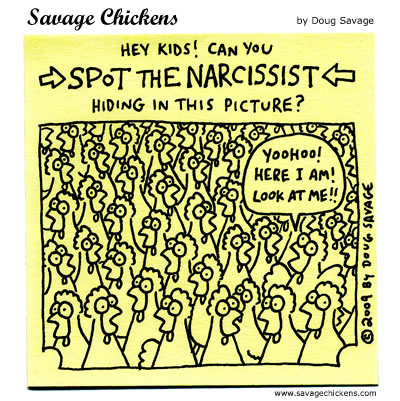
So you're a psycho and you want to advance your studies? Take Narcissism 101.
Here's a course outline:
1. When your supply runs low - how to get an interim supply, having safe sex, getting a free ride (includes love-bombing women, seeing hookers & bragging about it, and manipulating friends, mind control, seduction and using the net to "be anyone they want you to be")
2. How to find a victim - includes loads of internet dating, hooking the co-worker, using a friend or parent, trolling online for new & old targets (reunion sites, linkedin, facebook).
(Prostitutes when you want or need are o.k. - they "don't count'. Actually nobody 'counts' - only YOU!)
3. Checking their emotional state - includes psychological profiling. (depressed, alone, divorced, sick, abused, lonely, naive, religious, they believe there's good in everyone, etc...)
4. Finances - how to find a mate with cash, a good income, and property - in case you need someone to take care of you when you screw up. Repeatedly.
5. How to bait them - includes dressing for success, tips on pouring out your tales of woe, how your wife/ S.O. doesn't understand, you don't get enough love or sex, your job is mean to you, your parents abused you... list is endless.
6. Getting them to move in with you - includes how to get their cash and property put into your name, how to write a prep, finding a lawyer, drawing up wills, getting life insurance. Berating them so they keep trying to prove themselves by doing all the chores & heavy lifting will be included.
7. Early stages of living with them - includes going easy at first , etiquette, manners, calling the your 'soulmate', effective use of the word 'love', taking financial control, how to plan your marriage.
8. Managing your mate - includes isolation, brainwashing, coercion and persecution techniques that have a proven track record, plus how to fake a loving relationship and your OWN sanity while around them. Also, you will learn all there is about emotional terrorism.
9. Divorcing your mate - includes lists of lawyers, how to hide your accumulated wealth, having a back-up supply, projection, rallying support of family and friends.
10. Smearing your ex or ex-friends who are on to your game is important - threats, intimidation, bullying or posting lies about them online go hand-in-hand with calling them "crazy, a bitch/ bastard, stupid, obsessed with you, stalkers, scorned, jealous" and telling people they "can't let it go" after you've destroyed their life & crushed their spirit.
11. Moving on with your life - includes analyzing your situation, finding a new source, and getting your house in order all over again.
12. Find new source. Don't get help. Find new source. More than one is preferable.
The only requirement is a sick mind and a complete emotional void.
-anonymous
Labels: abuse, brainwashing, emotional rape, mind control, narcissism, narcissist, no empathy, pathology
Friday, July 06, 2018
The 10 Commandments of Con Artists

The Count's most unusual scam was selling the Eiffel Tower. Having read in Paris that upkeep on the Eiffel Tower was expensive for the French government, he forged some official government stationery, and as a government official, he called five wealthy European scrap merchants to a secret conference to select a buyer. He took each man on a tour of the Tower, selected the best victim, and accepted an illegal bribe as well as official payment to the French government. Then he fled the country, and his victim was too ashamed to report his loss. One year later the Count returned and sold the Eiffel Tower again the same way. The second victim reported the crime, so there wasn't a third victim.
The Count's Ten Commandments:
- Be a patient listener (it is this, not fast talking, that gets a con man his coups).
- Never look bored.
- Wait for the other person to reveal any political opinions, then agree with them.
- Let the other person reveal religious views, then have the same ones.
- Hint at sex talk, but don't follow it up unless the other person shows a strong interest.
- Never discuss illness, unless some special concern is shown.
- Never pry into a person's personal circumstances (they'll tell you all eventually).
- Never boast - just let your importance be quietly obvious.
- Never be untidy.
- Never get drunk.
(Source: Fakes, Frauds & Other Malarkey, by Kathryn Lindskoog, Grand Rapids, MI: Zondervan Publishing House, 1993.)
Labels: abusers, con men, lures, manipulative, mind control, pathological, predators, prey, psychopath, user
Wednesday, January 03, 2018
How to Identify a Psychopathic Bond

The most important self-defense against psychopathic seducers consists of recognizing the initial warning signals so that you can escape the relationship early on, hopefully before you’re seriously harmed. Dr. Joseph Carver has put together a helpful and instructive list outlining the early symptoms of a dangerous relationship with a psychopath, or as he puts it quite aptly, with “a Loser.”
As we’ve already seen in the previous account of Drew Peterson’s behavior, not all the signs of psychopathic seduction are obviously negative. But, as we’ll see, even the symptoms that seem positive (such as the instant attachment and over-the-top attention, flattery and gifts) are in fact negative. Similarly, Carver notes that the Loser doesn’t have to exhibit all of the symptoms listed below to be dangerous. The presence of even three of these symptoms indicates a potentially harmful relationship. Anything above this number points to not just probable, but certain harm. Carver begins by defining “the Loser”: “‘The Loser’ is a type of partner that creates much social, emotional and psychological damage in a relationship… The following list is an attempt to outline the characteristics of ‘The Loser’ and provide a manner in which women and men can identify potentially damaging relationships before they are themselves severely damaged emotionally or even physically.” (drjoecarver.com)
1. The Loser will Hurt you on Purpose. “If he or she hits you, twists your arm, pulls your hair, kicks you, shoves you, or breaks your personal property even once, drop them,” Carver advises. As we’ve seen, Drew Peterson escalated the abuse of his partners. He began with criticism, went on to name-calling and moved on to physical violence and (probably) murder. It’s very important to get away from a Loser at the slightest hint of violence, including verbal aggression, since abuse usually increases in frequency and severity over time.
2. Quick Attachment and Expression. “The Loser,” Carver notes, “has very shallow emotions and connections with others. One of the things that might attract you to the Loser is how quickly he or she says ‘I Love You’ or wants to marry or commit to you. Typically, in less than a few weeks of dating you’ll hear that you’re the love of their life, they want to be with you forever, and they want to marry you. You’ll receive gifts, a variety of promises, and be showered with their attention and nice gestures.” Drew Peterson and other dangerous seducers wouldn’t get any partners, much less attractive young women, if they showed their true colors from the very beginning. Psychopaths generally pour on the romance. They deluge their targets with flattery, promises and gifts at the beginning of the relationship. No matter how promiscuous they actually are, they focus their energies on their most desirable targets. Yet, Carver cautions, this seemingly positive sign is, in fact, also negative. It signals shallowness of emotions rather than strength of love. He elaborates, “Normal, healthy individuals require a long process to develop a relationship because there is so much at stake… The rapid warm-up is always a sign of shallow emotions which later cause the Loser to detach from you as quickly as they committed.” Which is exactly what Drew Peterson (and others like him) did after seducing each of his partners. As easily as he attached to them initially, he later detached from them to pursue his next conquest(s).
3. Frightening Temper. Sooner or later the Loser reveals his hot temper. Carver states that Losers often begin with indirect violence—such as demonstratively hitting the wall with their fist or throwing objects—before they start pushing, punching or hitting their partners. The physical outbursts towards inanimate objects function as a form of intimidation. Through such behavior, Losers show their targets that they’re capable of doing the same thing to them. Such outbursts also train the partners to become gradually habituated to acts of violence.
4. Killing Your Self-Confidence. Losers generally prefer flings and short-term affairs, which provide constant new thrills. They also engage in long-term relationships, however, to gain more lasting control over certain more promising targets. It’s nearly impossible to control strong human beings who have clear boundaries and a healthy self-esteem. This is why psychopaths eventually move from the initial over-the-top flattery to scathing criticism. Once they have secured their chosen partners in their grasp, they put them down to erode their self-esteem. Carver states that, for instance, Losers “constantly correct your slight mistakes, making you feel ‘on guard’, unintelligent, and leaving you with the feeling that you are always doing something wrong… This gradual chipping away at your confidence and self-esteem allows them to later treat you badly–as though you deserved it.” According to Tracy’s and Stacy’s families and friends, after seducing them, Drew undermined both women’s self-confidence. His assertion that he pampered Stacy by indulging her obsession with plastic surgery rings false. By way of contrast, her friends’ and family’s claim that he criticized her to the point that she felt compelled to make constant “improvements” in her physical appearance sounds much more plausible. Stacy’s growing insecurity also placed her under Drew’s power to determine how she felt about herself.
5. Cutting Off Your Support. In the wild, predators isolate their prey from the rest of the herd to better attack and devour it. That’s precisely what psychopaths do to their targets. Losers isolate their partners from their friends, colleagues and families. They may do so through overt criticism and by following them around when they meet with others, as Drew did to Stacy. Sometimes they opt for more subtle manipulation, such as by covertly turning the victim against her own family and friends (and vice versa). As Carver observes, “The Loser feels your friends and family might influence you or offer negative opinions about their behavior… Eventually, rather than face the verbal punishment, interrogation, and abuse, you’ll develop the feeling that it’s better not to talk to family and friends. You will withdraw from friends and family, prompting them to become upset with you.”
6. The Mean and Sweet Cycle. As we recall, Drew Peterson bought his wife a motorcycle and expensive jewelry even during the period of time when he was criticizing her, throwing her up against the wall, isolating her from her loved ones, accusing her of infidelity and calling her pejorative names. If they were consistently mean or violent, psychopaths wouldn’t be able to hold on to their partners. Which is why, as Dr. Carver observes, “The Loser cycles from mean to sweet and back again. The cycle starts when they are intentionally hurtful and mean. You may be verbally abused, cursed, and threatened over something minor. Suddenly, the next day they become sweet, doing all those little things they did when you started dating.” The period of sweetness leads the partners of Losers to cling to the relationship in the misguided hope of finding what psychologist Susan Forward calls “the magic key” that will make the psychopath stay nice to them. That magic key, however, doesn’t exist. The psychopath invariably cycles back to his real, nasty self. Over time, the meanness cycle escalates in severity and increases in duration. It’s interspersed with increasingly fewer “nice” moments, which trap the victim in her own wishful thinking. As Carver observes, “You hang on, hoping each mean-then-sweet cycle is the last one. The other purpose of the mean cycle is to allow The Loser to say very nasty things about you or those you care about, again chipping away at your self-esteem and self-confidence.”
7. It’s Always Your Fault. As we’ve seen, psychopaths never accept blame for anything they do wrong. They deny obvious facts and accuse their victims of wrongdoing. Their spurious logic goes something like this: I didn’t do it, but even if I did, you deserved it. When he didn’t outright deny the domestic abuse, Drew Peterson blamed it on each of his wives for provoking it. According to him, they lied about being hit by him. They also lied about his verbal abuse. They were the ones who were “on edge” and “disturbed,” not him. He never hit them, even if Kathy had to go to the emergency room to recover from his blows. Carver notes, “The Loser never, repeat never, takes personal responsibility for their behavior–it’s always the fault of someone else.”
8. Breakup Panic. Psychopaths need to maintain control of everything in their lives, especially their romantic relationships. When they get bored with one partner or find a replacement, they can leave her on the spur of the moment, heartlessly, often without even bothering to offer an explanation. But they get very angry when the tables are turned and their partners leave them. Drew Peterson didn’t mind cheating on his wives and abandoning them for other women. Yet when they wanted to leave him to escape the misery and abuse, he resorted to violence, threats, bribes and, when none of these strategies worked, (probably) murder. As Carver notes, “The Loser panics at the idea of breaking up–unless it’s totally their idea–then you’re dropped like a hot rock. Abusive boyfriends often break down and cry, they plead, they promise to change, and they offer marriage/trips/gifts when you threaten ending the relationship… Once back in the grasp of the Loser, escape will be three times as difficult the next time.”
9. No Outside Interests. To further control their victims, psychopaths don’t just isolate them from other people. They also narrow the range of their interests and activities, leading their partners to focus exclusively on them. Drew Peterson discouraged Stacy from working outside the home. He gave her money and gifts, not out of any real generosity but to keep her financially and emotionally dependent on him. He also followed his wife around everywhere. He wanted to monitor if she was seeing other men. But his stalking made her feel on edge about any kind of activity or pursuit that was external to their relationship. Carver goes on to state, “If you have an individual activity, they demand that they accompany you, making you feel miserable during the entire activity. The idea behind this is to prevent you from having fun or interests other than those which they totally control.”
10. Paranoid Control. Notoriously, psychopaths stalk their principal targets. They suspect other people, including their partners, of being as manipulative, deceptive and unscrupulous as themselves. Although they routinely cheat on their spouses, often with countless sexual partners, they tend to be plagued by the fear that their spouses may be cheating on them as well. Which is why, as Carver observes, “The Loser will check up on you and keep track of where you are and who you are with. If you speak to a member of the opposite sex, you receive twenty questions about how you know them. If you don’t answer their phone call, you are ask where you were, what were you doing, who you were talking to, etc.” Drew Peterson worked as a detective not only in his job on the police force, but also in his dealings with his wife. He followed Stacy around to monitor her.
11. Public Embarrassment. Psychopaths tend to put down their partners not only in private, but also publicly, to embarrass and isolate them. They want to build a psychological, if not physical, prison around their primary targets. They do everything possible to undermine their confidence, reduce their sociability, narrow the range of their interests and eliminate all positive human contact from their lives. Consequently, as Carver observes, “In an effort to keep you under control while in public, ‘The Loser’ will lash out at you, call you names, or say cruel or embarrassing things about you in private or in front of people… If you stay with The Loser too long, you’ll soon find yourself politely smiling, saying nothing, and holding on to their arm when in public.” As we’ll see in the chapter on Pablo Picasso, psychopaths aim to transform strong and proud individuals into their doormats.
12. It’s Never Enough. Psychopaths don’t want to have successful relationships. They want to assert dominance by destroying, at the very least psychologically and emotionally, their partners. In the long run, there’s nothing anybody can do to please a psychopath. Apparently, Drew Peterson flattered both his third and his fourth wives when they were still his girlfriends, which is to say, during courtship. But the honeymoon period ended once they decided to marry him. Nothing they did or failed to do henceforth pleased him for long. According to their families and friends, Stacy and Tracy constantly jumped through more and more hoops, while Drew lifted the bar higher and higher. Through this insidious process, a psychopath wears down his partner’s self-esteem. Eventually, she feels too insecure to leave the abusive relationship. As Carver puts it, “The Loser convinces you that you are never quite good enough. You don’t say ‘I love you’ enough, you don’t stand close enough, you don’t do enough for them after all their sacrifices, and your behavior always falls short of what is expected. This is another method of destroying your self-esteem and confidence. After months of this technique, they begin telling you how lucky you are to have them–somebody who tolerates someone so inadequate and worthless as you.”
13. Entitlement. As we’ve seen, psychopaths feel entitled to do and have everything and everyone they want. Laws, ethics and other people’s feelings don’t matter to them. “The Loser has a tremendous sense of entitlement, the attitude that they have a perfectly logical right to do whatever they desire,” Carver continues. “If you disobey their desires or demands, or violate one of their rules, they feel they are entitled to punish you in any manner they see fit.” In the case of Drew Peterson, even thought crime, or the intention to leave him, was punishable with (probably) murder. His interviews show that he felt entitled to mistreat each of his wives as he pleased. However, he believed that they didn’t have the right to object to his mistreatment or to leave him as a result of it.
14. Your Friends and Family Dislike Him. Psychopaths tend to be pleasant and charming, at least superficially, at the beginning of a relationship. But once they have their partner firmly in their clutches, they proceed to isolate her from her support system. In so doing, they alienate her family and friends. Carver notes, “As the relationship continues, your friends and family will see what the Loser is doing to you. They will notice a change in your personality or your withdrawal. They will protest. The Loser will tell you they are jealous of the ‘special love’ you have and then use their protest and opinion as further evidence that they are against you–not him.” Drew Peterson stalked his wife even when she was visiting with her sisters. Initially, at least some of Stacy’s family members and friends liked Drew and considered him a good match for her. But as he began to isolate and abuse her, they became unanimous in their dislike of him. In the end, they all saw the relationship as seriously damaging for Stacy.
15. Bad Stories. They say that the best indicator of future behavior is past behavior. There may be exceptions to this general principle. Fortunately, some people can improve their character and behavior with genuine and consistent effort. A psychopath can never be one of those exceptions, however. Generally speaking, if a man cheated on every wife he’s ever been with, it’s highly probable that he’ll cheat on the next one as well. Most likely, the problem isn’t the woman or women he was with, but his underlying lack of character. Similarly, if he abused his previous partners, he’s very likely to abuse the next ones as well. Stacy knew enough about how Drew treated his previous wife to see that he was a philanderer and potentially dangerous. But the intensity and perseverance with which he pursued her blinded her from seeing the same warning signals in their relationship. In addition, since psychopaths don’t find anything wrong with their harmful behavior, they’re likely to boast about it. This also sends out some glaring warning signals. As Carver states, “The Loser tells stories of violence, aggression, being insensitive to others, rejecting others, etc… They brag about their temper and outbursts because they don’t see anything wrong with violence and actually take pride in the ‘I don’t take nothing from nobody’ attitude… Listen to these stories — they tell you how you will eventually be treated and what’s coming your way.”
16. The Waitress Test. Just as how people behaved in the past tells a lot about how they’ll behave in the future, so how they treat others functions as a pretty good indicator of how you’ll eventually be treated. A person who’s uncaring and unethical towards others will most likely also be that way to you when you no longer serve his interests. Carver calls this “the waitress test.” In his estimation, how a Loser treats people who aren’t immediately useful to him reveals how he’ll treat you once your use has expired. “It’s been said that when dating, the way an individual treats a waitress or other neutral person of the opposite sex is the way they will treat you in six months. During the ‘honeymoon phase’ of a relationship, you will be treated like a king or queen. However, during that time the Loser has not forgotten how he or she basically feels about the opposite sex. Waitresses, clerks, or other neutral individuals will be treated badly. If they are cheap–you’ll never receive anything once the honeymoon is over. If they whine, complain, criticize, and torment–that’s how they’ll treat you in six months.” Psychopaths lack consistency in their “good” behavior because for them “goodness” is only a façade. The manner in which they treat someone relates strictly to that person’s perceived use value. When people are useful to them they treat them (superficially) well. When they aren’t, they ignore or mistreat them. By way of contrast, genuinely nice people treat others well regardless of their perceived utility. Carver advises, “If you find yourself dating a man who treats you like a queen and other females like dirt–hit the road.” Pretty soon, you’ll be the dirt he walks on, on his way to conquering other temporary queens.
17. The Reputation. Psychopaths tend to have polarized reputations. Their victims often describe them, in retrospect, as Janus figures (since they’re two-faced) or as Jekyll and Hyde personalities (since they switch from nice to mean). We’ve seen that for a psychopath the Jekyll side is a mask he constructs to attract, fool and use others. The Hyde side represents his true identity, which becomes increasingly dominant over time. To his buddies, Drew Peterson appeared to be an easy-going, nice guy. But that’s because they only saw one side of him, the jovial facet he wanted them to see. To his wives and their families– which is to say, to anyone who had extensive intimate contact with him–Drew exposed another, much more menacing side of his personality. Any sign of independence from his partners meant escaping his control: something he couldn’t tolerate and which he punished through abuse and (probably) murder. Carver states, “As mentioned, mentally healthy individuals are consistent in their personality and their behavior. The Loser may have two distinct reputations–a group of individuals who will give you glowing reports and a group that will warn you that they are serious trouble.” In addition to paying attention to what others say, trust your own intuition and powers of observation. Pay close attention to how your partner treats you over time and in different circumstances. Be particularly attuned to how he responds when you express different needs or opinions. Psychopaths can’t tolerate any real assertion of independence from others. They also can’t treat those they’re intimately involved with well for long. Although some psychopaths may consistently maintain the mask of charm in superficial interactions with their buddies, colleagues and acquaintances, their real controlling, selfish and aggressive natures tend to show through in extended intimate contact.
18. Walking on Eggshells. During the course of their marriages to Drew Peterson, at least two of his wives reported losing their self-confidence as a result of his emotional and physical abuse. While they both entered the relationship with Drew feeling desirable, in love and valued, by the end they were overpowered and intimidated by him. When involved with a psychopath, over time, his partner finds herself walking on eggshells. She fears that anything she does or says might trigger his emotional detachment, hostility or abuse. Carver observes that, “Instead of experiencing the warmth and comfort of love, you will be constantly on edge, tense when talking to others (they might say something that you’ll have to explain later), and fearful that you’ll see someone you’ll have to greet in public.”
19. Discounted Feelings/Opinions. For psychopaths, their fundamental callousness and capacity for evil stems from their absolute selfishness and inability to respect other individuals, as fellow human beings with independent needs and desires. That’s why those involved with a psychopath, following the initial stage when he praises everything they do and say, come to realize that their feelings, needs and opinions don’t matter to him. The Loser’s narcissism is, as Hervey Cleckley’s study of psychopathy concluded, absolute. Carver elaborates, “The Loser is so self-involved and self-worshiping that the feelings and opinions of others are considered worthless… The Loser is extremely hostile toward criticism and often reacts with anger or rage when their behavior is questioned.” Narcissists and psychopaths flatter others only to use and manipulate them. They lack genuine consideration for others.
20. They Make You Crazy. According to her friends, Kathy Savio felt overcome by rage, jealousy and anger when Drew cheated on her with Stacy. While her emotional response was perfectly understandable under the circumstances, Drew depicted Kathy to others as “insane” to justify his mistreatment of her. In some ways, however, this statement isn’t far removed from the truth. Sometimes, psychopaths quite literally drive their partners crazy. They lie to them to the point where they start doubting their knowledge of reality. They discourage and belittle them to the point where they lose their self-confidence and become reclusive. They mistreat them to the point where they’re overcome with rage. As Carver goes on to explain, “The Loser operates in such a damaging way that you find yourself doing ‘crazy’ things in self-defense… You become paranoid as well–being careful what you wear and say… While we think we are ‘going crazy’–it’s important to remember that there is no such thing as ‘normal behavior’ in a combat situation. Rest assured that your behavior will return to normal if you detach from the Loser before permanent psychological damage is done.” When involved with a psychopath, you may, unlike Drew Peterson’s misfortunate wives, escape alive. But unless you end the relationship in its earliest stages, you’re not likely to escape unharmed.
What do these warning signs indicate? They show that psychopathic seducers can fake decency and love convincingly in the beginning of a relationship. That’s how they manage to attract so many potential partners. But they can’t sustain their mask of sanity over time in intimate contact, since it’s fake and instrumental. If you remain vigilant, you’ll be able to see red flags early on in the relationship with a psychopath despite his veneer of charm and extravagant romantic words and gestures.
As psychotherapist Steve Becker indicates on his website, powercommunicating.com, most of his clients recognized the warning signals in their relationships with exploitative partners. They just minimized those red flags or downright ignored them. They preferred to focus on their romantic fantasies rather than face an unpleasant reality. According to Becker, the most difficult challenge isn’t noticing the red flags, but actually heeding them. He states,
“I find that many of my clients were in fact cognizant of odd, disconcerting behaviors/attitudes that their exploitative partners were reckless enough to reveal (or incapable of concealing). They may have even felt troubled by them. But in their intense need to want the relationship, and the partner, to be the elusive fit they so hungrily sought, they found ways to suppress their uneasiness: to ignore and/or minimize the significance of these signals; and rationalize the alarms their instincts triggered.” (powercommunicating.com)
If you encounter a man who is aroused primarily by the circumstances surrounding your relationship—especially the perverse and forbidden ones—rather than by you, yourself, run. If you encounter a man who does a bait and switch to gain your trust only to violate his promises or raise the bar higher and higher, run. If you encounter a man who behaves in a despicable manner towards any other woman, no matter what he says about her, examine his behavior carefully since that’s how he’ll eventually treat you and, needless to say, run.
Truth is not a convenient fiction. Similarly, love is not a power game for anyone capable of this emotion. It’s the deepest and most significant bond human beings form with one another and the foundation of our lives. If you encounter a man who gives any signs that he regards love as a game and you as a “prize” to be won, fold your cards and quickly leave the table. Or, better yet, refuse to engage with him at all. Any intimate relationship with a psychopath is a gamble where you risk losing everything and from which you have nothing to gain.
Labels: abuse, gaslighting, losers, mind control, narcissist, psychopath, red flags, seduction, sociopath