Sanctuary for the Abused
Thursday, June 17, 2021
Learned Helplessness
There are people who rely on learned helplessness as a means to cope with negative events happening in their life. Keith Joseph McKean points out that learned helplessness is based on three things:
Internal blaming - "It's me!"
Global distortion - "It'll affect everything I do!"
Stability generalization - "It will last forever!"
Parents/caretakers play major roles in whether or not a child develops learned helplessness. Learned helplessness can develop early in one's life. Therefore, adults need to be aware of how their type of criticism they use will affect children.
If adults are continually using negative criticism, the child will eventually have low self-esteem and will come to a point to want to give up trying. This can lead to the child having negative viewpoints throughout his/her life.
The type of reinforcement given to the child by the caregiver can determine whether or not the child will develop learned helplessness as a coping mechanism for everyday life events. The child will eventually feel he/she has no control over these events.
Heyman, Dweck and Cain confirm the influence of constant negative criticism on children by revealing how young children in their study assumed when they were receiving negative criticism they must have been "bad" children. Therefore, the children felt they were deserving of such negative criticism.
But, researchers claim as a child gets older the child feels the negative criticism is based on their lack of abilities, not based on if they were "good" or "bad." This study cites that children who have a secure attachment will demonstrate positive self-evaluations whereas children who don't have this positive attachment will demonstrate negative self-evaluations.
Learned helplessness can develop in any stage of one's life, not just childhood - it affects behavioral, cognitive and affective domains at the same time.
When a person is wanting to give up or has a continuous habit of putting things off, this is learned helplessness affecting his/her behavioral domain. A person's self-esteem will be low and feeling of frustration will be high. With these effects a person's ability to solve problems will be very low due to the fact that the person has no confidence in themselves.
These factors affect the cognitive domain. The affective domain is when a person will show signs of depression. When one fails, the blame will be that person's lack of abilities and when one succeeds this will be due to "luck."
Also, a characteristic of a person with learned helplessness is low self-esteem. Low self-esteem will decrease one's confidence in trying to change negative things that are going on in one's life. When a person with learned helplessness experiences success he / she will make themselves and others believe it was due to "luck" and not based on ones' own abilities.
This pessimistic explanatory way of dealing with events can affect a person's job performance and a student's academic performance which can eventually lead to wanting to give up. As stated earlier, learned helplessness can develop at any age.
Learned helplessness can be seen when comparing depressed elderly women and non-depressed elderly women (65-96 years) on successes and failures. The non-depressed women would describe their success due to positive reasons such as, their success was due to their own abilities. Whereas, the depressed women would use more of a negative reason by saying their success was due to "luck" and not based on personal abilities.
When it came to explaining failures, the non-depressed women would blame them on "bad luck" and the depressed women would blame it on their so-called lack of abilities. The depressed women would blame negative outcomes due to inner forces and positive outcomes due to outer forces. These depressed women show how people with learned helplessness will use these reasons to give up and not put an effort to take control of their lives.
Strube emphasizes a situation where learned helplessness traumatically effects lives. Women in abusive relationships have developed at some point in time learned helplessness. These women have low self-esteem and blame themselves when things go wrong, therefore, they feel they deserve the physical and mental abuse (similar to the young children who felt they deserved the negative criticism they received because of being "bad").
Society and family play a partial hand in this abuse by putting unnecessary pressures on the woman by making her feel it is her responsibility to make the relationship work. These pressures need to be removed and support from family needs to be increased.
Society as a whole needs to take a stand against abuse. Just as these studies show how learned helplessness can develop during early childhood and continue through adulthood, I know of a woman who has overcome learned helplessness.
There was this little girl who wasn't afraid of anything. She didn't even know what fear was. Then one day a traumatic event happened in her life. After that she knew what fear was.
She was made to feel what had happened was her fault. She tried hard to thing of what she did to deserve being treated so badly. For many years she felt she was a "bad" girl. After that experience came many other negative experiences. She felt she caused them because she was "bad" therefore, she deserved these bad experiences. She decided to be so "good" that nothing bad would ever happen again. But, bad things kept occurring. She figured it didn't matter if she was "good" or "bad" because she had no control over anything that happened in her life.
All through life whenever she failed she would just decide that was expected, so why try?
When she did achieve anything good, she would count that as being "lucky" - not because of her abilities. At times of success she didn't like to acknowledge it to anyone because she knew there would be someone there to remind her how "bad" she really was. She got to the point whenever she would achieve anything in life she never gave herself a chance to enjoy the precious moments. She felt she didn't deserve any praise for accomplishments. She even blamed herself for a relative's death.
For some reason, she felt she must have done something bad and she was to be punished by having him taken away from her. She continued for a number of years failing to achieve any goals that were set for her. She tried to finish college a number of times but continued to fail. She did not fail necessarily in grades but in giving up on everything in life. She just figured there would be something that would stop her so she didn't try.
During her early adulthood years she had no goals set and would just go along in life doing what it took to get by. She constantly placed herself in negative situations; abusive relationships, other relationships that were doomed to fail, and she felt any mistakes on the job were due to her lack of abilities. She felt she had no control over any events in her life.
She felt she was doomed for the rest of her life. She felt her family didn't expect anything from her since she was a woman. She was to get married and raise a family - nothing else. She became engaged numerous times but failed at actually going through with the marriages.
No matter how hard she would try, she always failed. Her negative surroundings and negative reinforcements over many years caused her to develop learned helplessness.
By her late twenties she knew something had to change.
After receiving professional help and joining a support group [see below], the once frightened little girl has turned into a woman who knows now that she has control over her life. Now in her thirties, she has gone back to school and has set short-term and long-term goals to help herself succeed in life. Now her belief is that if she has given it her best she has succeeded (no matter what others would rule as success and failure).
There are still days when she feels she has failed. At first she will start to blame herself and she will stop and tell herself over and over she is not to blame. She will then look back to analyze why she did not achieve what she had set out to do and if she didn't do her best, she would do her best to try and correct this. but, when she did her best, she will tell herself she must accept it and go on.
--------------------------------------------------------------------------------
She is learning to accept that when she does something good, she knows she worked hard for it and deserves it without feeling guilty, and she didn't get it from the luck of the draw.
--------------------------------------------------------------------------------
She has a new life after thirty years of living with learned helplessness. Society and parents play major roles in making sure a child avoids learned helplessness. Children must be encouraged to use their cognitive abilities to their fullest, be given positive criticism and be shown adaptive ways to cope with negative events that happen in their lives.
A person's self-esteem is very important to one's future. No one can eliminate negative events in anyone's life but one does have the power to help someone cope in a positive manner.
Terri Holcomb
Labels: abuse, abused, blame, criticism, depression, fear, giving up, learned helplessness, low self-esteem, trauma


Thursday, May 17, 2018
Why Women Stay
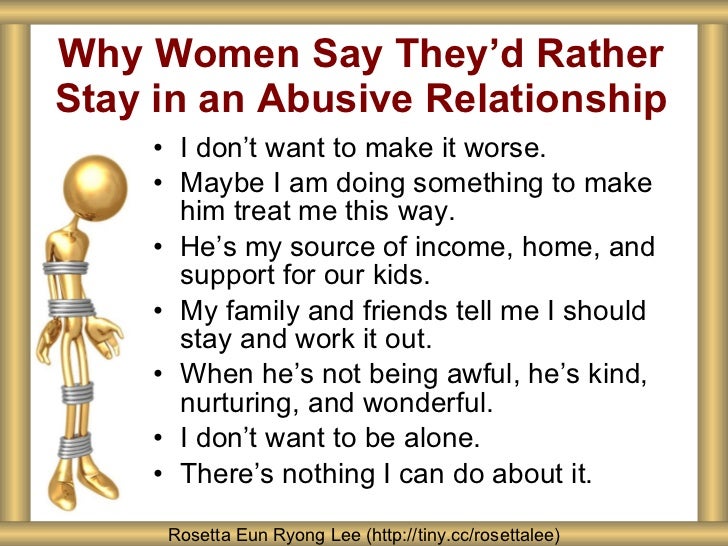
Situational Factors
Economic dependence. How can she support herself and the children? Fear of greater physical danger to herself and her children if they try to leave.
Fear of being hunted down and suffering a worse beating than before.
Survival. Fear that her partner will follow her and kill her if she leaves, often based on real threats by her partner.
Fear of emotional damage to the children.
Fear of losing custody of the children, often based on her partner's remarks.
Lack of alternative housing; she has nowhere else to go.
Lack of job skills; she might not be able to get a job.
Social isolation resulting in lack of support from family and friends.
Social isolation resulting in lack of information about her alternatives.
Lack of understanding from family friends, police, ministers, etc.
Negative responses from community, police, courts, social workers, etc.
Fear of involvement in the court process; she may have had bad experiences before.
Fear of the unknown. "Better the devil you know than the devil you don't."
Fear and ambivalence over making formidable life changes.
"Acceptable violence". The violence escalates slowly over time. Living with constant abuse numbs the victim so that she is unable to recognize that she is involved in a set pattern of abuse.
Ties to the community. The children would have to leave their school, she would have to leave all her friends and neighbors behind, etc. For some women, it would be like being in the Witness Protection program--she could never have any contact with her old life.
Ties to her home and belongings.
Family pressure; because Mom always said, "I told you it wouldn't work out." or "You made your bed, now you sleep in it."
Fear of her abuser doing something to get her (report her to welfare, call her workplace, etc.)
Unable to use current resources because of how they are provided (language problems, disability, homophobia, etc.) Time needed to plan and prepare to leave.
Emotional Factors
Insecurity about being alone, on her own; she's afraid she can't cope with home and children by herself.
Loyalty. "He's sick; if he had a broken leg or cancer--I would stay. This is no different."
Pity. He's worse off than she is; she feels sorry for him.
Wanting to help. "If I stay I can help him get better."
Fear that he will commit suicide if she leaves (often he's told her this).
Denial. "It's really not that bad. Other people have it worse."
Love. Often, the abuser is quite loving and lovable when he is not being abusive.
Love, especially during the "honeymoon" stage; she remembers what he used to be like.
Guilt. She believes--and her partner and the other significant others are quick to agree-- that their problems are her fault.
Shame and humiliation in front of the community. "I don't want anyone else to know."
Unfounded optimism that the abuser will change.
Unfounded optimism that things will get better, despite all evidence to the contrary.
Learned helplessness. trying every possible method to change something in our environment, but with no success, so that we eventually expect to fail. Feeling helpless is a logical response to constant resistance to our efforts. This can be seen with prisoners of war, people taken hostage, people living in poverty who cannot get work, etc.
False hope. "He's starting to do things I've been asking for." (counseling, anger management, things she sees as a chance of improvement.)
Guilt. She believes that the violence is caused through some inadequacy of her own (she is often told this); feels as though she deserves it for failing.
Responsibility. She feels as though she only needs to meet some set of vague expectations in order to earn the abuser's approval.
Insecurity over her potential independence and lack of emotional support.
Guilt about the failure of the marriage/relationship.
Demolished self-esteem. "I thought I was too (fat, stupid, ugly, whatever he's been calling her) to leave."
Lack of emotional support--she feels like she's doing this on her own, and it's just too much.
Simple exhaustion. She's just too tired and worn out from the abuse to leave.
Personal Beliefs
Parenting, needing a partner for the kids. "A crazy father is better than none at all."
Religious and extended family pressure to keep the family together no matter what.
Duty. "I swore to stay married till death do us part." Responsibility. It is up to her to work things out and save the relationship.
Belief in the American dream of growing up and living happily ever after.
Identity. Woman are raised to feel they need a partner--even an abusive one--in order to to be complete or accepted by society.
Belief that marriage is forever.
Belief that violence is the way all partners relate (often this woman has come from a violent childhood).
Religious and cultural beliefs.
(from the Rural Women's Advocacy Program)IF you can get to a Domestic Violence Center they can help with resources and a plan to help you get out (you do NOT have to live at the Shelter) CLICK HERE
Labels: emotional abuse, fear, financial, learned helplessness, no help, psychological, stockholm syndrome