Sanctuary for the Abused
Thursday, June 17, 2021
Learned Helplessness

There are people who rely on learned helplessness as a means to cope with negative events happening in their life. Keith Joseph McKean points out that learned helplessness is based on three things:
Internal blaming - "It's me!"
Global distortion - "It'll affect everything I do!"
Stability generalization - "It will last forever!"
Parents/caretakers play major roles in whether or not a child develops learned helplessness. Learned helplessness can develop early in one's life. Therefore, adults need to be aware of how their type of criticism they use will affect children.
If adults are continually using negative criticism, the child will eventually have low self-esteem and will come to a point to want to give up trying. This can lead to the child having negative viewpoints throughout his/her life.
The type of reinforcement given to the child by the caregiver can determine whether or not the child will develop learned helplessness as a coping mechanism for everyday life events. The child will eventually feel he/she has no control over these events.
Heyman, Dweck and Cain confirm the influence of constant negative criticism on children by revealing how young children in their study assumed when they were receiving negative criticism they must have been "bad" children. Therefore, the children felt they were deserving of such negative criticism.
But, researchers claim as a child gets older the child feels the negative criticism is based on their lack of abilities, not based on if they were "good" or "bad." This study cites that children who have a secure attachment will demonstrate positive self-evaluations whereas children who don't have this positive attachment will demonstrate negative self-evaluations.
Learned helplessness can develop in any stage of one's life, not just childhood - it affects behavioral, cognitive and affective domains at the same time.
When a person is wanting to give up or has a continuous habit of putting things off, this is learned helplessness affecting his/her behavioral domain. A person's self-esteem will be low and feeling of frustration will be high. With these effects a person's ability to solve problems will be very low due to the fact that the person has no confidence in themselves.
These factors affect the cognitive domain. The affective domain is when a person will show signs of depression. When one fails, the blame will be that person's lack of abilities and when one succeeds this will be due to "luck."
Also, a characteristic of a person with learned helplessness is low self-esteem. Low self-esteem will decrease one's confidence in trying to change negative things that are going on in one's life. When a person with learned helplessness experiences success he / she will make themselves and others believe it was due to "luck" and not based on ones' own abilities.
This pessimistic explanatory way of dealing with events can affect a person's job performance and a student's academic performance which can eventually lead to wanting to give up. As stated earlier, learned helplessness can develop at any age.
Learned helplessness can be seen when comparing depressed elderly women and non-depressed elderly women (65-96 years) on successes and failures. The non-depressed women would describe their success due to positive reasons such as, their success was due to their own abilities. Whereas, the depressed women would use more of a negative reason by saying their success was due to "luck" and not based on personal abilities.
When it came to explaining failures, the non-depressed women would blame them on "bad luck" and the depressed women would blame it on their so-called lack of abilities. The depressed women would blame negative outcomes due to inner forces and positive outcomes due to outer forces. These depressed women show how people with learned helplessness will use these reasons to give up and not put an effort to take control of their lives.
Strube emphasizes a situation where learned helplessness traumatically effects lives. Women in abusive relationships have developed at some point in time learned helplessness. These women have low self-esteem and blame themselves when things go wrong, therefore, they feel they deserve the physical and mental abuse (similar to the young children who felt they deserved the negative criticism they received because of being "bad").
Society and family play a partial hand in this abuse by putting unnecessary pressures on the woman by making her feel it is her responsibility to make the relationship work. These pressures need to be removed and support from family needs to be increased.
Society as a whole needs to take a stand against abuse. Just as these studies show how learned helplessness can develop during early childhood and continue through adulthood, I know of a woman who has overcome learned helplessness.
There was this little girl who wasn't afraid of anything. She didn't even know what fear was. Then one day a traumatic event happened in her life. After that she knew what fear was.
She was made to feel what had happened was her fault. She tried hard to thing of what she did to deserve being treated so badly. For many years she felt she was a "bad" girl. After that experience came many other negative experiences. She felt she caused them because she was "bad" therefore, she deserved these bad experiences. She decided to be so "good" that nothing bad would ever happen again. But, bad things kept occurring. She figured it didn't matter if she was "good" or "bad" because she had no control over anything that happened in her life.
All through life whenever she failed she would just decide that was expected, so why try?
When she did achieve anything good, she would count that as being "lucky" - not because of her abilities. At times of success she didn't like to acknowledge it to anyone because she knew there would be someone there to remind her how "bad" she really was. She got to the point whenever she would achieve anything in life she never gave herself a chance to enjoy the precious moments. She felt she didn't deserve any praise for accomplishments. She even blamed herself for a relative's death.
For some reason, she felt she must have done something bad and she was to be punished by having him taken away from her. She continued for a number of years failing to achieve any goals that were set for her. She tried to finish college a number of times but continued to fail. She did not fail necessarily in grades but in giving up on everything in life. She just figured there would be something that would stop her so she didn't try.
During her early adulthood years she had no goals set and would just go along in life doing what it took to get by. She constantly placed herself in negative situations; abusive relationships, other relationships that were doomed to fail, and she felt any mistakes on the job were due to her lack of abilities. She felt she had no control over any events in her life.
She felt she was doomed for the rest of her life. She felt her family didn't expect anything from her since she was a woman. She was to get married and raise a family - nothing else. She became engaged numerous times but failed at actually going through with the marriages.
No matter how hard she would try, she always failed. Her negative surroundings and negative reinforcements over many years caused her to develop learned helplessness.
By her late twenties she knew something had to change.
After receiving professional help and joining a support group [see below], the once frightened little girl has turned into a woman who knows now that she has control over her life. Now in her thirties, she has gone back to school and has set short-term and long-term goals to help herself succeed in life. Now her belief is that if she has given it her best she has succeeded (no matter what others would rule as success and failure).
There are still days when she feels she has failed. At first she will start to blame herself and she will stop and tell herself over and over she is not to blame. She will then look back to analyze why she did not achieve what she had set out to do and if she didn't do her best, she would do her best to try and correct this. but, when she did her best, she will tell herself she must accept it and go on.
--------------------------------------------------------------------------------
She is learning to accept that when she does something good, she knows she worked hard for it and deserves it without feeling guilty, and she didn't get it from the luck of the draw.
--------------------------------------------------------------------------------
She has a new life after thirty years of living with learned helplessness. Society and parents play major roles in making sure a child avoids learned helplessness. Children must be encouraged to use their cognitive abilities to their fullest, be given positive criticism and be shown adaptive ways to cope with negative events that happen in their lives.
A person's self-esteem is very important to one's future. No one can eliminate negative events in anyone's life but one does have the power to help someone cope in a positive manner.
Terri Holcomb
Labels: abuse, abused, blame, criticism, depression, fear, giving up, learned helplessness, low self-esteem, trauma


Saturday, November 03, 2018
Emotional Abuse or Going Crazy?

The blows of physical or sexual abuse are oftentimes obvious. Broken bones, bruises, and lacerations leave scars as evidence. Yet worst of all are the scars of emotional abuse - nearly invisible to the naked eye. Unfortunately, these can be more caustic, long-lasting, and life-altering than those left by any other type of abuse and the psychological damage the most profound.
What is emotional abuse? Sometimes called "Ambient Abuse," it is an extremely subtle form of control and manipulation that may go unrecognized for months or years -- many times even by those on the receiving end -- at least until it is too late. By the time the victim is aware of the actual abusive behaviors, she has oftentimes become a bundle of nerves and finds it difficult to see her way off the emotional roller coaster ride she's stuck on. Worse yet, she can't even explain what's happening to her, and in some cases, she may actually think she is going crazy; struggling with anxiety, depression, fear, or eventually -- apathy. She may quit doing anything, for fear of doing it "wrong" - at least according to the controller in her life.
Abusers and controllers may start out using little digs like, "Honey, everyone knows that you do it this way," as just another way to say, "How stupid are you that you don't know this?"
Constant criticism becomes part of the game. "You are too fat, dumb, ugly," or even, "I wish I had that abortion instead of having you!" These are all ammunition in emotional abuse.
Even teasing can be abusive, for it frequently has some truth at its core. Jane lives in a marriage where her husband's teasing-type cuts are constant. "The Ayatollah says dinner is ready," he announces regularly whenever they have guests. He thinks it's funny. She certainly doesn't. And what are we, the guests supposed to think -- that he is paying her a compliment? Absolutely not. I don't care how much he smiles or laughs when he throws it out there -- it is meant to wound. And she knows it. And he knows that she knows it.
Emotional abuse may take the form of the controller limiting the "victim's" outside contacts. "You don't need anybody but me," he may remind you constantly, and can actually get angry if you spend time with your friends or family, even on the phone. The more he can lock you away from your external support systems, the more he locks you in his boxx of control.
Deanna's husband tells her what time she can go to bed, what she is allowed to eat, and just how long she'd better be gone when she goes out to do errands. He never gives her a birthday or Christmas gift. He threatens to kill her and hide her car if she doesn't obey him. He makes her recite each day that she is worthless -- that he will tell her what she is worth, what she can and can't do, and who she is allowed to see when. This is obviously extreme emotional abuse.
Unfortunately, all these situations may seem extremely difficult to escape for the victim. The brainwashing of weeks, months, and years of constant demeaning remarks are meant to make her feel worthless and as though no one else in the world could love her. Thus, her fear of leaving exceeds the fear of staying, and even worse -- many times she blames herself for all that is wrong. Guilt becomes her constant companion. Leaving seems impossible. And besides, it's "not that bad." For if it were, there would certainly be broken bones to prove it. Or so she believes.
If you find yourself trapped in the boxx of emotional abuse, it's important to know you CAN escape! The long-term emotional damage caused by this type of situation will affect your physical as well as your mental health -- and that of your children. While there may not be laws protecting you from the constant verbal attacks, you do have the ability to recognize it for what it is -- definitely NOT something that goes hand-in-hand with a loving relationship. Furthermore, teaching your children that this is an acceptable behavior only leads them to believe that emotional abuse is an acceptable part of a normal relationship. Would you wish this for your child? Or your grandchild?
Mary Jo Fay is a speaker and writer. http:// www.outoftheboxx.com.
SOURCE
Labels: abuser, controller, criticism, emotional abuse, guilt, narcissist, psychopath, sarcasm, truth, verbal abuse
Monday, October 08, 2018
Should I End This Relationship?

Leaving a relationship before knowing what the real problem is, is generally a waste of time (aside from domestic violence) - especially if you eventually want to be in another relationship.
The reason it’s a waste of time is because whatever you are doing to create your unhappiness, you are not going to stop doing just because you leave the relationship. You take yourself with you when you leave, and unless you heal your part of the relationship problem, you will continue to behave in ways that eventually destroys relationships.
You might be surprised to learn that the time to leave a relationship is NOT when you are miserable, but rather when you are happy, joyful and peaceful. When you have learned how to make yourself happy and bring yourself peace and joy, and if your partner is still distance, angry, needy, disconnected, resistant, unloving, or acting out addictively - then it may be time to leave if that is what you want.
When I work with couples, I help each partner learn how to take full, 100% responsibility for their own feelings and needs. Obviously, if both people are behaving in ways that bring themselves joy, they will have a lot of love to share with each other. As long as they are stuck believing that their unhappiness of the other person’s fault, they are being victims. As victims they want to control the other person and get them to behave the way they want them the behave. As victims, they are afraid of being rejected or controlled, and are behaving in ways to protect themselves from what they fear. All the ways they are trying to have control over not being rejected or controlled are creating the relationship problems.
Until you become aware of how you are being a victim and how you are trying to control your partner - and you are successful in taking care of your own feelings and needs - there is no point in leaving.
Most people who are unhappy in their relationship are reactors. They are reacting to the other person’s controlling behavior with their own controlling behavior. For example:
• When Jacob criticizes her, Hannah shuts down. When Hannah shuts down, Jacob criticizes.
• When Sally gets angry at Joe, Joe defends, lectures and explains himself. When Joe lectures, Sally gets angry and resistant.
• When Robert is demanding, Ingrid gives herself up to comply with Robert’s demands. The more Ingrid complies, the more Robert demands.
• When Michele complains, Hugh resists. The more Hugh resist, the more Michele complains.
• When Craig acts like an irresponsible child, Karen becomes parental and judgmental. The more Karen is parental and judgmental, the more Craig is resistant and irresponsible.
Each of these people are reacting in controlling ways, rather than acting in ways that take loving care of themselves. Both people are participating in creating a negative circle. Generally, they then blame the other for their own reaction: “If you wouldn’t criticize, then I wouldn’t withdraw.” “Well, if you wouldn’t withdraw, then I wouldn’t criticize.” “If you weren’t so resistant, I wouldn’t get angry.” “If you weren’t so angry, I wouldn’t resist.”
If they were to act in loving ways toward themselves rather than react in controlling ways toward their partner, then:
If they were to act in loving ways toward themselves rather than react in controlling ways toward their partner, then:
• When Jacob criticized, Hannah might speak up for herself instead of shutting down, saying something like, “Jacob, I don’t like being criticized. I’m not willing to have this discussion until we can be open with each other.” When Hannah shut down, Jacob could be curious instead of critical, saying something like, “Honey, you must have a good reason for withdrawing from me. Do you want to talk about it?”
• When Sally got angry, Joe could disengage from the conversation instead of trying to talk her out of her feelings. He would give up
trying to have control over Sally’s anger and how she sees him and take care of himself. When Joe tried to control Sally with his lecturing and explaining, instead of trying to control him with her anger, Sally could speak up for herself, telling Joe that she doesn’t like it when he tries to talk her out of her feelings.
There is no point in leaving a relationship until you have learned act in ways that are loving to yourself and your partner, instead of reacting in controlling and resistant ways. Leaving only delays this learning until your next relationship.
About the author: Margaret Paul, Ph.D. is the best-selling author and co-author of eight books, including "Do I Have To Give Up Me To Be Loved By You?", "Do I Have To Give Up Me To Be Loved By My Kids?", "Healing Your Aloneness","Inner Bonding", and "Do I Have To Give Up Me To Be Loved By God?"
Labels: criticism, end, fair, feelings, fighting, relationship, victim
Thursday, April 12, 2018
Children Can be Damaged by Narcissistic Parents
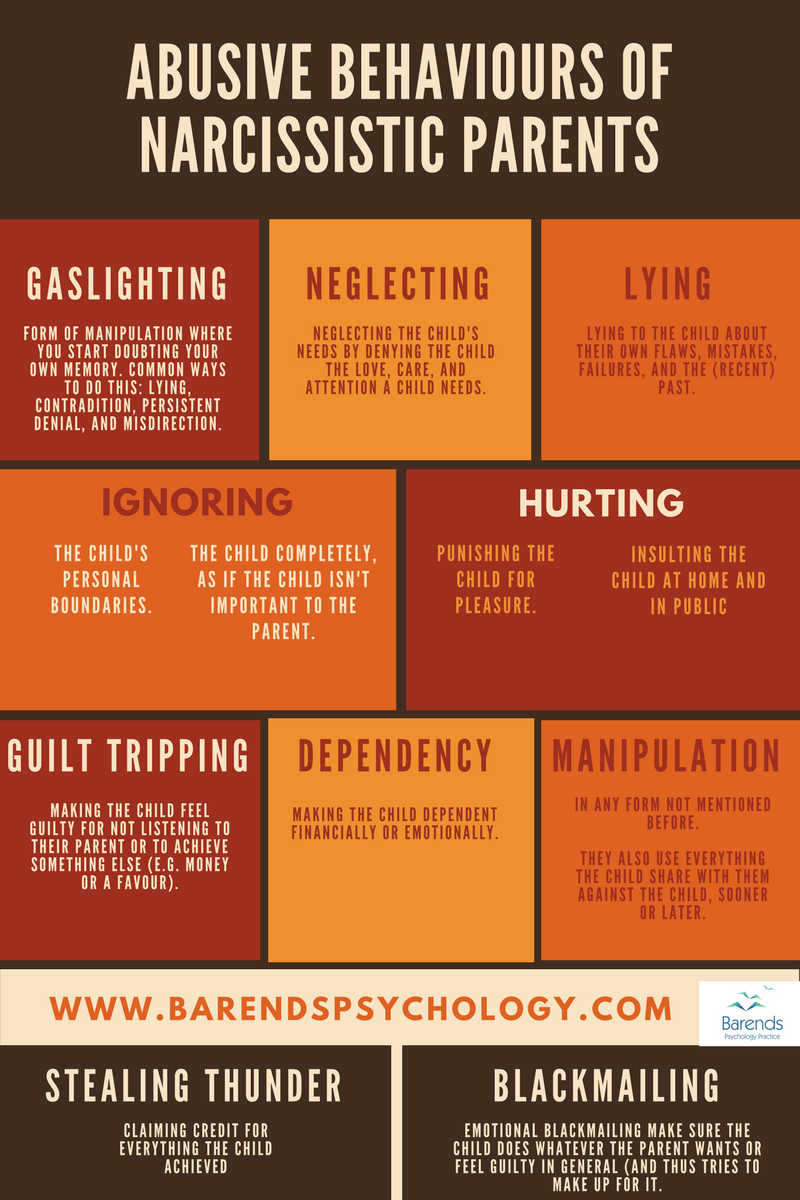
Children of narcissistic parents pressured to meet adult's needs
by Neil Rosenthal
Did you have a parent who constantly criticized you? Did this parent expect you to admire them and give them constant attention? Or perhaps your parent insisted that everything be done their way, and your contributions were ignored or devalued. If these descriptions of one or both of your parents ring true, it is very likely that you have been shaped by a parent with destructive narcissism.
An adult with healthy narcissism has a good sense of self, has empathy for others, is able to delay gratification, assumes responsibility for him/herself and for others, has a capacity to develop and maintain meaningful and satisfying relationships and has clear and firm boundaries, says Nina Brown in her book Children of the Self-Absorbed (New Harbinger Publications).
An adult with destructive narcissism, on the other hand, cannot reliably respond to a child's needs, or nurture, or respond empathetically, or put a child's needs above his/her own — or tune into the emotional life of a child. Instead, the child is expected to meet the adult's needs.
The child constantly receives messages about what they are supposed to be or do for the parent. When the child becomes an adult, the expectations are so internalized that they now respond to other people in the same way they responded to their parents, says Brown.
As an adult, you will either cater to others (and then resent them) or you will ignore others — and they will be unhappy with you. [this is what makes children of narcissists targets for pathological relationships - Barbara]
Here's a description of various components of how parents with destructive narcissism act, courtesy of Brown:
Needs attention: Becomes uncomfortable when the spotlight is turned to someone else. Will brag, throw a tantrum, sulk, act loud and boisterous, complain, act seductive and engage in one-upmanship.
Needs admiration: Fishes for compliments or approval, flaunts possessions, is vain, gloats over wins, tries to impress others and does everything — so others think they are “superman” or “superwoman.”
Feels what they have to say is more important than what others have to say, so they frequently interrupt others; does not wait their turn; becomes angry when ignored or overlooked; tries to find a way around rules or laws; expects to be taken care of first and to receive more service than others.
Has a lack of empathy. Is more interested in their concerns than in yours; ignores your feelings and fails to listen to you; diminishes the importance of your concerns, issues or feelings and calls you “touchy” “oversensitive” or that “you brought it on yourself” if you say you feel devalued or upset.
Wants to control what you do and say. Expects you to drop what you're doing and attend to them; uses your possessions without first asking permission; gets angry when you don't act as they tell you to; forces you to accept unwanted touching or kisses, and makes you feel inept when you don't rely on them to tell you what to do.
Considers others as inferior. Is easily offended by any hint that you think they are wrong or mistaken; is wounded when you disagree with their opinions or suggestions; is arrogant and acts as if they are control of everything.
Has shallow emotions, except for anger and fear.
Acts entitled. Expects to receive more attention, special consideration and deference. Assumes that their wants and needs take priority over yours, and that things be done in their way.
Exploits others by making misleading statements, being manipulative, lying, not reciprocating a gift or favor or by using emotional blackmail.
Is emotionally abusive. Makes demeaning comments about your appearance or abilities, is critical, devalues you and your accomplishments, suggests that whatever you do or say is never quite right, attacks without provocation and keeps you on the defensive.
THIS INCLUDES GRANDCHILDREN!!!
Neil Rosenthal is a licensed therapist in Westminster and Boulder, Colorado
Labels: adult children of narcissists, control, criticism, lack of empathy, narcissist, narcissistic father, narcissistic mother, narcissistic parent, rage
Sunday, March 04, 2018
Why Are Most Judgmental, Critical People So Critical and Judgmental?
Pull back the curtain on a critical, judgmental person and you’ll usually find this…

Everybody knows a few of them — arrogant people who think they’re always right about things and everyone else is wrong. To these people, nothing anyone else does is ever “right” or good enough.
But what’s usually behind the actions of the know-it-all, the finger-pointer, the high-horse rider, the snob, the harasser, the holier-than-thou, the name-caller, the assume-the-worst accuser, the constant critic? Usually, the same thing…
Lack of empathy.
If you’re dealing with someone who just can’t see the possible value or meaning in your point of view, then you’re dealing with someone who cannot empathize well. People who cannot empathize cannot take on an alternate position and view things from another’s vantage point, and take on the perceptions and feelings that a person in that alternate position would have. If they could, they’d easily be able to see the reasons why their point of view is not the only valid one and stop claiming that everyone else is just “wrong”. People with low or no empathy also have a difficult time understanding or caring about the fact that insisting your thinking is wrong and valueless will hurt your feelings.
Many things affect a person’s ability to empathize or express empathy. Mental disorders and brain differences are the most likely culprit. Among the most vigorous criticizers and judgers are people with traits of the following personality disorders:
Narcissistic Personality Disorder – a mental disorder that is partially defined by a lack of empathy for others. Narcissists can be arrogant, insensitive, critical, self-centered and don’t like being questioned.
Obsessive-Compulsive Personality Disorder – a mental disorder that makes its sufferers rigid, critical, fault-finding and demanding. Not surprisingly, the current considerations for the revised version of this disorder’s characteristics include difficulty empathizing.
Antisocial Personality Disorder (Psychopaths and Sociopaths) – another mental disorder partly characterized by insufficient empathy. Sociopaths (aka Psychopaths) can be cold, callous, sneaky, aggressive, conniving, and even dangerous.
Labels: abuser, always right, antisocial, arrogant, criticism, harassment, judgmental, narcissist, never good enough, no empathy, obessive compulsive, psychopath, sociopath