Sanctuary for the Abused
Tuesday, May 18, 2021
Financial Abuse / Economic Abuse
Financial and economic abuse is a form of domestic violence in which the abuser uses money as a means of controlling his or her partner. Financial and economic abuse is only one tactic that an abuser may use to gain power and dominance over his or her victim.
An abuser may deny his or her partner money. One way this is accomplished may be by forbidding a partner to be employed. This makes the non-working partner dependent upon the abuser for money. There are some economically abused women who are forced to beg their partner for everyday necessities such as diapers (for children), food and/or health care. If an abuser does permit his or her partner to work, he or she may be required to hand over their paycheck each week to their abuser.
Many times an abuser will give money to his or her partner. However, it may not be sufficient enough to meet the needs of the individual. Any monies that are given to a partner by an abuser will generally have to be accounted for and proof will have to be shown of all purchases.
Many financial and economic abusers will put all of the family bills in their victim’s name. At the same time, the abuser will not allow his or her partner to see bank records, bills or credit records. Many financial and economic abusers are not good with money and he or she will end up destroying the credit of their partners.
Some economic abusers who require their partners to do illegal acts for money. There are also abusers who will use any money brought in for children through welfare, child support checks, or monetary gifts on themselves.
Some financial abusers who refuse to work, putting the burden upon their partners to keep the household running. However, money that is brought in by the working victim is mishandled and squandered by the abuser. Then, the victim is berated if bills fall behind.
If you are a victim of domestic violence, help is available. Call the National Domestic Violence Hotline at 1-800-799-SAFE
 1-800-799-SAFE. They will direct you to places in your area where you can seek help.
 (While the 'male' is used here, your abuser could also be female!)
Labels: abuse, control, economic, financial, poverty, refusing to work, selfish, withholding


Thursday, October 31, 2019
The place of “Cognitive Dissonance” in Narcissistic Victim Syndrome
by Christine Louis de Canonville
(Miss de Canonville's great website has been linked at the bottom for a long time)
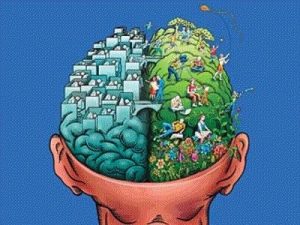
Understanding Cognitive Dissonance in relation to narcissistic abuse:
Stockholm syndrome involves the victim paradoxically forming a positive relationship with their oppressor; this is called “Trauma Bonding”. When victims of narcissistic are suffering from Stockholm Syndrome, they are often seen by outsiders as somehow having participated in some bizarre way that seems to support their abuse. However, to understand how the trauma bonding occurs, it is especially relevant to understand what is involved in the decision-making and problem-solving process of the victim. This theory is known as Cognitive Dissonance.
If therapists are to understand the behaviour of clients who have been victims of narcissistic abuse, then it is crucial for them to appreciate why the victim combines the two unhealthy conditions of Stockholm Syndrome and Cognitive Dissonance as part of their survival strategy. When these two strategies are in place, the victim firmly believes that their relationship is not only acceptable, but also vital for their survival. They become so enmeshed in the relationship with the abuser, that they feel that their world (mental and emotional) would fall apart if the relationship ended. This explains why they fear those people who attempt to rescue them from their abuser, and how this creates the victim to develop cognitive dissonance and become protective of their abuser.
What is Cognitive Dissonance?
Cognitive dissonance is a psychological term which describes the uncomfortable tension that results from having two conflicting thoughts at the same time, or from engaging in behavior that conflicts with one’s beliefs (Rational Wiki). Cognitive Dissonance is a communication theory that was published by Leon Festinger 1957, a theory that changed the way in which social psychology was to look at human decision-making and behaviour. The concept of cognitive dissonance is almost self explanatory by its title: ‘Cognitive’ is to do with thinking (or the mind); while ‘dissonance’ is concerned with inconsistencies or conflicts. Simply speaking, cognitive dissonance is the discomfort a person experiences whenever they are holding two conflicting ideas simultaneously (i.e. Shall I wear the red or the blue dress?). Naturally, people do not like the discomfort of conflicting thoughts; this theory proposes that when this happens, people have a motivational drive within them that allows them to rationalize and change their attitudes, beliefs, values and actions, anything that allows them to reduce or dissolve the dissonance they are experiencing (i.e Which makes my bum look smallest?) . When it comes to victims of abuse, there are several behaviours that a victim may use for reducing their cognitive dissonance. For a start they may try to ignore or eliminate it, or they may try to alter its importance, they may even create new cognitions, but most importantly they will try to prevent it from happening in the first place.
What part does Cognitive Dissonance play with victims of narcissistic abuse?
Victims living in a household where there is narcissistic abuse are living in a torturous war zone, where all forms of power and control are used against them (intimidation; emotional, physical and mental abuse; isolation, economic abuse, sexual abuse, coercion etc.). The threat of abuse is always present, and it usually gets more violent and frequent as time goes on. The controlling narcissistic environment puts the victim in a dependency situation, where they experience an extreme form of helplessness which throws them into panic and chaos. The narcissist creates a perverse form of relationship wherein the victim has no idea of what will happen next (alternating between acts of kindness or aggressive raging). This prolonged torturous situation is likely to trigger old negative scripts of the victim’s childhood internal object relations (attachment, separation and individuation). To survive the internal conflict, the victim will have to call on all their internal resources and defense strategies in order to manage their most primitive anxieties of persecution and annihilation. In order to survive, the victim has to find ways of reducing their cognitive dissonance, the strategies they employ may include; justifying things by lying to themselves if need be, regress into infantile patterns, and bond with their narcissistic captor. Most defense mechanisms are fairly unconscious, so the victim is unaware of using them in the moment; all they are intent on is surviving the madness they find themselves in.
As you can imagine, these states of mind throw the victim into any number of inner conflicts where defense mechanisms are called for, cognitive dissonance being one.
For example, a woman who is abused by her narcissistic spouse will hate the conditions she is living in. However with the real fear of a violent reprisal from her captor if she tried to leave, she will more likely choose to stay put. The cognitive dissonance shows itself through rationalization: On the one hand: she abhors her unhealthy relationship and all the abuse that goes with it; while on the other hand, she tells herself that he only fights with her because he loves and cares for her. This inner dialogue reduced her anxiety, allowing her to bond (Stockholm Syndrome) with her abuser, to the point that she will even protect him from the outside world if people attempt to rescue her or encourage her to leave. The result is that a massive draining conflict ensues between the person’s emotional self and their rational reasoning self. Their “cognitive dissonance” is a sign of the disharmony the victim is experiencing as a result of two conflicting ideas going on at the same time; i.e. the victim knows that they should get out of the abusive situation, but they also know that to do so will put them (and possibly their children) in great danger. While experiencing cognitive dissonance they may adopt a pattern of denial, diversion and defensiveness to control their discomfort. In the cognitive dissonance theory, the decision that decides which path the victim will take will be likely to be the path that causes the least emotional stress. In order to reduce the dissonance, the victim will choose the path of least resistance, and their motivational drive will support their beliefs and justify any decision that helps them stay safe. As you can imagine, the cognitive dissonance can lead to irrational decision making as the person struggles to reconcile these two conflicting beliefs. Researchers suggest that it is actually the cognitive dissonance that causes the victims to choose to stay put with their abuser. Furthermore, in order to support their seemingly irrational decisions to stay put in the abusive relationship, the victim makes heavy investments that almost cements them into the bad relationship forever.
There are six types of investment the victim may get embroiled in that helps to reduce their cognitive dissonance:-
Emotional Investment: Unable to get out of the relationship due to the fear of what will happen to them, the victim decides that they should stay, and see it through to the bitter end. The victim convinces themselves that “things are not that bad”, especially when the narcissistic abuser shows them acts of kindness. Their trauma bonding is interpreted as love. They use that love to feel compassion for their narcissistic abuser; they may even make excuses that their abuser suffered so much hurt and pain in their own childhood, that they cannot help the way they are. They convince themselves that by loving their abuser as much as possible they will heal their wounds, and then everything will be alright. They continue in this way, investing so much emotion in the relationship, (i.e. They shed so many tears, blaming themselves for upsetting their abuser, becoming responsible for their abusers feelings and behaviour. They worry for their abuser in case they harm someone and end up in jai. They even end up blaming themselves when there is another eruption (“I caused the upset, I should have known better”). They even go so far as to convince themselves that their abuser is the victim of society, and therefore must be protected from everybody.
Social Investment: The biggest social investment the victim makes is to the person nearest to them, their narcissistic abuser. The narcissist’s superiority will demand that they are the most important one in the relationship, and the victim (in time) will comply with that arrangement. It does not help that society in general has a matter-of fact attitude toward victims, they do not understand why a victim would stay in such an abusive relationship, let alone protect the abuser. This response can create a further helplessness within the victim, which leaves them feeling isolated and alienated. With a sense of damage to their pride, and deep feelings of shame, the victim begins to avoid further social embarrassment and uncomfortable situations, alienating themselves further with their abuser. Isolated, dependent and dis-spirited, the way is paved for more acceptance of the abuser, and the victim stays in the relationship. They become caught in a cycle with their abuser that involves a sequence of violent episodes, followed by an absence of battering, once again tension building, and finally tension escalating into another violent episode where they get hurt. Around and around it goes, and helplessly the victim looses all hope, so they settle for investing their loyalty there.
Family Investments: For a start, a narcissist is preoccupied in self investment, therefore they expect everybody to pamper to their false self (sadly their true self is in a state of atrophy). If the narcissist is a spouse, then the partner is going to have to invest heavily in their abuser until they are emotionally, mentally, physically and spiritually bankrupt. The narcissist requires perfect mirroring and stroking continuously, when they don’t get it, they withdraw (this withdrawal is likely to lead to danger for the victim). Step by step the supposed closeness is disappearing, and the victim experiences this as a great loss (and fear), seeing this, the narcissist feels a sense of power and control. In their withdrawal state, the narcissist is going to loose their sense of specialness, power and omnipotence, this makes them very susceptible to narcissistic injury. When there is narcissistic injury, the terror monster is released, and all of the family is likely to encounter their rage. All of this is going to evoke anxiety on the victimized partner, not just around their own safety, but also for the safety of the children. The narcissist suffers from a chronic evasive pattern that does not change. Just as the narcissist is demanding of its spouse, as a parent they are also very demanding of their children, (remember that everything is about them). They see the children as extensions of themselves, representing them in every aspect. For that reason they expect their children to be high achievers, the very best in every thing that they do. However, the child is faced with a dilemma; If the child comes second best in any task, they will be perceived as being “the first looser” by their narcissistic parent. Silver medals are not seen as a reason to celebrate, they are are more likely to be perceived as a disgrace (looser). If they came first, they risk triggering the narcissist’s jealousy and envy; for the narcissist, envy always involves a comparison – they envy that which they lack. When the child shines, its success is always somehow due to the narcissist itself, but when the child fails, the narcissist takes the failure personally (narcissistic wound), and they will punish the child, whether it be by word or deed. Living with a narcissistic parent, so often the child finds it hard to get their own needs meet, which can lead to serious emotional problems for them. Because the narcissist parent is like a child their own self, there will be power struggles for attention between the child and the parent. All these dynamics are going to put strain on the partner of the narcissist, and they are likely to be the butt of all the narcissist frustration and anger, which will manifest itself as rage. Investing everything they have in their narcissistic partner is the only way the victim finds to keep the family going.
Financial Investment: Narcissist typically seeks to control the family finances, money is a love substitute for them. No matter who earn the money in their family, it is they who are entitled to control how the monies get spent. Often the victim finds themselves being put on an allowance to run the house, and the abuser closely monitors how it is spent. If there is a shortage of money, the narcissist will be stingy when it comes to members of their family spending, yet they will spend what it takes to get what they want. Where possible, the narcissist creates a complex financial situation where everybody is dependent on them, this keeps them in control. Without financial means and usually alienated, many victims are unaware of support resources they may be entitled to, they are trapped by the situation, finding themselves waiting and hoping for a better financial situation to develop so that they can make their exit and detachment easier. In the meantime they do what they can to keep their abuser happy.
Lifestyle Investment: When the narcissist is successful, they will use a lifestyle as an investment. Because they need to display their “specialness” to the world, they will want to display all of their wealth trophies (Narcissistic Supply): the big house, car, private school, business etc. All these things contribute to getting them the praise and adulation they feel they deserve. For the victim, sharing in this financial security, they may fear loosing their current lifestyle for themselves or their children. So they stay because of their fear of the poverty trap that awaits them if they manage to leave.
Intimacy Investment: Narcissism is a personality trait associated with an inflated, grandiose self-concept and a lack of intimacy in interpersonal relationships. The narcissist perceives themselves as being unique and uncommon. Being intimate requires that two people operate commonly with openness and truth (True Self) so that they relate as “equals”. The narcissist operates from a False Self, and becoming equal with anybody would only negate their notion of uniqueness, so they avoid that entirely. Unknown to them, narcissists are still held ransom to their unresolved conflicts with their primary objects (parents). Like the child, they are still harboring the deep wounds of abandonment they experienced back then. Afraid of their own negative emotions, unconsciously, they promise themselves that they will never put themselves in that position again, and they avoid further narcissistic injury by holding everybody at bay, this includes their partner and children. Unfortunately, they too, like the rest of us, are susceptible to loneliness, which is why they are always on the look out for “narcissistic supply” for attention. When they have a partner, they separate the sexual from the emotional and treat their partner as a sex object, and the typical cycle of frustration-aggression is set in motion. Unfortunately, in love with their own reflection, they are incapable of loving anybody else. Where the partner thought she had married the nice Dr. Jekyll, she now finds herself facing the raging maniac that is Mr. Hyde. In such an unhealthy relationship, she will experience the destruction of her emotional and sexual self-esteem. He is not a good father, rather than love his children he abhors them (they take the mother’s attention away from him), so they are confined to the role of being another narcissistic supply source. Furthermore, they use a type blackmail of intimacy against their partner (threatening to tell intimate detains about them that would humiliate and destroy their character). The partner finds themselves in a hopeless situation, broken, the only way out is for them to stay. This serves to send the message to the narcissist that they are truly unique and superior.
One would wonder how the victim tolerates living with an abuser who is so intolerant and hostile? For healthy relationships, tolerating intolerance is neither acceptable nor possible, but for the victim of narcissistic abuse it is vital for survival. Finding themselves in such an intolerable situation, the victim must calm the cognitive dissonance that rocks their self-esteem and self worth. The Dissonance Theory allows the victim to make their choice (even if it means lying to themselves), and gives them a way to justify that they can be happy about not making the opposite choice that would surely put them in danger. Once the choice is made and the cognitive dissonance calmed, the victim has all sorts of tools (unconscious defense mechanism) at their disposal to bolster their decision to stay in the relationship (i.e. Stockholm Syndrome, Infantilism, Trauma Bonding).
CLICK HERE FOR THIS GREAT RESOURCE!
Labels: cognitive dissonance, emotional, emotional rape, family, financial, investment, narcissism, narcissist, obsessive thinking, stockholm syndrome, trauma bonding
Thursday, October 25, 2018
Abuse is More Than Physical
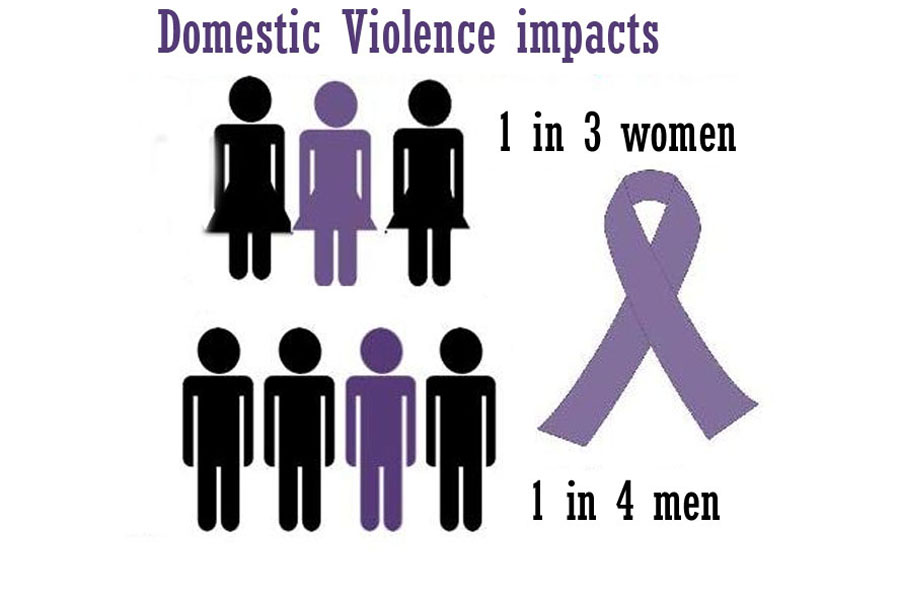
When the general public thinks about domestic violence, they usually think in terms of physical assault that results in visible injuries to the victim.
This is only one type of abuse.
There are several categories of abusive behavior, each of which has its own devastating consequences. Lethality involved with physical abuse may place the victim at higher risk, but the long term destruction of personhood that accompanies the other forms of abuse is significant and cannot be minimized.
CONTROL
Controlling behavior is a way for the batterer to maintain his dominance over the victim. Controlling behavior, the belief that he is justified in the controlling behavior, and the resultant abuse is the core issue in abuse of women. It is often subtle, almost always insidious, and pervasive. This may include but is not limited to:
Checking the mileage on the odometer following her use of the car
Monitoring phone calls, using caller ID or other number monitoring devises, not allowing her to make or receive phone calls
Not allowing her freedom of choice in terms of clothing styles, makeup or hairstyle. This may include forcing her to dress more seductively or more conservatively than she is comfortable
Calling or coming home unexpectedly to check up on her. This may initially start as what appears to be a loving gesture, but becomes a sign of jealousy or possessiveness
Invading her privacy by not allowing her time and space of her own, reading her mail, computer communications or listening to her phone calls
Forcing or encouraging her dependency by making her believe that she is incapable of surviving or performing simple tasks without the batterer or on her own
Using the children to control the mother by using the children as spies, threatening to kill, hurt or kidnap the children, physical and/or sexual abuse of the children, and threats to call Child Protective Services if the mother leaves the relationship
PHYSICAL ABUSE
According to the AMEND Workbook for Ending Violent Behavior, physical abuse is any physically aggressive behavior, withholding of physical needs, indirect physically harmful behavior, or threat of physical abuse. This may include but is not limited to:
Hitting, kicking, biting, slapping, shaking, pushing, pulling, punching, choking, beating, scratching, pinching, pulling hair, stabbing, shooting, drowning, burning, hitting with an object, threatening with a weapon, or threatening to physically assault
Withholding of physical needs including interruption of sleep or meals, denying money, food, transportation, or help if sick or injured, locking victim into or out of the house, refusing to give or rationing necessities
Abusing, injuring, or threatening to injure others like children, pets, or special property
Forcible physical restraint against her will, being trapped in a room or having her exit blocked, being held down
The batterer hitting or kicking walls, doors, or other inanimate objects during an argument, throwing things in anger,destruction of property
Holding the victim hostage
SEXUAL ABUSE
Sexual abuse is using sex in an exploitative fashion or forcing sex on another person. Having consented to sexual activity in the past does not indicate current consent. Sexual abuse may involve both verbal and physical behavior. This may include, but is not limited to:
Using coercion, guilt, or manipulation.
Not considering the victim's genuine desire to have sex. This may include making her have sex with others, have unwanted sexual experiences, or be involuntarily involved in prostitution
Using her circumstances to lure her into an inappropriate relationship
Exploiting a victim who is unable to make an informed decision about involvement in sexual activity because of being asleep, intoxicated, drugged, disabled, too young, too old, in an already abusive relationship or dependent upon or afraid of the perpetrator
Laughing or making fun of anther's sexuality or body, making offensive statements, insulting, or name-calling in relation to the victim's sexual preferences/behavior
Making contact with the victim in any nonconsensual way, including unwanted penetration (oral, anal or vaginal) or touching (stroking, kissing, licking, sucking or using objects) on any part of the victim's body
Exhibiting excessive jealousy resulting in false accusations of infidelity and controlling behaviors to limit the victim's contact with the outside world
Having affairs with other people and using that information to taunt the victim
Making fun of or being judgmental or nasty to the victim during sex
Withholding sex from the victim as a control mechanism
EMOTIONAL ABUSE AND INTIMIDATION
According to the AMEND Workbook for Ending Violent Behavior, emotional abuse is any behavior that exploits anther's vulnerability, insecurity, or character. Such behaviors include continuous degradation, intimidation, manipulation, brainwashing, or control of another to the detriment of the individual(AMEND 3). This may include but is not limited to:
Insulting or criticizing to undermine the victim's self-confidence. This includes public humiliation, as well as actual or threatened rejection
Threatening or accusing, either directly or indirectly, with intention to cause emotional or physical harm or loss. For instance, threatening to kill the victim or himself, or both
Using reality distorting statements or behaviors that create confusion and insecurity in the victim like saying one thing and doing another, stating untrue facts as truth, and neglecting to follow through on stated intentions. This can include denying the abuse occurred and/or telling the victim she is making up the abuse. It might also include crazy making behaviors like hiding the victim's keys and berating her for losing them.
Consistently disregarding, ignoring, or neglecting the victim's requests and needs
Using actions, statements or gestures that attack the victim's self-esteem and self-worth with the intention to humiliate
Telling the victim that she is mentally unstable or incompetent
Telling her its "her own fault"
Forcing the victim to take drugs or alcohol
Not allowing the victim to practice her religious beliefs, isolating her from the religious community, or using religion as an excuse for abuse
Using any form of coercion or manipulation which is disempowering to the victim
ISOLATION
Isolation is a form of abuse often closely connected to controlling behaviors. It is not an isolated behavior, but the outcome of many kinds of abusive behaviors. By keeping her from seeing who she wants to see, doing what she wants to do, setting and meeting goals, and controlling how she thinks and feels, he is isolating her from the resources (personal and public) which may help her to leave the relationship.
By keeping the victim socially isolated the batterer is keeping her from contact with the world which might not reinforce his perceptions and beliefs. Isolation often begins as an expression of his love for her with statements like if you really loved me you would want to spend time with me, not your family.
As it progresses, the isolation expands, limiting or excluding her contact with anyone but the batterer. Eventually, she is left totally alone and without the internal and external resources to change her life.
Some victims isolate themselves from existing resources and support systems because of the shame of bruises or other injuries, his behavior in public, or his treatment of friends or family.
Self-isolation may also develop from fear of public humiliation or from fear of harm to herself or others. The victim may also feel guilty for the abuser's behavior, the condition of the relationship, or a myriad of other reasons, depending on the messages received from the abuser.
VERBAL ABUSE: COERCION, THREATS, BLAMING
Verbal abuse is any abusive language used to denigrate, embarrass or threaten the victim. This may include but is not limited to:
Threatening to hurt or kill the victim or her children, family, pets, property or reputation
Name calling ("ugly," "bitch," "whore," or "stupid")
Telling victim she is unattractive or undesirable
Yelling, screaming, rampaging, terrorizing or refusing to talk (the 'silent treatment')
Threatening to take victim's children from her
USING MALE PRIVILEGE
As long as we as a culture accept the principle and privilege of male dominance, men will continue to be abusive. As long as we as a culture accept and tolerate violence against women, men will continue to be abusive.
According to Barbara Hart in Safety for Women: Monitoring Batterers' Programs:
All men benefit from the violence of batterers. There is no man who has not enjoyed the male privilege resulting from male domination reinforced by the use of physical violence. . . . All women suffer as a consequence of men's violence.
Battering by individual men keeps all women in line. While not every woman has experienced violence, there is no woman in this society who has not feared it, restricting her activities and her freedom to avoid it. Women are always watchful knowing that they may be the arbitrary victims of male violence.
Only the elimination of sexism, the end of cultural supports for violence, and the adoption of a system of beliefs and values embracing equality and mutuality in intimate relationships will end men's violence against women.
Domestic violence is about power and control. A feminist analysis of woman battering rejects theories that attribute the causes of violence to family dysfunction, inadequate communications skills, women's provocation, stress, chemical dependency, lack of spiritual relationship to a deity, economic hardship, class practices, racial/ethnic tolerance, or other factors.
These issues may be associated with battering of women, but they do not cause it. Removing these factors will not end men's violence against women.
Batterers behave abusively to control their partner's behavior, thereby achieving and maintaining power over their partners and getting their own needs and desires met quickly and completely.
There are also many secondary benefits of violence to the batterer. A batterer may choose to be violent because he finds it fun to terrorize his partner, because there is a release of tension in the act of assault, because it demonstrates manhood, or because violence is erotic for him. Violence is a learned behavior and batterers choose to use violence. The victim is not part of the problem.
The victim may accept responsibility for causing the batterer to lose their temper, but the truth is, the abuser must be held accountable for his behavior.
Four widespread cultural conditions allow and encourage men to abuse women. These are:
Objectification of women and the belief that women exist for the "satisfaction of men's personal, sexual, emotional and physical needs" (includes such things as using 'love' as a coercion method; the use of prostitutes; use of guilt; use of marital 'obligation')
An entitlement to male authority with a right and obligation to control, coerce, and/or punish her independence
That the use of physical force is acceptable, appropriate, and effective
Societal support for his dominance, controlling and assaultive behavior. By failing to intervene aggressively against the abuse, the culture condones the violence
ECONOMIC ABUSE
Financial abuse is a way to control the victim through manipulation of economic resources. This may include, but is not limited to:
Controlling the family income and either not allowing the victim access to money or rigidly limiting her access to family funds. This may also include keeping financial secrets or hidden accounts, putting the victim on an allowance or allowing her no say in how money is spent, or making her turn her paycheck over to him
Causing the victim to lose a job or preventing her from taking a job. He can make her lose her job by making her late for work, refusing to provide transportation to work, or by calling/harassing/calling her at work
Spending money for necessities (food, rent, utilities) on nonessential items (drugs, alcohol, stereo equipment, hobbies)
Material from Women's Center and Shelter of Greater Pittsburgh Volunteer Training Manual, AMEND, and the AzCADV safety plain Manual were used to develop this section.
ORIGINAL HERE
(note: women can be just as abusive as men)
Labels: abuse, coercion, emotional, financial, guilt, intimidation, misogyny, sexual, types
Wednesday, June 06, 2018
Diagnosis of the Victim / Types of Abuse

In some cases it is seen that the abused partner becomes abused because it happened in her own childhood, so she is ready to accept it in the marriage. It is repetition of familiar events. In some instances the wife had a father who was indifferent, cold, often absent and often angry when present. She may not remember a single time when he hugged her – so distant was the relationship. These scenarios make her an easy victim to abuse by her husband. Women are abused and they are blamed as being the cause for that abuse. It is the worst kind of persecution. How does the victim feel? She feels hurt because he is hurting her. She feels like nothing because he is making her feel like nothing. She feels ignored because he is ignoring her – her thoughts and her feelings. She feels ridiculed because he ridicules her on a regular basis. She feels closed off, ex-communicated because he does it to her. Sometimes he causes the entire family to ex-communicate her. Whatever she expresses to her husband, he will invalidate it, he will scoff, he will discount it, he will deny it and he will oppose it. She has no self-esteem because he destroys it every chance he gets.
In a balanced and mutually loving relationship, there is the following scenario: both will love to hear the other’s thoughts. Both will express enthusiasm and delight in the other’s enthusiasm. Both will open their hearts and souls to the other. Both will nurture the other’s physical, intellectual and spiritual growth. Both will help the other. Both will live peacefully and let the other live in peace. Evans says that the wife has the right to expect respect, dignity, esteem, appreciation, warmth, empathy, an open communication, attentiveness, caring and equality in the relationship.
Generally, the wife (meaning, the victim) always blames herself for all the problems. She does this because he is telling her that she is to blame and she believes him. She believes she is not expressing herself well enough. She feels she is inadequate in every way. It is due to his endless accusations. What is noteworthy is that the more the wife gives up on getting any closeness from her husband, and the more she finds friends outside the marriage for companionship, the angrier and more abusive her husband becomes. Due to jealousy, due to his personal insecurities, he cannot tolerate that she becomes happy through other, albeit completely innocent friendships.
Let us again summarize what are the typical traits we can identify in the victim of an abusive relationship. She ceases to be spontaneous. She loses her enthusiasm for life. She is always on guard. She has lost her self-confidence and is often afraid to speak in public or to anyone outside the family, because she has been attacked so many times inside the family for what she has said. She is full of self-doubt. At times she may feel she is going crazy. She is deeply confused as to why her marriage is not a happy marriage. She feels sometimes like running away but due to her now completely codependent nature she is afraid to take the step. If the present relationship ever ends, she will be afraid or even terrified to begin a new relationship. These are the traits of an abused woman, of a victim.
Eventually, the wife feels a constant shame and humiliation at his treatment of her. Eventually he abuses her anywhere, even in front of their friends, work colleagues, at religious functions, and in public places. Her shame becomes unbounded. With this kind of humiliation, she begins to reach a breaking point, and all this while sometimes still not realizing why this is happening – that she is a victim of now extreme verbal violence. There is no other word for it. Daily a minimum of four women are murdered by their husbands in the U.S. But, in all these cases, verbal abuse preceded the physical abuse. It never happens that physical violence starts suddenly without any precedent. The first step in the sequence of violence is verbal abuse and ridicule that escalates to verbal violence, which further moves on or has the potential to move on to the physical level at any point thereafter.
Beverly Engel in her book, The Emotionally Abused Woman: Overcoming Destructive Patterns and Reclaiming Yourself, describes six categories of abused women. They are: (1) the selfless woman, (2) the pleaser, 3) the sinner or people who abuse themselves, (4) the codependent or the obsessive rescuer, (5) the drama junkie or people addicted to crisis situations, and (6) the victim or martyr.
In cases where the husband is highly educated, it becomes even more difficult for the wife to extricate herself from his clutches. His education serves to completely intimidate her and it becomes a simple matter to convince her that he is a logical, rational man speaking with his superior intellect, backed up by higher degrees. How many wives will have the self-esteem or the moral courage to object to torturous verbal abuse coming from such an educated man?
********************
Economic Abuse
One lady’s husband refused to let her have a checkbook, saying men should take care of the money. She said, If a woman (or her husband) is in a high economic bracket, and she complains about not having any money, that she is penniless, we should be alert. Some complain, but far more do not tell due to shame. Some husbands will never confide in their wives regarding financial matters, will be secretive for the entire marriage, will not tell them their salary, will always give the impression they are poor or broke, will force the wife to spend any money that she may have – either earned or inherited, and will give her pittance to cover household operating expenses, forcing her to grovel and beg him for more – which then gives him the chance to say, ‘All she wants is my money.’ It is clear economic exploitation. If a woman tries to question such a man, he will react in anger, thus making the subject a taboo one for life. Can one blame a wife then if she begins to steal from his wallet to obtain enough for basic necessities – instead of having to grovel again and again? Some women have families to assist them in these situations. But other women have no one, making them completely dependent on this economically abusive husband. It is a terrible situation. He purposely doles out the money in such meager amounts that she has no option but to begin begging for more. This gives him the chance to further humiliate, deride and scorn her for begging. Today there are all situations in the society.
In some divorces, the wives make millions from their marriages. In other cases, they end up penniless. It is typical for economic abusers to compel their wives to deposit their earnings into his account. He tells her that he will handle the money. Maybe he tells her it will be easier to keep track of the balance that way. Or he may tell her that she’s not responsible enough to manage a checking account. Surprising that she is responsible enough to earn the money but not mature enough to manage it! Economic abusers generally want their wives to work and earn money, so that they can increase their own wealth. Such men will easily tell their wives that if they don’t ‘behave’, they will cut them off – kick them out of the house without a penny, without food, without clothes. What can such women do? What is the alternative for these women? It must appear to them as a very dark abyss without any escape.
According to Dr. Mary Miller, women are able to adapt more easily to economic abuse as compared to social, emotional and psychological abuse. Resourceful women in these circumstances will steal money here and there, praying their husband will not notice.
Psychological Abuse
“The most powerful weapon in the hands of an oppressor is the mind of the oppressed.” -- Steve BikoThe goal of psychological abuse is to undermine the wife’s security. Hence, cause will not lead to effect. The wife finds herself in a senseless, unpredictable environment created by the husband to confuse and terrify her. He will give her mental torture for days and weeks on end, and then suddenly bring her a bouquet of flowers. He will often tell her how lucky she is to have him, as otherwise she would be on the road or in a mental hospital. The tactics used by husbands to torture and control their wives are very similar to those used in brainwashing prisoners. Psychological abuse means, he will call her a slut, a bitch, a fat pig, or a whore again and again. If she makes any small mistake, he will maximize it into a big fight. Slowly she becomes convinced that she really is a slut, if not also a bitch and a whore. She loses all sense of self-worth.
Perhaps what is most common among such husbands is that invariably they convince their wives that they are dumb. The essential purpose of psychological abuse is to convince the woman that (1) she is stupid and incapable of doing anything, (2) she is a failure as a wife and mother, (3) she is innately immoral, and (4) she is essentially sinful. All of this is designed to reduce the wife to complete psychological dependence on the man. Such men are often educated but emotionally immature and hence unable to deal with a vibrant, dynamic woman. This image of the woman as strong is something he is determined to wipe out. This is why even when the wife is totally subservient, when the husband perceives the wife acting like a confident, mature adult, he erupts in psychological violence to reduce the wife to a terrified, guilt-ridden child.
It is very sad to see the survivors of such marriages – they have escaped their oppressor but the inferiority complexes he instilled remain embedded in the minds of the now physically free wives. He alternates verbal abuse with gentleness, wrath with caring, so as to constantly confuse her until she fully submits to his will. Due to daily abuse from their husbands, tormented wives far more often suffer from mental depression and poor physical health. What abused wives need more than anything else are kind people who tell them they are good, not bad. Who tell them they are (internally) beautiful, not ugly. Who tell them they are sane, not insane. They need continual praise and encouragement so that slowly these victims regain a sense of identity, begin to realize that they have some existential value, that they can love people without being tortured in return, that they can accomplish great and noble deeds in life. Gradually the victim will understand that it was not she who was insane; it was her husband who was insane in his treatment of her. Due to their own suffering, such women are in a prime position to serve others who are suffering, regardless of the cause of that suffering. Often they will relate to all human beings who are oppressed and suppressed and try their best to help them. This psychological abuse is often interwoven with emotional abuse.
Moral Abuse – Guilt Trips and Emotional Blackmail
Moral abuse is abuse of one’s character. It convinces the victim that she is immoral or guilty of known and unknown crimes. The abuser convinces her that she is innately selfish and does not deserve to be well treated by him. The way in which this is done is by continually using every opportunity to fill the wife with guilt. According to Dr. Susan Forward,
“…emotional blackmail is a powerful form of manipulation in which people close to us threaten, either directly or indirectly, to punish us if we don’t do what they want. At the heart of any kind of blackmail is one basic threat, which can be expressed in many different ways: If you don’t behave the way I want you to, you will suffer.”Dr. Forward describes a pattern that is repeated in cases of emotional abuse. First he makes a demand. Second, she offers some resistance. Third, he puts pressure. If he continues to meet with resistance, he makes threats. She doesn’t want to lose him. So the fifth stage is her compliance. And finally, this cycle repeats itself over and over, because it works! Forward likewise describes emotional abuse or blackmail by using the acronym FOG. Fear, obligation, guilt. The husband instills these three emotions into his wife by one means or the other, and she is at his command.
Fear, and fear of abandonment are in many people, and especially in women. The man needs to only touch on this fear and he can exploit it any time. If there is no recent mistake the wife has made, then the husband will bring up anything at all from the past to throw in her face and riddle her with guilt. I knew one man who, after 34 years of marriage, told his wife that she was still in love with someone she knew 36 years before – before the marriage. It was a great crime in his mind that there was somebody else before she had met him. He convinced her also that it was a great crime. His sole sick purpose was to riddle her with guilt.
Dr. Forward further describes four main types of emotional blackmailers. There are punishers, who are of two types: active punishers who make constant threats, and passive punishers who use the silent treatment. There are self-punishers, who turn the threats inward, emphasizing what they will do to themselves if they don’t get their way. Such men will threaten suicide, quitting their job. There is the sufferer. This is the person who constantly complains of his own misery and suffering. This husband will also constantly remind the wife that she is responsible for his personal suffering.
Finally there are the tantalizers. These are men who try and bribe their wives into doing what they want. Blackmailers will continually remind their wives that they themselves are wise and well-intentioned while the wives are the ‘bad guys’. The husband constructs an unreal story detailing the history of their relationship. Due to constant repetition of this story, the wife begins to accept his lies as truth.
These husbands spend their marriages minimizing their own wrong actions, denying their mistakes and blaming all problems in daily life on their women. I remember one woman who took her husband to visit her aged father, a former professor. For everything the father said, her husband would argue and contradict. Her father put him coolly in his place. After leaving, she had to bear punishment for nearly one year from her husband who almost daily would have rages, shouting at her about how badly he had been treated by her father. Though this was highly abnormal conduct, she still did not realize it. She only realized that she suffered and did not understand the reason.
Amnesty International has published a “Chart of Coercion” which outlines eight types of conduct that a controller engages in for gaining control of another person, as follows:
1. Isolation: This removes a woman’s support system, setting her up for easy brainwashing.
2. Monopolization of perception: It means eliminating outside phone calls, activities and even TV shows which would give the wife glimpses of ‘normal’ life and enable her compare it with her own.
3. Induced debility: He overworks her and allows her less sleep, as it also wears down her resistance.
4. Threats: They keep her in perpetual fear.
5. Occasional indulgences: These keep the woman confused and hopeful and in his control.
6. Demonstrating omnipotence: He can hide the car keys, deny her any money, lock the long-distance phone facility or refuse to eat her food – all to demonstrate his all-powerful control over her.
7. Degradation: It means near daily drilling into her head that she is fat, stupid, ugly, without any skills or talents, so that her self-esteem drops to nil, and she gets convinced that she doesn’t deserve better treatment. After years of this kind of abuse, when occasionally someone comes along and does a simple kindness like present her with flowers or offer praise for her cooking or hard work, she becomes overwhelmed and cries uncontrollably. Long after she has left him, his daily slander, brainwashing and hurling insults over her fatness, stupidity and worthlessness have left an indelible, near incurable stamp on her mind from which it takes years or a lifetime to recover.
8. Enforcing trivial demands: By doing this, he is conditioning her to obey bigger demands.
Emotional Abuse
The bottom line is, she could never do enough. He was always unhappy with her. Her husband abused her emotionally, verbally, by humiliating her. To criticize and refuse to eat the food cooked by his wife is a clear example of emotional abuse. From there he would add other things like telling her she is too dumb to do anything right. Or he would constantly run her down for gaining weight. Later he may begin accusing her of having a lover, and may start stalking her whenever she goes out.
In such cases, if the woman works, it will be a tremendous relief for her to get out and reach the office, where smiling faces and kind people are there to surround her. She will often not understand why the workplace seems like heaven and the home like a living hell. However the husband will often start social abuse by talking to her boss and yelling at her colleagues or even making private visits to the homes of his wife’s friends to discuss the wife’s failings and mental instability. The husband will say that he is doing this merely to help solve the situation when all along his real intention is purely sadistic. This can cause friends to avoid or judge the wife, which causes her deep emotional pain. Then with relish the husband will tell the shamed wife that no one likes her, that she cannot maintain any lasting friendship with anybody. The husband will say this in a way calculated to emotionally hurt the wife. This will reduce the wife to chaotic sobbing and will eliminate any outside competitors to the husband’s emotional resources that the wife represents.
All of the other types of abuse discussed here can be viewed as means of emotional violence. Joan Zorza, director of the National Center on Women and Family Law, has noted that while women in shelters will talk easily about their broken noses, black eyes and swollen faces, it is when the talk turns to the emotional abuse that they break down sobbing, becoming riddled with feelings of worthlessness and ‘badness’ – all the ideas their spouse has been feeding them for years. Often the husband will convince the wife that she is crazy or has psychological problems, and then he takes concrete steps to prove it. Such an abuser – emotional or physical – will fight hard against his wife divorcing him, because he cannot bear to lose the control. He will tell the judge that he loves her. But, this ‘love’ will be in total contrast to his conduct, which tells the real story. The real story is, he was an emotional bully. This was the role he played in the life of his wife. Typically, such men will make mountains out of molehills. It is a clear warning to a woman that something is not right in the marriage, that something is wrong with the man. It starts over the smallest of issues, and then his anger grows into rages. The result of emotional abuse is that women lose their integrity and their dignity. They lose their self-respect.
Emotional abuse is inflicted not merely to reduce a woman to a state of psychological dependency, but for the sadistic purpose of emotional violence. Hence emotional abuse like physical abuse is done not merely to protect one’s ego but because of the pleasure the emotional violence brings. Emotional violence is designed simply to use intimate knowledge of the wife’s heart to commit emotional battery. Emotional violence, like physical violence, very easily spirals out of control because like physical violence it is so easy to do and the results are so immediate. Here the goal is simply to inflict emotional pain. This is the reason why emotional abuse along with physical abuse is the most destructive form of abuse. The goal here is to eliminate the existence of the wife emotionally as a separate being with rights and dignity.
The wife facing this violence on a daily basis is deprived of any real existence emotionally except as a resource for the husband’s emotional needs. Thus using emotional violence the husband eliminates any sense of responsibility towards the wife as a separate emotional entity with rights and needs, because by his emotional beating she is stripped of all self-identity. What women need to realize is that just like the bullies on the school-ground who used to beat up the weak boys in class, emotional bullies are in reality emotional cowards. Confident people have no need to bully others. Cowards do, because it makes them feel big and strong temporarily.
Materialists reduce the human psyche to a bundle of sensations, thoughts and emotions. Just like materialism is always connected with imperialistic conquest of other peoples and their lands, so the reduction of the wife to merely a collection of physical and emotional services is essentially a form of domestic imperialism. It is important to understand that emotional violence, even if not accompanied by physical violence, is an innate evil just as much as macro-imperialism is. Hence fighting against emotional violence in the home is just as much a required human duty as protesting imperialism in the global home.
Fighting against emotional violence through awareness programs must forcibly remind abusers that no one has the right to inflict emotional violence on another human being and that just as we can no longer commit physical violence behind closed doors, so also will society no longer tolerate emotional violence behind closed doors. It is especially important that young people be taught a zero tolerance attitude towards emotional violence.
Social Abuse
Social abuse comprises of slandering, shaming, ostracizing and isolating the wife from her close family members and friends. The husband will not allow her to even speak to them on the phone, let alone see them. He will ridicule and deride her relatives, calling them every name he can think of, insulting their characters or personal habits, making up slander about them. One can call it called family-bashing. This is the definition of social abuse. Some women live completely isolated, always in the house, speaking to no one except their husband and children, for ten, fifteen or twenty years – nearly their entire adult life. Is it not similar to the life of a prisoner? Yet, if she expresses reluctance to mix with the husband’s ‘friends’, he will attack her forthwith and call her anti-social.
Only rarely, if it is financially required, will such a husband allow his wife to work, where she has the chance to escape her virtual prison. Still more rarely will he allow her to develop herself intellectually by taking courses. If such a wife gets the chance to do either, she lives in a world of heaven and hell – hell at home and heaven for the few hours she can escape the home. Isolation is a horrible weapon wielded by men to make their women desperate and helplessly dependent on the one person in their life – their abuser. He forces her to retreat not only from her family members but from the entire community of human beings. Another tactic used by abusers is to bring in other people – family members, friends, anyone – and use them to outnumber his already exhausted victim on issues of conflict.
It is common in some Middle Eastern and Asian countries when men leave for work to lock their women inside the house from the outside. It is shocking, however, to find out while doing research into domestic violence that here in this advanced, supposedly more civilized United States there are some husbands who also their lock their wives inside the house while they are out! They may also make sure she has no car, thus increasing her dependence and immobility.
One of the tactics of death squads throughout history, be they in medieval Spain, communist China, or fascist Guatemala, is to initiate ordinary people into the practice of killing victims. The victims are condemned in Spain as devilish Jews, in China as American capitalist agents, in Guatemala as Cuban communist agents. By making everyone a part of the process of violence they hope that everyone will be so shamed by guilt that their crimes will never be punished. On a micro-social scale this is exactly what abusers do to their wives through society.
There are different stages that relatives, friends and especially children go through as part of the drama of social abuse. They act (1) as witness to abuse, (2) as partial participant in the abuse (starting with jokes), (3) as a convert to the belief that the victim is innately stupid, evil, immoral, and (4) as an even more violent abuser than the husband himself. The end result for those who may only reach stage (1), is that they will try to block out the memory of the social abuse, thus ensuring that any kind of help or justice for the victim remains an impossible dream.
“It killed me having to ask for a few dollars to go marketing or buy the kids shoes – like a beggar. But that’s the way it was….. I tried not to notice how he made fun of opinions I expressed on anything, whether it was politics or an author… From the very beginning, if (he) didn’t get his way, he would make me pay. Sometimes he wouldn’t talk to me for weeks or wouldn’t eat, even when I cooked his favorite dinner, and believe me, I tried. Oh, how I tried!”
FROM: Wife Abuse: Breaking It Down and Breaking Out by Garda Ghista
Labels: abuse, emotional, financial, sexual, verbal abuse, victim
Thursday, May 17, 2018
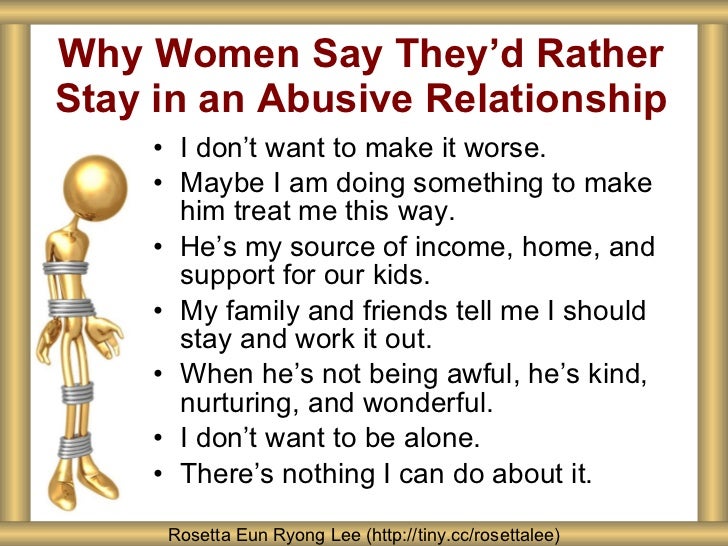
Why Women Stay
Situational Factors
Economic dependence. How can she support herself and the children? Fear of greater physical danger to herself and her children if they try to leave.
Fear of being hunted down and suffering a worse beating than before.
Survival. Fear that her partner will follow her and kill her if she leaves, often based on real threats by her partner.
Fear of emotional damage to the children.
Fear of losing custody of the children, often based on her partner's remarks.
Lack of alternative housing; she has nowhere else to go.
Lack of job skills; she might not be able to get a job.
Social isolation resulting in lack of support from family and friends.
Social isolation resulting in lack of information about her alternatives.
Lack of understanding from family friends, police, ministers, etc.
Negative responses from community, police, courts, social workers, etc.
Fear of involvement in the court process; she may have had bad experiences before.
Fear of the unknown. "Better the devil you know than the devil you don't."
Fear and ambivalence over making formidable life changes.
"Acceptable violence". The violence escalates slowly over time. Living with constant abuse numbs the victim so that she is unable to recognize that she is involved in a set pattern of abuse.
Ties to the community. The children would have to leave their school, she would have to leave all her friends and neighbors behind, etc. For some women, it would be like being in the Witness Protection program--she could never have any contact with her old life.
Ties to her home and belongings.
Family pressure; because Mom always said, "I told you it wouldn't work out." or "You made your bed, now you sleep in it."
Fear of her abuser doing something to get her (report her to welfare, call her workplace, etc.)
Unable to use current resources because of how they are provided (language problems, disability, homophobia, etc.) Time needed to plan and prepare to leave.
Emotional Factors
Insecurity about being alone, on her own; she's afraid she can't cope with home and children by herself.
Loyalty. "He's sick; if he had a broken leg or cancer--I would stay. This is no different."
Pity. He's worse off than she is; she feels sorry for him.
Wanting to help. "If I stay I can help him get better."
Fear that he will commit suicide if she leaves (often he's told her this).
Denial. "It's really not that bad. Other people have it worse."
Love. Often, the abuser is quite loving and lovable when he is not being abusive.
Love, especially during the "honeymoon" stage; she remembers what he used to be like.
Guilt. She believes--and her partner and the other significant others are quick to agree-- that their problems are her fault.
Shame and humiliation in front of the community. "I don't want anyone else to know."
Unfounded optimism that the abuser will change.
Unfounded optimism that things will get better, despite all evidence to the contrary.
Learned helplessness. trying every possible method to change something in our environment, but with no success, so that we eventually expect to fail. Feeling helpless is a logical response to constant resistance to our efforts. This can be seen with prisoners of war, people taken hostage, people living in poverty who cannot get work, etc.
False hope. "He's starting to do things I've been asking for." (counseling, anger management, things she sees as a chance of improvement.)
Guilt. She believes that the violence is caused through some inadequacy of her own (she is often told this); feels as though she deserves it for failing.
Responsibility. She feels as though she only needs to meet some set of vague expectations in order to earn the abuser's approval.
Insecurity over her potential independence and lack of emotional support.
Guilt about the failure of the marriage/relationship.
Demolished self-esteem. "I thought I was too (fat, stupid, ugly, whatever he's been calling her) to leave."
Lack of emotional support--she feels like she's doing this on her own, and it's just too much.
Simple exhaustion. She's just too tired and worn out from the abuse to leave.
Personal Beliefs
Parenting, needing a partner for the kids. "A crazy father is better than none at all."
Religious and extended family pressure to keep the family together no matter what.
Duty. "I swore to stay married till death do us part." Responsibility. It is up to her to work things out and save the relationship.
Belief in the American dream of growing up and living happily ever after.
Identity. Woman are raised to feel they need a partner--even an abusive one--in order to to be complete or accepted by society.
Belief that marriage is forever.
Belief that violence is the way all partners relate (often this woman has come from a violent childhood).
Religious and cultural beliefs.
(from the Rural Women's Advocacy Program)IF you can get to a Domestic Violence Center they can help with resources and a plan to help you get out (you do NOT have to live at the Shelter) CLICK HERE
Labels: emotional abuse, fear, financial, learned helplessness, no help, psychological, stockholm syndrome