Sanctuary for the Abused
Tuesday, April 26, 2022
Abuser As Slanderer

by Kathy Krajco
On their way through life, narcissists leave a trail of trashed good names in their wake. This is a serious problem in the workplace, for narcissists often destroy the careers of their betters. Narcissistic managers and administrators often are serial bullies, who destroy the career and credibility of anyone who doesn't participate in a lynching and therefore is a threat to blow the whistle.
The narcissist is a slanderer partly to get attention. But he is a slanderer mainly because he must be one to create his phony image. He makes himself look good by making others look bad.
Yet narcissists are not the only people who create a false image of themselves. If you want to call it close, virtually everybody does, even that paragon of honesty, Prince Hamlet. In a world that surrounds us with the prying eyes of fault-finders, we would be traitors to ourselves if we were not at least modest about the things we should be ashamed of. Especially insofar as they are none of anybody else's business. In fact, it's a virtue to keep what's private private. It is the moral equivalent of wearing clothes.
Yet narcissists are different: they are hypocrites = for looks only. They think a thing ain't wrong if they get away with it. In other words, they confuse appearances with reality. Consequently, they have no conscience — just an unconscience. That is, they repress their conscience. Hence, what they do in the dark is shockingly different than what they do in the light of day. These are the people who put make-up on their image a little too thick in spots.
....they confuse appearances with reality
Since it's all about their image, as Hamlet's mother said, they view sin as some kind of taint instead of as moral illness, or spiritual dis-ease. This is what gives them the notion that it can be "washed away" or smeared off. No wonder that, to get rid of it, they project instead of repent.
Projection is the Oldest Trick in the Book.
Magicians call it "misdirection." The Serpent pulled it on Eve when he accused God of being the liar. ("God told you THAT?") Stupid Eve should have looked at the other end of that pointed finger for the liar. As St. Paul does when he says that if somebody condemns others of being [fill in the blank], you can bet your bippy that he is one himself. Sometimes in a different way, but always at least the moral equivalent of one.* Paul was in line with the ancient Hebrew scriptures. Their name for the spirit in which people do this is satan, which means the "finger-pointer," the "name-slayer" (slanderer), the "prosecutor/persecutor," or the "accuser." In some places (e.g., the Book of Job) they also call him "the policer of the world." Which makes me wonder why religious leaders think that condemning these and those for this and that all the time is a good deed. This trick still works great today: I know of one narcissist who was a pedophile and for many years kept people from noticing the glaring warning signs in his own behavior by spreading rumors about one single teacher after another at his school. (He, of course, was married.)
* An example of what I mean by moral equivalence: Mr. Self-Righteous union-busts to keep the workers in his shoe factory so poor they go barefoot — and shows moral indignation in loudly condemning his neighbor for "muzzling an ox trampling the grain."
The rules about projection are in the Book of Leviticus, prescribed in the ritual for the Day of Atonement. Christianity has inherited them. The scapegoat must be the cleanest, most perfect potential victim available, the one with the most potential to do well in the world. (Sloppy thinking has twisted the meaning a full 180 degrees: these ugly demonstrations of the human race in action, symbolically performed by abominable cruelty to an animal, were intended to shame us. Not to prescribe this travesty of justice as the way to purify ourselves and win salvation from justice.)
The worst thing about projection is that mud sticks best to a clean spot.
I'm sure that people who do this think they're clever, but it's childsplay. Send a muddy child into an unsupervised school yard and wait to see what happens. He will rub himself off on every cleaner, smaller child he can find, till they are all crying and he looks good by comparison.
Looks good by comparison. Those are the all-important words. The hypocrite makes himself look good by comparison with others. He does that the easy way — by making others look bad. This is the root of envy. Which is not a rare motive for what people say about others. It's a common motive.
In a moment of self awareness, the hypocrite says, "Well, I may not be perfect, but I'm not as bad as others are." Then he instantly looks for somebody to make himself look better than = somebody to rub himself off on. And he's certainly smart enough to pick somebody pretty good to look better than!
So, narcissists are by no means alone in doing this. It's just that they invest so much energy in doing it. They are fixated on their image to the point that it is uppermost in their mind 100% of the time. In contrast, normal people project only when on the defensive. And then they're likely to shake themselves off on whoever happens to be near at the moment. So, their aim is poor, and sometimes they project a flaw off onto somebody who actually has it. But a narcissist's aim is impeccable.
For example, whom does he call a liar? The most honest person around.
Who does he say is dangerous? The savior of the group.Every single time. His talent for farce is so great that you could mistake him for astute.
Also, normal people have normal, human and loving relationships. So they don't smear themselves off on just anybody. They wouldn't dream of harming those near and dear. And they stick to slander (which has at least some degree of truth in it), rarely engaging in calumny (lies). When they do calumniate somebody, he or she is an enemy. Even then they don't go hog-wild and calumniate somebody so badly and so widely as to destroy them and ruin their lives. Not so with the narcissist. He is a child with no sense of measure or moderation. He loves only himself. He has no normal human relationships. He relates to people as objects. So he will smear himself off on his own children as thoughtlessly as we smear ourselves off on a towel. In fact, he is most likely to smear off on somebody he owes gratitude, because needing help damages his image. So he repays help as though it were an insult. He must devalue it by devaluing the giver of it, as if such a contemptible person is incapable of really helping somebody as grand as he.
he is most likely to smear off on somebody he owes gratitude, because needing help damages his image. So he repays help as though it were an insult.
Since he is a little child, the only reign on a narcissist's behavior is what he feels he can get away with. So, the more he gets away with, the more repressed guilt he has to purge himself of. The bad thing about repressed guilt is that it is an unconscious puppet master. Scripture calls it "the demon lurking at the door." The door being the way out, the escape, through repentance.
This could be why narcissists get worse with age. The load of repressed guilt they keep trying to purge themselves of (in a way that only dirties them more) gets so heavy that the wild accusations they make get viciouser and viciouser. It's as though they get drunk on blood.
They become living, breathing Projection Machines. Projection becomes such a knee-jerk reflex that a narcissist accuses his victim of doing to him the very thing (or essentially the same thing) as he is in the very act of doing to the victim. This creates bizarre scenes that make you wonder whether the narcissist is hallucinating or tripping out on psychedelic drugs. You feel like Alice in Wonderland. You have to pinch yourself and wonder whether "it's me or him that is crazy."
If you've ever thought that, congratulations. It means you're not. The narcissist never thinks that: he just accuses whoever he abuses of being the crazy one. (I said "crazy," not "insane." There's a difference.)
The narcissist never thinks [he's crazy]: he just accuses whoever he abuses of being the crazy one.
Another big difference between narcissists and normal people when they're projecting on you is that narcissists expect you to share their delusion. Yes! You cannot help but perceive this as gaslighting. Narcissists try to make you be what they say you are because, like a psychopath, they view you as an object, not as a human person with perceptions and a mind of your own.* They view you as an extension of themselves (like a tool) to control. It is the moral equivalent of the control a rapist thinks he has over the body of another, whom he views as but an object, an extension of himself, an executioner of HIS will. Psychologists call this bizarre behavior projective identification, a defense mechanism. The narcissist wants you to identify with the image he projects on you. You are a mirror to reflect his fantasy, so he pressures you to behave as though it is real.
* A narcissist's need to conform you to his or her specifications can go to bizarre extremes. For example, I know of one female narcissist who, during an assault on her sister, habitually forced her up against a wall and then spent a long time moving and twisting her sister's arms about to position them grotesquely — thus forcing her sister into different "shapes."
Behave is the key word. Narcissists do not connect with reality: appearances are all that matter in their world. So, you can lay out your grievances to a narcissist in a letter to let him know what you think, but if tomorrow you encounter him and act as though none of it happened, he is perfectly satisfied.
So, though the narcissist's projective identification seems like gaslighting and affects the victim like gaslighting, it is not gaslighting in the strictest sense of the word. For the narcissist only cares how you behave; he does not care what you think. He doesn't think at all about what you think. In fact, you can crash his brain by asking, "What do you think I think about you?" The question does not even compute.
Bottom Line: Anyone who outshines a narcissist diminishes the glow of his glory. So, that person had better be somebody with power that he fears or had better lay low and get away.
ORIGINAL FROM THIS GREAT SITE
Labels: defamation, gaslighting, harassment, hate, honesty, initimidation, narcissism, narcissist, slander, strong arming, threats


Wednesday, June 02, 2021
Narcissists are Projection Machines

Narcissists really know only a few tricks. One happens to be projection, and they practice it so much that it becomes second nature. Hence narcissists love to commit character assassination by calling the party they're tearing down (to look better than) the narcissist. A joke.
Where is the character assassination coming from? Where is the inflated measure of self importance (grandiosity) coming from? Where is the envy coming from? Where is the grandiosity shamed by needing the other party's help? Where is all the dissing and denigrating coming from? Where is the rage over nothing on a regular basis? Where is the dehumanizing charicature coming from? Who's making all the wild accusations?
That's yer narcissist. Every time. Always a living, breathing Projection Machine. Your first clue? He or she is trashing somebody else.They just cannot get the difference between true greatness and grandiosity. You can tell them a million times that grandiosity is a gross overestimate of importance and greatness. They always get it exactly backwards and accuse the great one (like the great leader or the great inventor or the great builder or the great nation = America) of being "grandiose". It is too complex an idea for them to comprehend that you are not grandiose because you are important: you are grandiose because you're a piss-ant who thinks they're important.
Never expect narcissists to comprehend that.
And who cares more about their fellow human beings than those who spend their blood and treasure saving them? Those who make a virtue out of looking the other way while dictators mass murder their own people would have us think that sacrificing your blood and treasure for others is the very opposite of what it is. They characterize it as, of all things, "selfish" and "brutal".
And the punch line is that they characterize their looking the other way as the "humanitarian" behavior. They keep a perfectly straight face while saying this! They call that (of all things) "loving peace."
Enough to make the head spin.
There is just enough room in the skull for the brain to get twisted all the way around backwards and upside down. All you have to do is arrive at your desired conclusion first, and then think backwards to justify it.
People who just think whatever is popular today will swallow it whole without ever noticing how absurd your "reasoning" is.
SOURCE
Labels: blame shifting, character assassination, crazy-making, defamation, delusional, lying, narcissism, narcissist, pathological, projection, slander
Wednesday, March 21, 2018
Restraining Orders May Restrain Nothing!
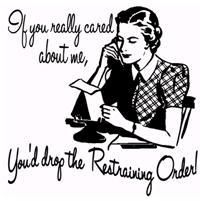
BE AWARE
Victims & Survivors need to know... RESTRAINING ORDERS ARE NOT THE BE-ALL ANSWER!
Psychopaths & Narcissists as well as other pathologicals often ignore or breach the restraining order -- and police far too often do not follow up!
~~~~~~~~~~~~~~
The increase in stalking cases a result of determined harassers looking for alternative methods to target victims
When it comes to harassment, there is a vast range of behavior. Much of it will not justify (or win) any lawsuits, but this doesn’t change the nature of what it is. And quite a few experts have described categories of harassers, and types of harassment, to help make some sense out of the confusion that most people feel about the issue.
Real harassers are abusers or predators who are out to exploit, and care only about their own needs and agendas.
A real harasser is someone who will continue to try to harass or predate despite sexual or other harassment law, and even after being given education about the seriousness of their actions, or the effects of their actions. In most cases, they will simply blame the victim. They rarely take responsibility themselves. They will just change their tactics so that they can continue to harass and exploit in such a way that the victim/s, or the law, can’t do anything about it.
One method for real harassers is stalking. Most forms of stalking are forms of sexual harassment because they are attempts to force a relationship with someone who is unwilling or unavailable. Stalking is the extreme, but covert, version of refusing to take ”No,” or “Leave me alone!” for an answer–you know, behaviors that were the catalysts for sexual harassment law.
Stalking has always been a problem, but experts will tell you that it is clearly on the rise.
I think the increase in stalking is partially a result of sexual harassment law, and real sexual harassers looking for ways to target their victims without fear of consequence for their actions. Because it is covert, it helps them get around sexual harassment law. It enables them to harass anonymously, and to more easily mask their motives and intentions. It also makes gathering evidence next to impossible for the victim, and without concrete evidence, there is no hope for them to even get an investigation.
On top of this, it makes the victim look paranoid, if not crazy, if they should report the problem to anyone.
In it’s most subtle forms (i.e. surveillance, sending anonymous “love” mail/ emails, hang-up phone calls), stalking can be like a chinese water torture. However, most stalking methods are more extreme, invasive, and destructive. (Breaking and entering, phone tapping, computer hacking, character defamation and slander, obscene mail or phone calls, etc.) Some stalkers will try to organize groups of people to assist them in their harassment campaign – called gang stalking or organized stalking. They usually seek out people in their victim’s community, utilizing the victim’s ”real world” community and/or Internet communities. In fact, stalkers often work to take control of, or destroy, a victim’s support network, resources, and options. This leaves the victim vulnerable, or even dependent on the stalker for survival, at least in the mind of the stalker.
Being stalked is NOT flattering – it is a form of psychological abuse and violence. And while stalking motives are usually sexual (or love obsessional), the stalking behaviors themselves may not be–that is another way real harassers can use it to get around sexual harassment law. (For example, watching someone over an extended period of time isn’t overtly sexual, at least not in of itself.)
Moreover, the psychological damage to the victim can be devastating. One expert writes,
”Stalking is a form of mental assault, in which the perpetrator repeatedly, unwantedly, and disruptively breaks into the life-world of the victim, with whom he (or she) has no relationship (or no longer has)….Moreover, the separated acts that make up the intrusion cannot by themselves cause the mental abuse, but do taken together (cumulative effect).”(Rokkers)
To most stalking victims, being stalked is like being put through a long, slow rape. For gang stalking victims, it’s like a gang rape. (The very insightful judge in the Christina Orozco case referred to her actions as akin to “murder.”)
And being stalked can be very frightening, regardless of whether or not the stalker’s activities are overtly violent. Physical attacks, even murders, can occur after long periods of ”more passive” stalking activities. Often, the violence is precipitated by the stalker’s being forced to face they have been rejected by their target.
Besides suffering the psychological damage, and damage to life, reputation, relationships, and options, most stalking victims live in fear that something will push their stalkers over the edge to physical violence.
Unfortunately, if a state or country recognizes stalking at all, this is mostly in the context of direct/overt violence, or clearly escalating violence. So, if a stalker avoids overtly violent acts, they can pretty much do as they please. In other words, if the stalker does not threaten or attack, a stalking victim is out of luck. They will not even be able to get a restraining order.
As long as they use stalking to disguise their motives, activities, and/or their identities, they are free from worry about being held accountable by sexual harassment law. And as long as they keep their stalking activities from being/seeming overtly violent, they will suffer no consequence from stalking law. Even better (for them), they can operate for as long as they wish.
And there is nothing the victim can do about it. (Suicides have been reported as victims use this as the only means they have to bringing an end to the harassment.)
It also makes stalking a good retaliation tactic for harassers who have been disciplined (i.e. been demoted, lost job) as many are using this as a way of getting revenge against an harassment target who filed a grievance against them – retaliation laws do not include stalking, either.
In my own situation, I took a course from the female professor who turned out to be a lesbian who quickly became interested in me. (That I’m not a lesbian didn’t deter her as she became obsessed with getting me to “try it” with her.) She began by making a pass, which she clearly saw right off the bat was a mistake, particularly since she did it in front of witnesses. But like most real harassers, she was not willing to give up. She simply revised her methods and began stalking me with an extraordinary determination. It is still amazing to me how far she went, and the depth and breadth or her obsession.
She used classic stalking tactics, such as surveillance and character defamation, the latter enabling her to destroy not only my reputation, but all my relationships and options, both personal and professional. She used cyberstalking extensively in her pursuit and surveillance, using this to watch me and try to interact with me at numerous Internet forums. She even organized groups of people to assist her (gang stalking), enlisting people not only in my “real world” but also in Internet communities I frequented, or she thought I might join. Because she was a department chair and a psychologist, no one questioned her character or motives.
Current stalking laws are woefully inadequate, and don’t even begin to confront the problem, let alone deal with it.
But even if the laws are revised to protect victims from the psychological violence of stalking, real harassers will simply find other ways to abuse. Any stumbling block placed before them, they will get around. It is a game to them. It is in their nature.
SOURCE
Labels: abuse, cyberstalking, defamation, harassment, inadequate police response, ptsd, restraining order, stalking
Thursday, January 11, 2018
Smear Campaigns - Part V in a Series

A summary of important points to remember about smear campaigns:
- Smear campaigns are typically conducted against people who have stood up against some form of unfairness, abuse, or entitlement.
- Narcissists are highly active smear campaigners, and those with other “high conflict” cluster B personality disorders such as AsPD, BPD and HPD are prone to smearing others.
- A smear campaign involves lies, exaggerations, and cultivation of mistrust toward the victim.
- Smear campaigners insinuate that the victim is mentally ill, unreasonable, incompetent, untrustworthy, or abusive.
- Smear campaigners typically play on the sensibilities of others, using people’s empathy and morals to turn people against their victims – most often for having done nothing more than disagree with the smearer.
- A smear campaigner prefers to make others think they are good people who are rightfully standing up against the victim’s supposed immorality or abuse.
- Smear campaigners play the victim, the hero, or both.
- Smear campaigners try to ostracize their victims and make them feel alone, unpopular, and unsupported by others.
- Smear campaigners enjoy the feeling of having “gotten back at” their victims, and believe it is completely justifiable – even fun – to mistreat someone for having an opinion that is different from theirs.
- Smear campaigners do not acknowledge the wrong they do, and cannot typically be expected to genuinely confess or apologize — even after they’ve been proven liars.
- Do not speak to smear campaigners unless it’s completely impossible not to. If you DO have to speak to the smearer, do so only in the presence of others. Plan ahead to prevent being put in difficult positions by the smear campaigner.
- Lastly, remember that you do have the right to make fair and healthy requests, and if you are smeared as a result, smearing is an unreasonable and unacceptable response.
Labels: abuse, defamation, edited facts, emotional terrorism, hate, libel, slander, smear campaign
Wednesday, January 10, 2018
Smear Campaigns - Part IV in a Series

If you should become the subject of a smear campaign, you may find the following practices to be helpful in reducing or eliminating the damage.
1. Immediately discontinue speaking to the smear campaigner.
If you can’t possibly do this because it’s a work situation, limit the time spent talking to this person alone as much as humanly possible. Abusers lie and manipulate, and prefer to have all their conversations with their victims when the victim is without the benefit of witnesses. Abusive people don’t like witnesses, so avoid being alone with them at all cost. That’s when the abuse will be at its worst, and that’s when you’ll say the things they will cruelly twist into lies later.
Deliberately approach them to have any unavoidable conversations in public, while standing in line at the water cooler, in a busy hall, while in a vehicle with others, or in a packed elevator. They may attempt to weasel out of the conversation by suggesting you have it later, in their office, at their house, or another isolated environment.
Avoid this by cutting comments down into very small pieces. For instance, don’t ask what the plan is for the big sales project while flying by their door. That’s a conversation for later, when the two of you will be sitting down alongside Jane (surprise!) whom you thoughtfully arranged to have join you to help take notes. Right now, as you race by their office, you just need to know “one quick thing”. If you’re invited into a more lengthy discussion, let them know you’re rushing and you’ll get back to them. Then carefully plan that interaction, too, or they’ll take the upper hand.
2. Put things in writing.
One of the great benefits of the electronic age is, we can have an instant copy of every piece of correspondence we send. If you absolutely must speak to the smear campaigner and you have the option of saying whatever you need to say in writing, do it. Having a record of exactly what has been said by you is invaluable protection against distortions and misrepresentation. Blind Carbon Copy (BCC) what you send to the smear campaigner to a third party whenever possible. When writing the content of the correspondence, do not say anything you would not want everyone to read. If you do, it’s guaranteed that everyone will soon be reading it (or what’s left of it after the smear campaigner’s creative “editing” work).
3. Know the lay of the land, and act accordingly.
If the abuser is a coworker, you have two options: sit down with management or leave the position. If the abuser is a supervisor, you can approach senior management, however you may still have to leave the employer (or at least that particular role).
If the abuser is a family member, your options are similar: approach others to see if you can get support, and stop seeing abusive/unsupportive members. Unfortunately, the great majority of families in which there is an abuser are not at all supportive of members who demand that the abuse stop, and members of these families often turn against the abused member. Dysfunctional families are irrational and incapable of meeting requests for healthy boundaries, and no contact with some or all of the family may be your only option.
If your work environment is similarly dysfunctional and the abuse is not seen through, not looked into, or you’re not taken seriously, then the problem, like with abusive families, is a deeper and more systemic one, and leaving will be your best option, no matter how much you may have wanted to keep the job otherwise.
SOURCE
Labels: abuse, defamation, edited facts, emotional terrorism, hate, libel, slander, smear campaign