Sanctuary for the Abused
Thursday, December 08, 2022
When Toxic People Start Hoovering
Wanting to end a relationship with someone who keeps trying suck you back in with manipulations (or fake apologies too) ?
You’re being hoovered!
Some toxic people will let you leave a relationship without caring one bit. They never really cared about you, and if you don’t want to be used and abused anymore, they’re simply on to the next person before you can say, “Bye!”
Others, however…
Others hoover.
The toxic hooverer doesn’t truly care about you either — they just want to keep you around to feed on emotionally, and when you decide to go no contact, they don’t plan on letting you get away that easily.
Many hooverers have traits of borderline, narcissistic, antisocial or histrionic personality disorders.
Hoovering is manipulation to gain control over your choice to distance yourself, and typically takes the following forms:
- Ignoring your requests to break off the relationship and attempting to continue on as if nothing has changed.
- Asking you when you’re going to “get over it” and return to your past actions.
- Sending you a fake apology to give you hope that things have changed.
- Trying to trick you into contact by saying someone needs you, is sick, or in trouble.
- Triangulating with others, communicating things to you through them.
- Saying they’re worried about you, concerned about whether you’re okay, need to know where you are, etc.
- Sending unwanted cards, messages and gifts, sometimes gifts for your children, as they know you are likely to feel guilty about keeping a gift from your kids. Don’t allow this – exposing your children to manipulation is far worse!
- Returning old items you left behind.
- Baiting you with drama games.
- Contacting you about “important” things they “forgot” and suddenly have to tell you.
Don’t Fall for Hoovering Tactics
Attempts to pull you back into a toxic relationship are not valid expressions of caring and concern — they are attempts to regain control over your behavior. Beware — hoovering attempts are often disguised as caring, loneliness, hurt, desperation, fear, and other things designed to play on your sympathies and pull you back. Abusers know that pulling on heartstrings works very well. (In the case of BPD, it may be simply out-of-control emotions and fear of abandonment more than an attempt to control you per se; however you will likely still feel that you are not being allowed to end a relationship you no longer want).
If your wish to end a relationship is not being honored, whatever a toxic person thinks will work best on you will be what they try, so when one angle doesn’t work, they will try another, and another, ramping up their efforts until it seems they might never stop.
Typically, hoovering DOES stop if the person being hoovered does not fall for the hooverer’s tricks.
The sooner the person being hoovered completely ignores everything and does not respond to anything at all in any way, the sooner the toxic person finally understands that they do not have the control. Some toxic people may still make the occasional attempt on holidays, anniversaries of events, etc. Don’t bite the bait. Simply ignore any attempts.
If you have already made it clear that you do not want a relationship (or if it’s obvious) then DON’T ever contact the person doing the hoovering to tell them to stop again, or how angry you are. That is a reward. They will be thrilled to receive your attention and pleased to know that their efforts have paid off by snagging you, so they’ll be contacting you even more!
Harassment
If you have told someone you do not want contact, and they continue to bother you, the police can assist you. If you ever feel that someone you are trying to break off a relationship with may be capable of more than simply annoying you mildly, contact your local police for assistance. They are well-accustomed to dealing with skillful manipulators and have many smart ways of handling them, so do not hesitate to ask for help. (And remember, you have nothing to be ashamed about; you’re not the one behaving badly, and the police are there to protect you from abuse.)
FROM THIS SITE - CLICK HERE
Labels: baiting, borderline personality disorder, female psychopathy, harassment, histrionic, hoover maneuver, hoovering, narcissist, no contact, sociopath, tactics


Tuesday, April 26, 2022
Abuser As Slanderer

by Kathy Krajco
On their way through life, narcissists leave a trail of trashed good names in their wake. This is a serious problem in the workplace, for narcissists often destroy the careers of their betters. Narcissistic managers and administrators often are serial bullies, who destroy the career and credibility of anyone who doesn't participate in a lynching and therefore is a threat to blow the whistle.
The narcissist is a slanderer partly to get attention. But he is a slanderer mainly because he must be one to create his phony image. He makes himself look good by making others look bad.
Yet narcissists are not the only people who create a false image of themselves. If you want to call it close, virtually everybody does, even that paragon of honesty, Prince Hamlet. In a world that surrounds us with the prying eyes of fault-finders, we would be traitors to ourselves if we were not at least modest about the things we should be ashamed of. Especially insofar as they are none of anybody else's business. In fact, it's a virtue to keep what's private private. It is the moral equivalent of wearing clothes.
Yet narcissists are different: they are hypocrites = for looks only. They think a thing ain't wrong if they get away with it. In other words, they confuse appearances with reality. Consequently, they have no conscience — just an unconscience. That is, they repress their conscience. Hence, what they do in the dark is shockingly different than what they do in the light of day. These are the people who put make-up on their image a little too thick in spots.
Projection is the Oldest Trick in the Book.
Magicians call it "misdirection." The Serpent pulled it on Eve when he accused God of being the liar. ("God told you THAT?") Stupid Eve should have looked at the other end of that pointed finger for the liar. As St. Paul does when he says that if somebody condemns others of being [fill in the blank], you can bet your bippy that he is one himself. Sometimes in a different way, but always at least the moral equivalent of one.* Paul was in line with the ancient Hebrew scriptures. Their name for the spirit in which people do this is satan, which means the "finger-pointer," the "name-slayer" (slanderer), the "prosecutor/persecutor," or the "accuser." In some places (e.g., the Book of Job) they also call him "the policer of the world." Which makes me wonder why religious leaders think that condemning these and those for this and that all the time is a good deed. This trick still works great today: I know of one narcissist who was a pedophile and for many years kept people from noticing the glaring warning signs in his own behavior by spreading rumors about one single teacher after another at his school. (He, of course, was married.)
* An example of what I mean by moral equivalence: Mr. Self-Righteous union-busts to keep the workers in his shoe factory so poor they go barefoot — and shows moral indignation in loudly condemning his neighbor for "muzzling an ox trampling the grain."
The rules about projection are in the Book of Leviticus, prescribed in the ritual for the Day of Atonement. Christianity has inherited them. The scapegoat must be the cleanest, most perfect potential victim available, the one with the most potential to do well in the world. (Sloppy thinking has twisted the meaning a full 180 degrees: these ugly demonstrations of the human race in action, symbolically performed by abominable cruelty to an animal, were intended to shame us. Not to prescribe this travesty of justice as the way to purify ourselves and win salvation from justice.)
I'm sure that people who do this think they're clever, but it's childsplay. Send a muddy child into an unsupervised school yard and wait to see what happens. He will rub himself off on every cleaner, smaller child he can find, till they are all crying and he looks good by comparison.
Looks good by comparison. Those are the all-important words. The hypocrite makes himself look good by comparison with others. He does that the easy way — by making others look bad. This is the root of envy. Which is not a rare motive for what people say about others. It's a common motive.
In a moment of self awareness, the hypocrite says, "Well, I may not be perfect, but I'm not as bad as others are." Then he instantly looks for somebody to make himself look better than = somebody to rub himself off on. And he's certainly smart enough to pick somebody pretty good to look better than!
So, narcissists are by no means alone in doing this. It's just that they invest so much energy in doing it. They are fixated on their image to the point that it is uppermost in their mind 100% of the time. In contrast, normal people project only when on the defensive. And then they're likely to shake themselves off on whoever happens to be near at the moment. So, their aim is poor, and sometimes they project a flaw off onto somebody who actually has it. But a narcissist's aim is impeccable.
For example, whom does he call a liar? The most honest person around.
Who does he say is dangerous? The savior of the group.Every single time. His talent for farce is so great that you could mistake him for astute.
Also, normal people have normal, human and loving relationships. So they don't smear themselves off on just anybody. They wouldn't dream of harming those near and dear. And they stick to slander (which has at least some degree of truth in it), rarely engaging in calumny (lies). When they do calumniate somebody, he or she is an enemy. Even then they don't go hog-wild and calumniate somebody so badly and so widely as to destroy them and ruin their lives. Not so with the narcissist. He is a child with no sense of measure or moderation. He loves only himself. He has no normal human relationships. He relates to people as objects. So he will smear himself off on his own children as thoughtlessly as we smear ourselves off on a towel. In fact, he is most likely to smear off on somebody he owes gratitude, because needing help damages his image. So he repays help as though it were an insult. He must devalue it by devaluing the giver of it, as if such a contemptible person is incapable of really helping somebody as grand as he.
Since he is a little child, the only reign on a narcissist's behavior is what he feels he can get away with. So, the more he gets away with, the more repressed guilt he has to purge himself of. The bad thing about repressed guilt is that it is an unconscious puppet master. Scripture calls it "the demon lurking at the door." The door being the way out, the escape, through repentance.
This could be why narcissists get worse with age. The load of repressed guilt they keep trying to purge themselves of (in a way that only dirties them more) gets so heavy that the wild accusations they make get viciouser and viciouser. It's as though they get drunk on blood.
They become living, breathing Projection Machines. Projection becomes such a knee-jerk reflex that a narcissist accuses his victim of doing to him the very thing (or essentially the same thing) as he is in the very act of doing to the victim. This creates bizarre scenes that make you wonder whether the narcissist is hallucinating or tripping out on psychedelic drugs. You feel like Alice in Wonderland. You have to pinch yourself and wonder whether "it's me or him that is crazy."
Another big difference between narcissists and normal people when they're projecting on you is that narcissists expect you to share their delusion. Yes! You cannot help but perceive this as gaslighting. Narcissists try to make you be what they say you are because, like a psychopath, they view you as an object, not as a human person with perceptions and a mind of your own.* They view you as an extension of themselves (like a tool) to control. It is the moral equivalent of the control a rapist thinks he has over the body of another, whom he views as but an object, an extension of himself, an executioner of HIS will. Psychologists call this bizarre behavior projective identification, a defense mechanism. The narcissist wants you to identify with the image he projects on you. You are a mirror to reflect his fantasy, so he pressures you to behave as though it is real.
* A narcissist's need to conform you to his or her specifications can go to bizarre extremes. For example, I know of one female narcissist who, during an assault on her sister, habitually forced her up against a wall and then spent a long time moving and twisting her sister's arms about to position them grotesquely — thus forcing her sister into different "shapes."
Behave is the key word. Narcissists do not connect with reality: appearances are all that matter in their world. So, you can lay out your grievances to a narcissist in a letter to let him know what you think, but if tomorrow you encounter him and act as though none of it happened, he is perfectly satisfied.
So, though the narcissist's projective identification seems like gaslighting and affects the victim like gaslighting, it is not gaslighting in the strictest sense of the word. For the narcissist only cares how you behave; he does not care what you think. He doesn't think at all about what you think. In fact, you can crash his brain by asking, "What do you think I think about you?" The question does not even compute.
Bottom Line: Anyone who outshines a narcissist diminishes the glow of his glory. So, that person had better be somebody with power that he fears or had better lay low and get away.
ORIGINAL FROM THIS GREAT SITE
Labels: defamation, gaslighting, harassment, hate, honesty, initimidation, narcissism, narcissist, slander, strong arming, threats
Friday, March 11, 2022
Common Traits of Stalkers

Stalkers will not take no for an answer.
They refuse to believe that a victim is not interested in them or will not rekindle their relationship and often believe that the victim really does love them, but just doesn't know it and needs to be pushed into realizing it. As long as they continue pursuing their victim, the stalker can convince themselves they haven't been completely rejected yet.
Stalker often accuse their victims of stalking them or others.
Stalkers display an obsessive personality.
They are not just interested in, but totally obsessed with the person they are pursuing. Their every waking thought centers on the victim, and every plan the stalker has for the future involves the victim. Ask yourself this. Is the person totally involved in and completely overwhelmed with pursuing someone who has no and never will have any interest in him or her?
Along with obsessive thinking, they also display other psychological or personality problems and disorders. They may suffer from erotomania, paranoia, schizophrenia, and delusional thinking. According to Professor R. Meloy, "these stalkers have rigid personalities and maladaptive styles. These disorders in themselves are very stable and not treatable." There are drugs to treat certain specific mental disorders, but stalkers, when given the choice, seldom continue with their medication or treatment.
Stalkers are above average in intelligence and are usually smarter than the run of the mill person with mental problems.
They will go to great lengths to obtain information about their victims or to find victims who have secretly moved. They have been known to hack into computers, tap telephone lines, take jobs at public utilities that allow them access to the victims or information about the victims, and even to travel thousands of miles and spend thousands of dollars to gain information about or find their victims. Stalkers many times use their intelligence to throw others off their trail.
Most stalkers don't have many relationships outside the one they are trying to re-establish or the one they have imagined exists between them and their victim.
Stalkers don't display the discomfort or anxiety that people should naturally feel in certain situations.
Normal individuals would be extremely embarrassed to be caught following other people, going through their trash looking for information about them, leaving obscene notes, and other inappropriate behavior displayed by stalkers. Stalkers, however, don't see this as inappropriate behavior, but only as a means to gain the person's love.
Stalkers often suffer from low self-esteem, and feel they must have a relationship with the victim in order to have any self worth.
Preoccupations with other people almost always involve someone with weak social skills and low self-esteem.
Few stalkers can see how their actions are hurting others.
- Won't take no for an answer
- Has an obsessive personality
- Escalating behavior - such as threats or cyberstalking
- Above average intelligence
- No or few personal relationships
- Lack of embarrassment or discomfort at actions
- Low self esteem
- Sociopathic thinking
- Has a mean streak
Labels: abuse, anxiety, control, cyberstalking, delusional, harassment, sociopathic, stalkers, stalking
Monday, October 29, 2018
Safety Nets Often Fail Abuse Victims

By SCOTT GUTIERREZ
Victims of domestic violence often turn to a neighbor instead of the police, and even if they sought court protection they often weren't given help to stay safe, according to a recent study of domestic violence homicides in Washington.
In addition, women of color were two or three times more likely than Caucasian women to be killed by an intimate partner, according to the report, and often faced cultural and language barriers to escaping an abusive relationship. The same trend was apparent with 43 men who have been killed since the biennial Domestic Violence Fatality Review began in 1997, according to the report.
The report, which was presented Monday by the Washington State Coalition Against Domestic Violence, looks at trends in domestic violence homicides in an effort to improve the criminal justice system and community response to better protect victims.
Sixty-eight people were killed as the result of domestic violence in the latest two-year period examined, between July 2006 and June 2008. Of those cases, 11 were chosen for an in-depth look.
In six of those cases, victims went to a neighbor or community member instead of calling the police. Private citizens often didn't know what to do and weren't aware of organizations that they could call for advice about how to help a victim of abuse.
In the past, the fatality review mostly focused on improving how police and courts handle domestic violence. This year, the focus shifted more toward how community members could better prepare if someone sought help from them, including how to help without jeopardizing their own safety, she said.
"In general, who do you turn to when in a crisis? I think most go to the people who are closest to us before we go to a stranger," said Kelly Starr, a coalition spokeswoman. "We can't rely on all of these systems as the answer."
The report recommended that block watches and crime-prevention groups learn more about domestic violence resources and share information. It also suggested that the media give contact information about advocacy services when reporting on domestic violence.
"I think the next piece is building the community's capacity to respond to this. We all have to build ourselves up so we're ready," Starr said.
Still, the report found areas where the court system needed improvement. For instance, victims often had no help from advocates when petitioning for court protection orders against their abusers. Without someone helping them make that decision, they could increase their risk in some cases, according to the report. An advocate can help plan where to go or what to do if the abuser retaliates or with deciding whether obtaining an order is the safest option.
One woman was killed last year in Federal Way just three hours after her boyfriend was served with an anti-harassment order.
In King County, the Prosecutor's Office provides a protection order advocacy program that victims have used in 73,000 cases since it was established 20 years ago. Generally, advocates serve about 5,000 cases each year, in addition to 2,500 walk-ins seeking advice, said David Martin, who supervises the domestic violence unit.
"For some folks, these are very difficult decisions to make -- life-altering decisions. There could be children involved, or a long-term relationship," Martin said. "We want people to understand what's going on and to make a good, informed decision."
Most Washington courts that provide protection orders, however, don't offer advocacy services, according to the report.
In those cases, court clerks' offices could consider referring victims to community-based organizations, which wouldn't cost extra money, Starr said.
SOURCE
Labels: abuse survivors, domestic violence, failure, harassment, hotline, protective order, safety, victims
Saturday, September 01, 2018
Characteristics of the Targets of Harassers & Adult Bullies

Labels: abuse, bullying, harassment, intimidate, minimize, smear campaign, threaten
Friday, August 24, 2018
Are You Involved With a Psychopath?

"Are You Involved With A Psychopath?"
Stop The Madness
By: Michael G. Conner, Psy.D, Clinical, Medical & Family Psychologist
For most of us the idea of a psychopath conjures up images from movies like "Silence of The Lambs" and characters with names like "Hannibal Lector." Fortunately characters like Hannibal don’t really exist. Serial killers and people involved in ritual torture are rare, but psychopathic behavior is more common than you might think.
I have known several psychopaths in my life. The clearest case involved an older teen who had no sense of guilt. He could learn the rules, but he had no sense of conscience. The only thing that saved him was a mother who loved him, took him to counseling for years and spent a great deal of time patiently teaching him right from wrong. I remember a conversation where he told me, "People know when something is wrong because it feels wrong. I have to remember or be reminded that stealing from someone is wrong. I don’t feel bad if I take something."
Meeting this young boy changed my opinion of a psychopathic personality. Why? Because children with this condition are "emotionally blind." And while I do not excuse cruelty or criminal behavior, I have sympathy and appreciate how hard it is for some people to learn how to act responsibly. Without help, potentially psychopathic children will become adults who never remain attached to anyone or anything for long. They may end up living a "predatory" lifestyle, feeling little or no regret, and having little or no remorse - except when they are caught or about to be locked up. And then they do feel bad - for themselves. They may marry but continue to have illicit relationships or promiscuous sex; the marriage is for appearances only. But they are prone to have problems with society, rules, expectations and relationships.
A psychopath will use people for excitement, entertainment, to build their self-esteem and they invariably value people in terms of their material value (e.g. money, property, comfort, etc..). They can involve and get other people into trouble quickly and they seem to have no regret for their actions. To date there is no checklist of behavior and symptoms that will tell you with certainty whether or not a person is a psychopath. But there are warning signs. The following warning signs are based on my experience but primarily research conducted by Robert Hare, Ph.D - the leading expert on the Psychopathic Personality.
Characteristics of a Psychopath
superficial charm
self-centered & self-important
need for stimulation & prone to boredom
deceptive behavior & lying
conning & manipulative
little remorse or guilt
shallow emotional response
callous with a lack of empathy
living off others or predatory attitude (taking advantage of others' trust)
poor self-control
promiscuous sexual behavior
early behavioral problems
lack of realistic long term goals
impulsive lifestyle
irresponsible behavior
blaming others for their actions
short term relationships
juvenile delinquency (some 'never caught')
breaking parole or probation, ignoring restraining or cease & desist orders
varied criminal activity (some 'under the radar')
The idea that psychopaths eat people is a myth. In reality, a person with a psychopathic personality can lead what appears to be an ordinary life. They can have jobs, get married and they can break the law like anyone else. But their jobs and marriages usually don’t last and their life is usually on the verge of personal chaos. They are almost always in some kind of trouble or they are not far from it.
A psychopath is usually a subtle manipulator. They do this by playing to the emotions of others. They typically have high verbal intelligence, but they lack what is commonly referred to as "emotional intelligence". There is always a shallow quality to the emotional aspect of their stories. In particular they have difficulty describing how they felt, why they felt that way, or how others may feel and why. In many cases you almost have to explain it to them. Close friends and parents will often end up explaining to the psychopath how they feel and how others feel who have been hurt by him or her. They can do this over and over with no significant change in the person's choices and behavior. They don't understand or appreciate the impact that their behavior has on others. They do appreciate what it means when they are caught breaking rules or the law even though they seem to end up in trouble again. They desperately avoid incarceration and loss of freedom but continue to act as if they can get away with breaking the rules. They don't learn from these consequences.
They seem to react with feelings and regret when they are caught. But their regret is not so much for other people as it is for the consequences that their behavior has had on them, their freedom, their resources and their so called "friends."
They can be very sad for their self. A psychopath is always in it for their self even when it seems like they are caring for and helping others. The definition of their "friends" are people who support the psychopath and protect them from the consequence of their own antisocial behavior. Shallow friendships, low emotional intelligence, using people, antisocial attitudes and failure to learn from the repeated consequences of their choices and actions help identify the psychopath.
Psychopaths with low intelligence or a poor education seem to end up in jail more than ones with a higher education. The lack of emotional insight is the first good sign you may be involved with a psychopath. The second best sign is a history of criminal behavior in which a person does not seem to learn from their experience, but merely thinks about ways to not get caught.
So what happens to these poor kids if they don’t learn right from wrong? Parents with a child like this usually end up angry and frustrated. They will often shield their child from the consequences of their decisions and take the role of continuously trying to educate their child as to right and wrong. The child is always in trouble and doesn’t seem to learn. Their parents may begin to excuse their child's behavior believing their child will eventually "get it." When they don't, many parents resort to punishment. But what these children need is intensive guidance, instruction, training, choices, consequences and supervision. Severe and repeated punishment alone is the worst thing you can do. Letting a child like this run around unsupervised with violent and antisocial children is almost as bad. And child abuse is a sure way to create a social misfit or a monster.
There is a growing discussion among researchers to suggest there may be a genetic influence that creates a psychopathic personality. The psychopath may lack the ability to physically feel what others identify as the physical sensation of guilt. They can feel fear, anger, sadness in the moment but not guilt for what they did or what they are about to do. Some sociologists believe that a sexually promiscuous psychopath who can live off others is a survivor and may represent one of many genes for survival in the human species. Even more surprising has been the observation that many adult psychopaths do not seem to benefit from support, counseling or therapy and may in fact commit crimes again and sooner because of it. Research using brain scanning technology has revealed that the brain of a psychopath functions and processes information differently. One famous brain imaging study showed that psychopaths can remain calm looking photos of dead bodies in automobile accidents where as other people were clearly upset. They don't use their brain they way others do. This suggests that they may be physically different from normal people.
Are you involved with a psychopath? You may not know because they can be very charming and friendly until you get close and disappoint them. Don’t assume anyone is a psychopath based on their behavior alone. It is the pattern of their life and many other factors. Please don’t go around assuming or calling someone a psychopath just because they may have some of the warning signs. Get a professional opinion from a qualified mental health professional if you think you are involved with a psychopath.
SOURCE
Labels: abusive, emotional rape, fabricating evidence, harassment, lack, lack of empathy, liar, moral insanity, narcissist, predatory, projection, psychopath, sociopath, subconscious, user
Saturday, June 16, 2018
One Group Has a Higher Domestic Violence Rate Than Everyone Else

There's one group we're overlooking: The people we trust to keep us safe.
In families of police officers, domestic violence is two-to-four times more likely than in the general population — from stalking and harassment to sexual assault and even homicide. As the National Center for Women and Policing notes, two studies have found that at least 40% of police officer families experience domestic violence, in contrast to 10% of families in the general population.
America's police domestic abuse problem was on full display in the horrific murder of Valerie Morrow, who police say was shot to death by her ex-boyfriend, Stephen Rozniakowski, a Philadelphia-area police officer. Morrow, 40, had just been granted a protection from abuse order against Rozniakowski, who had been charged with 75 counts of stalking.
After Rozniakowski reportedly resigned from his job Monday, police say he kicked open the door to Morrow's home, shot her to death and wounded her teenage daughter before being apprehended at the scene.
There is an epidemic of domestic violence by police officers: Recently, a Cleveland police officer was arrested for stalking and domestic violence, and officers in New Jersey and New York were charged in domestic violence cases.
A 2013 Bowling Green State University study, through news searches, tallied 324 cases of reported officer domestic violence. It is likely that this number is a gross underestimate, because as the National Center for Women and Policing has detailed, officers frequently cover for each other.
"A big part of police culture is the code of silence," Diane Wetendorf, author of Police Domestic Violence: Handbook for Victims, told the San Francisco Chronicle. "The prosecutors depend on police for their cases, the police depend on each other — it's a very insulated system,"
Why aren't we talking about this more? A September analysis on officer domestic violence by the Atlantic explains how cases come to be underreported. It's not just that women are more intimidated to report domestic violence because their attackers are officers and worry that nobody will believe them; it's that officers adjudicate the entire process on an informal level.
"Cops 'typically handle cases of police family violence informally, often without an official report, investigation, or even check of the victim's safety,'" the Atlantic's Conor Friedersdorf writes, quoting a study from the National Center for Women and Policing. "'Even officers who are found guilty of domestic violence are unlikely to be fired, arrested or referred for prosecution.'"
From underreporting by victims and colleagues to informal investigations, this means that available statistics only hint at the pervasive violence perpetrated by the people who are paid to protect and serve us. If evidence from a 2007 change in reporting arrests of Florida officers is any indication, reported cases of officer domestic violence would double.

Unfortunately there is no solution to this solution in sight, because this epidemic is systemic. Underreporting is a symptom of the fact that officers are rarely criminalized or even fired from their jobs even though, like Rozniakowski, their criminal history is well-documented.
In fact, as the Atlantic and and other sources observe, not only are these officers not fired, many of them receive promotions. This evidence suggests that not only is domestic violence by police officers ignored by the criminal justice system, it is condoned and, at times, even rewarded.
But available statistics prove one thing: The criminal justice system needs to readjust its focus. Instead of policing the general public, it needs to turn inward to police itself first, before it can claim to "protect and serve" in the truest sense of justice.
SOURCE
MORE INFORMATION ON POLICE OFFICE DOMESTIC VIOLENCE ISSUES click here
Labels: abuse, abuse of power, blue wall of silence, cop, domestic violence, harassment, justice, police, protect and serve, violence
Sunday, June 10, 2018
Cyberstalking and Online Harassment
A Real Life Problem
The Internet is a wonderful place to work, play and study. But don't let that fact make you blind to its down side. The Net is no more and no less than a mirror of the real world, and that means it also contains electronic versions of real life problems. Stalking and harassments are problems that many people especially women, are familiar with in real life. These problems can also occur on the Internet, in what has become know as "cyberstalking" or "online harassment".
If you thought that owning a computer and having an Internet account would make a person considerate and respectful; then think again. There are just as many predators in cyberspace as anywhere else. It is only their methods that have changed. Some predators might harass you by trailing around after you in live channels like lovesick puppies; unable to take NO for an answer and pestering you with email messages. In other cases this harassment may become a systematic campaign against you; where your harasser bombards you with threatening messages of hate and obscenities. Although distressful enough, the situation can even escalate to the point where your harasser traces your home address and telephone number; causing you to face not just emotional distress but also physical danger. It should come as no surprise to you that the "bad guys" are making use of this wonderful technology to harass people and prey on the innocent. Why wouldn't they? Not all bad guys are street punks with no education. Some are university graduates with computers.
There have been many examples of cyberstalking crossing over to "IRL" stalking (In Real Life stalking). Sadly, those users who have been victims of cyberstalking, tell a similar story: That no one took the harassment seriously until it became "IRL". Cyberstalking can be a devastating experience for a person online. As they discover that the difference between the "Brave New World" of the Internet and the Real World is that in the real world people listen when you tell them you are being stalked and harassed. In cyberspace people say things like "well just turn off your computer". Such incomprehension is common. "You can't be hurt on the Internet - it's just words" is commonly heard and "If you can't handle it, then you shouldn't be online" is another commonly hear comment. The online stalking is just as frightening and distressing as off-line stalking, and just as illegal.
Men and women may be stalked on-line, but statistics show that the majority of victims are female. Women are the minority of the Internet population which means that their attention is generally a fierce competition between male users. This part of the Internet, resembles crude online single bars, with little in the way of politeness. Unfortunately the immediate and relative anonymity of live chat communications facilities enable users to be rude and insensitive. Cyberstalking and online harassment are also much easier to practice than real life stalking. In cyberspace, a stalker can harass their victim without ever have to leave the comfort of their own home, or have any witnesses to the incidents.
One reason for the lack of successful prosecution of cyberstalkers, is that there usually is a lack of sufficient evidence available for the officials to warrant "probable cause" in order to further investigate. Many law enforcement agencies are Internet illiterate, therefore unaware that the problem could and does exist. To date, the only legislation regarding cyberstalking is the Communications Decency Act, enacted by the US Congress on 2-1-96, and is still being challenged in the Supreme Court. The real life, anti-stalking laws deal with actual attacks, and until such an attack happens, are actually very limited in defending yourself, or preventing any progression of the stalker. There is very little done about threats or harassment in the early stages.
Online users are vulnerable to being targeted as cyberstalking victims in three areas.
1) Live Chats (Facebook, Yahoo, Skype, Messenger) or IRC (Internet Relay Chat): in which a user talks live with other users. This is the most common place for cyberstalking.
2) Message boards, Blogs, Reunion Sites, Support Groups and Newsgroups: a user interacts with others by posting messages, conversing back and forth. Boards for emotional issues such as divorce; death; domestic violence are especially prone. Disordered persons can track others they disagree with for years reeking all sorts of havoc.
3) Email box: a user has the ability to write anything and even attach files to the email.
Example: a user enables your email, via live chat or newsgroup postings, then emails you with obscenities, and attaches porno pictures. A common area regarding cyberstalking is at the "edu" sites, which are educational institutes, such as colleges and universities.
One user might know another user personally and interacts on the Internet anonymously, so starting the cyberstalk. One student can enter the Internet as easily as another student, therefore not letting his true identity be known. And since user names can be unknown alias, who would ever know the identity or be able to prove the identity. In such cases, the stalker usually has the ability to trace the victim's phone number and sometimes the address of his victim. Another includes interpreting a posting you may have made on a message board regarding your opinion as an "attack" if it differs from theirs. The stalker then becomes fixated on proving you wrong.
Other forms of online harassment:
1) Unsolicited email
2) Live Chat
3) Hostile Postings about you, using a few "facts" to make an untrue picture
4) Spreading vicious, fabricated, untrue rumors about you (as opposed to telling the Truth at exposure sites)
5) Leaving untrue messages on site guestbooks
6) Impersonation of you online
7) Electronic sabotage, (sending viruses, trojans, etc)
8) Threatening phone calls
9) Threatening mail
10) Vandalism of property
11) Physical attack
12) Posing as you on groups, in emails or in postings.
There are many precautions that you can take NOW to protect yourself in advance from the unwelcome attention of a cyberstalker. Remember: The goal of a cyberstalker is CONTROL. Your task is to reverse this situation. Keep control of who you communicate with on the Internet. To do this, you may like to consider the advice below. Remember, the time to deal with cyberstalking is before you become a target.
CYBERSTALKING PREVENTION TIPS
If you are being harassed online by a cyberstalker, the chances are that you are not the first person they have stalked. Cyberstalkers, like other predators, are opportunists. They know what they are looking for and how to get it. "Stalking" is a "power" crime, the stalkers has the power to make you suffer and enjoys that power. Stalkers' self-esteem rises when they attack your self- esteem. The more pain and suffering they can cause, the better they feel about themselves. The best protection against becoming a target of stalking is not to reveal anything personal that you might have in common. Often, stalkers are mentally unstable, paranoid, delusional, and extremely jealous, and have extremely low self-esteem. Stalkers may display selfishness, malice, sadism, be very cunning and arrogant. Most are anti-social, and to put it in layman's terms, be a "control freak", enjoying manipulating other people. They crave power over others, and enjoy the type power that hurts other people. harassment is common enough in live chat on the Internet.
The three most common ways it can start are:
1) sexual harassment (or innuendo);
2) a flame war (argument that gets out of hand);
3)users that show their technological power by attacking innocent users, channels or even networks.
Those who regularly start flame wars online are rude and obnoxious people, often having poor social and communication skills. Their idea of fun is throwing obscene abuse at another just to upset them. These kind of harassers are often loners who don''t have a companion and their attempts to attract your attention is often clumsy and crude. Care should always be taken when turning the away, as the are highly sensitive to rejection and humiliation, and could cause a vendetta to start against you. Understand that although clumsy and crude in most cases, the stalker is not stupid, they are very organized and usually experienced in their war against you.
Stalking is a form of obsession. The difference between a normal cyber harasser and a cyberstalker, is this: harasser moves on to others and forgets you and a stalkers will come back to stalk you another day.
The Internet enables the stalker, his powers, in most cases, merely a knowledge of the technology is all required to have the ability to stalk another user. Most stalkers, having been rejected desire to instill fear in users, therefore, upsetting the normal enjoyment of the Internet.
Note that educated, smooth talking, responsible people also can be stalkers, appearing to be a perfect gentleman or lady with perfect manners. The major "clue" to cyberstalking, is when the stalker pushes for information regarding you personal life, private life, or life away from the net. Rule of thumb, as it may be referred to is: "NEVER GIVE ANY PERSONAL INFORMATION ACROSS THE INTERNET!"
Online meetings should stay online, the individuals are, in fact, strangers. Online, the physical warning signs usually in the "body language" are missing. Also the clues of personality within the voice and eyes are missing. All there is to determine a personality is the skill in which they type there messages. There is no code of honor in protecting privacy on the Internet. Each user should therefore take steps to protect their privacy online.
1) never specify gender
2) use neutral-gender names
3) change your password often
4) edit your online profiles often
5) review your email headers and signatures often
6) use secure chat programs that do not permit tracking of your isp#
7) use a good chat network
8) use standard names, passive names to as to not draw attention to you
9) use anonymous remailers
10)use an anonymous browser
11)use encryption to authenticate email
12) discuss privacy with your server.
And last: learn your technology. REMEMBER: PROTECT YOURSELF!
GRAFX-SPECS DESIGN & HOSTING
NOTE FROM BLOG OWNER: Ms. Kester and I have the same cyberharasser.
Labels: abuse, cyberstalking, harassment, internet addiction, online
Wednesday, March 21, 2018
Restraining Orders May Restrain Nothing!
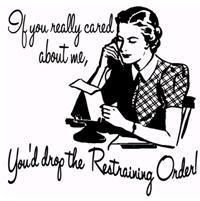
BE AWARE
Victims & Survivors need to know... RESTRAINING ORDERS ARE NOT THE BE-ALL ANSWER!
Psychopaths & Narcissists as well as other pathologicals often ignore or breach the restraining order -- and police far too often do not follow up!
~~~~~~~~~~~~~~
The increase in stalking cases a result of determined harassers looking for alternative methods to target victims
When it comes to harassment, there is a vast range of behavior. Much of it will not justify (or win) any lawsuits, but this doesn’t change the nature of what it is. And quite a few experts have described categories of harassers, and types of harassment, to help make some sense out of the confusion that most people feel about the issue.
Real harassers are abusers or predators who are out to exploit, and care only about their own needs and agendas.
A real harasser is someone who will continue to try to harass or predate despite sexual or other harassment law, and even after being given education about the seriousness of their actions, or the effects of their actions. In most cases, they will simply blame the victim. They rarely take responsibility themselves. They will just change their tactics so that they can continue to harass and exploit in such a way that the victim/s, or the law, can’t do anything about it.
One method for real harassers is stalking. Most forms of stalking are forms of sexual harassment because they are attempts to force a relationship with someone who is unwilling or unavailable. Stalking is the extreme, but covert, version of refusing to take ”No,” or “Leave me alone!” for an answer–you know, behaviors that were the catalysts for sexual harassment law.
Stalking has always been a problem, but experts will tell you that it is clearly on the rise.
I think the increase in stalking is partially a result of sexual harassment law, and real sexual harassers looking for ways to target their victims without fear of consequence for their actions. Because it is covert, it helps them get around sexual harassment law. It enables them to harass anonymously, and to more easily mask their motives and intentions. It also makes gathering evidence next to impossible for the victim, and without concrete evidence, there is no hope for them to even get an investigation.
On top of this, it makes the victim look paranoid, if not crazy, if they should report the problem to anyone.
In it’s most subtle forms (i.e. surveillance, sending anonymous “love” mail/ emails, hang-up phone calls), stalking can be like a chinese water torture. However, most stalking methods are more extreme, invasive, and destructive. (Breaking and entering, phone tapping, computer hacking, character defamation and slander, obscene mail or phone calls, etc.) Some stalkers will try to organize groups of people to assist them in their harassment campaign – called gang stalking or organized stalking. They usually seek out people in their victim’s community, utilizing the victim’s ”real world” community and/or Internet communities. In fact, stalkers often work to take control of, or destroy, a victim’s support network, resources, and options. This leaves the victim vulnerable, or even dependent on the stalker for survival, at least in the mind of the stalker.
Being stalked is NOT flattering – it is a form of psychological abuse and violence. And while stalking motives are usually sexual (or love obsessional), the stalking behaviors themselves may not be–that is another way real harassers can use it to get around sexual harassment law. (For example, watching someone over an extended period of time isn’t overtly sexual, at least not in of itself.)
Moreover, the psychological damage to the victim can be devastating. One expert writes,
”Stalking is a form of mental assault, in which the perpetrator repeatedly, unwantedly, and disruptively breaks into the life-world of the victim, with whom he (or she) has no relationship (or no longer has)….Moreover, the separated acts that make up the intrusion cannot by themselves cause the mental abuse, but do taken together (cumulative effect).”(Rokkers)
To most stalking victims, being stalked is like being put through a long, slow rape. For gang stalking victims, it’s like a gang rape. (The very insightful judge in the Christina Orozco case referred to her actions as akin to “murder.”)
And being stalked can be very frightening, regardless of whether or not the stalker’s activities are overtly violent. Physical attacks, even murders, can occur after long periods of ”more passive” stalking activities. Often, the violence is precipitated by the stalker’s being forced to face they have been rejected by their target.
Besides suffering the psychological damage, and damage to life, reputation, relationships, and options, most stalking victims live in fear that something will push their stalkers over the edge to physical violence.
Unfortunately, if a state or country recognizes stalking at all, this is mostly in the context of direct/overt violence, or clearly escalating violence. So, if a stalker avoids overtly violent acts, they can pretty much do as they please. In other words, if the stalker does not threaten or attack, a stalking victim is out of luck. They will not even be able to get a restraining order.
As long as they use stalking to disguise their motives, activities, and/or their identities, they are free from worry about being held accountable by sexual harassment law. And as long as they keep their stalking activities from being/seeming overtly violent, they will suffer no consequence from stalking law. Even better (for them), they can operate for as long as they wish.
And there is nothing the victim can do about it. (Suicides have been reported as victims use this as the only means they have to bringing an end to the harassment.)
It also makes stalking a good retaliation tactic for harassers who have been disciplined (i.e. been demoted, lost job) as many are using this as a way of getting revenge against an harassment target who filed a grievance against them – retaliation laws do not include stalking, either.
In my own situation, I took a course from the female professor who turned out to be a lesbian who quickly became interested in me. (That I’m not a lesbian didn’t deter her as she became obsessed with getting me to “try it” with her.) She began by making a pass, which she clearly saw right off the bat was a mistake, particularly since she did it in front of witnesses. But like most real harassers, she was not willing to give up. She simply revised her methods and began stalking me with an extraordinary determination. It is still amazing to me how far she went, and the depth and breadth or her obsession.
She used classic stalking tactics, such as surveillance and character defamation, the latter enabling her to destroy not only my reputation, but all my relationships and options, both personal and professional. She used cyberstalking extensively in her pursuit and surveillance, using this to watch me and try to interact with me at numerous Internet forums. She even organized groups of people to assist her (gang stalking), enlisting people not only in my “real world” but also in Internet communities I frequented, or she thought I might join. Because she was a department chair and a psychologist, no one questioned her character or motives.
Current stalking laws are woefully inadequate, and don’t even begin to confront the problem, let alone deal with it.
But even if the laws are revised to protect victims from the psychological violence of stalking, real harassers will simply find other ways to abuse. Any stumbling block placed before them, they will get around. It is a game to them. It is in their nature.
SOURCE
Labels: abuse, cyberstalking, defamation, harassment, inadequate police response, ptsd, restraining order, stalking
Tuesday, March 20, 2018
Characteristics of a Psychopath/ Abuser

(1. not all Abusers are Psychopaths, but all Psychopaths are Abusers.
2. only a FEW of these need to apply for them to be PATHOLOGICAL)
- superficial charm
- self-centered
- prone to boredom
- deceptive behavior & lying
- conning & manipulative
- little remorse or guilt
- shallow emotional response
- callous lack of empathy
- living off others & predatory
- poor self-control
- sexually promiscuous
- early behavioral problems
- lack of realistic goals
- impulsive lifestyle
- irresponsible behavior
- blaming you for their actions
- short term relationships
- juvenile delinquency
- varied criminal activity
- truly believes their own lies
- insanely jealous
- will turn their friends on you
- enlists others to harass you
- prone to stalking their exes
Labels: abuser, characteristics. smear campaign, harassment, irresponsible, jealous, liar, narcissists, pathological, predator, psychopath, sociopath, stalker
Sunday, March 04, 2018
Why Are Most Judgmental, Critical People So Critical and Judgmental?

Lack of empathy.
Labels: abuser, always right, antisocial, arrogant, criticism, harassment, judgmental, narcissist, never good enough, no empathy, obessive compulsive, psychopath, sociopath
Wednesday, February 14, 2018
Cyberstalking in the 21st Century - Part One

PART ONE OF A SERIES
~~~~
They used to sit outside their targets' homes -- hiding in cars or bushes -- waiting to follow them.
They used to leave hastily-scrawled notes on their windshields before slashing their tires.
But now stalkers have moved into the 21st century, using modern technology to leave their terrorized victims living in fear.
Satellite technology, such as GPS, makes it possible to follow people in real-time from a remote location.
Threatening e-mails have supplemented the notes, while online background checks allow people access to information victims would otherwise want kept private, such as addresses and places of business.
Police forces across the country deal with thousands of criminal harassment cases every year, and suspects in these incidents are frequently turning to technology as a way of stalking their victims.
Det. Gordon Robertson of the Calgary Police Service, one of Canada's foremost stalking experts, said new technologies provide further tools for a stalker to exert his -- the overwhelming majority of stalkers are men -- controlling behaviour on the victim.
"The technological age has put a whole different spin on even regular stalking -- technology has added a dark twist," Robertson said.
He said the perceived anonymity of e-mail and Internet chat rooms lead to more bold behaviour -- offenders will say and do things on-line they wouldn't in real life. (This is called the "ONLINE DISINHIBITION EFFECT")
The technology is also there for a stalker to monitor a person's computer use, down to a single keystroke, or to get access to their e-mails and personal information.
"For people with the know-how, the computer offers that readily-accessible medium," he said. "You're seeing the computers involved in a lot of these cases."
Because computers and e-mails are increasingly used, Robertson said police are more often turning to search warrants to seize a suspect's hard drive.
Techno-stalking cases add to the workload of technological crimes units, which are already fighting a seemingly endless battle against another technological scourge: online kiddie porn.
"How do you police cyberspace?" Robertson said. "A lot of things are going on in that medium because there is virtually no one watching it."
Technology and stalking have become so linked, groups in the U.S. are designing programs that specifically target the problem.
Cindy Southworth, director of technology at the National Network to End Domestic Violence in Washington, D.C., said the increase in technology-related domestic violence cases in the U.S. led to the creation of Safety Net: the National Safe and Strategic Technology Project.
"We found there was a fair amount of technological misuse woven in with stalking and domestic abuse," she said, adding the majority of high-tech stalking cases fall within a domestic violence context, as is the case with the low-tech approach.
"We find stalking in general is not very well understood and when you add technology to it, it's even more of a challenge."
But she said old-fashioned measures to track and terrorize a stalking victim have not yet fallen out of style.
"They're still showing up at the house, they're still slashing the tires, but in addition they've added these other tools," she said.
"Because all of these technologies are widely available in the U.S. and Canada ... the more awareness we get out, the more cases we expect to see."
Part of Southworth's job, as is Robertson's, is educating law enforcement about the crime.
Southworth trains police to ask questions which could lead to evidence a stalker or abuser is using technology to facilitate a campaign of terror.
"Police need to start asking questions like 'Does your ex ever e-mail you? Does he seem to know things he shouldn't know about your daily activities,' " she said. (Most police have no clue how to deal with this)
On a positive note, she said, as more technology is being misused for the purposes of stalking and abuse, more groups are focusing on the misuse of that technology. "It's a step in the right direction," she said.
The goal now, Southworth said, is to educate women how to use technology to their advantage, to search out shelters, to log e-mails and to protect their privacy so they're no longer victims.
~~~~~~~
PROJECT CIVILITY AT RUTGERS UNIVERSITY
Labels: cyberpath, cyberstalking, emotional rape, follow, harassment, ptsd, smear campaign, stalking, terrorism, threats, trauma