Sanctuary for the Abused
Wednesday, January 09, 2019
Passive-Aggressive Behavior
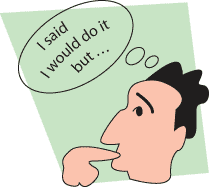
Passive-aggressive communication is a means of expressing anger indirectly.
Examples of passive-aggressive behaviors are listed below.
PASSIVE-AGGRESSIVE BEHAVIORS AND ISSUES
- Obstructionism (making things difficult)
- Hostility, anger, and bad attitude toward people in authority or people who have an advantage. Scorn and resentment.
- Issues such as specific kinds of fears, a sense of victimization, feelings of being misunderstood, etc. (see list below)
- Complaints of having it hard or being treated unfairly
- Sneaky, “Sideways” or “Backhanded” comments/compliments hidden behind a veneer of pleasantry
Examples of Passive-Aggressive Obstructionism
- Arriving late to meetings and other events, making other people wait
- Purposely doing a poor job on a required work project
- Claiming to have “forgotten” what is wanted by other people
- Making issues more difficult than they have to be
- Making excuses
- Lazy communication, failing to follow through on messages
- Lying and mental manipulation
- Procrastination and laziness at home or in the workplace
- Deliberately creating disorder in situations with friends, employer and family
- Expressing ambiguity when interacting with people
Examples of Common Fears and Issues for Passive-Aggressive People
- Fear of intimacy
- Fear of competition
- Fear of dependency
- Arguing
- Enviousness
Dealing with passive-aggressive people can be especially difficult, particularly when you are relying on them to do something properly and on time, without difficulty and complications.
In the workplace, passive-aggressive people should be dealt with administratively, since trying to work around, adjust to, and change their behavior is impossible. They will sorely resent the supervision; however, they were likely already displeased and resentful of it anyhow.
________________________________________________________________
Passive-aggressive people will always find a way to slip out of what you need them to do or otherwise make you pay for trying to get them to cooperate.
________________________________________________________________
Dealing or working with a passive-aggressive person can feel like a gigantic game of Whack-a-Mole.
Once you think you’ve addressed the first excuse, lie, issue or ambiguity, they’re off and running presenting you with a third, second and fourth. It’s as if they’re playing a mental game designed to exhaust you into giving up asking anything reasonable of them. Insisting and pressuring them into fulfilling their obligations only makes things worse.
When in situations where you are forced to work with them, do not assume responsibility for their work or lack thereof. Do not let the maddening inefficiency and game-playing get to you. Concentrate on your own responsibilities, and minimize working on joint projects with them as much as possible. Above all, don’t take the bait that sends you begging them to cooperate. They will only resent you for it and get you back later.
And definitely, without delay, add passive-aggressive people to your list of toxic people to avoid wherever possible.
Labels: anger, chaos, difficult, forgetting, lying, narcissist, obstruction, passive-aggressive, playing games, psychopath, sarcasm, sociopath


Saturday, November 03, 2018
Emotional Abuse or Going Crazy?

The blows of physical or sexual abuse are oftentimes obvious. Broken bones, bruises, and lacerations leave scars as evidence. Yet worst of all are the scars of emotional abuse - nearly invisible to the naked eye. Unfortunately, these can be more caustic, long-lasting, and life-altering than those left by any other type of abuse and the psychological damage the most profound.
What is emotional abuse? Sometimes called "Ambient Abuse," it is an extremely subtle form of control and manipulation that may go unrecognized for months or years -- many times even by those on the receiving end -- at least until it is too late. By the time the victim is aware of the actual abusive behaviors, she has oftentimes become a bundle of nerves and finds it difficult to see her way off the emotional roller coaster ride she's stuck on. Worse yet, she can't even explain what's happening to her, and in some cases, she may actually think she is going crazy; struggling with anxiety, depression, fear, or eventually -- apathy. She may quit doing anything, for fear of doing it "wrong" - at least according to the controller in her life.
Abusers and controllers may start out using little digs like, "Honey, everyone knows that you do it this way," as just another way to say, "How stupid are you that you don't know this?"
Constant criticism becomes part of the game. "You are too fat, dumb, ugly," or even, "I wish I had that abortion instead of having you!" These are all ammunition in emotional abuse.
Even teasing can be abusive, for it frequently has some truth at its core. Jane lives in a marriage where her husband's teasing-type cuts are constant. "The Ayatollah says dinner is ready," he announces regularly whenever they have guests. He thinks it's funny. She certainly doesn't. And what are we, the guests supposed to think -- that he is paying her a compliment? Absolutely not. I don't care how much he smiles or laughs when he throws it out there -- it is meant to wound. And she knows it. And he knows that she knows it.
Emotional abuse may take the form of the controller limiting the "victim's" outside contacts. "You don't need anybody but me," he may remind you constantly, and can actually get angry if you spend time with your friends or family, even on the phone. The more he can lock you away from your external support systems, the more he locks you in his boxx of control.
Deanna's husband tells her what time she can go to bed, what she is allowed to eat, and just how long she'd better be gone when she goes out to do errands. He never gives her a birthday or Christmas gift. He threatens to kill her and hide her car if she doesn't obey him. He makes her recite each day that she is worthless -- that he will tell her what she is worth, what she can and can't do, and who she is allowed to see when. This is obviously extreme emotional abuse.
Unfortunately, all these situations may seem extremely difficult to escape for the victim. The brainwashing of weeks, months, and years of constant demeaning remarks are meant to make her feel worthless and as though no one else in the world could love her. Thus, her fear of leaving exceeds the fear of staying, and even worse -- many times she blames herself for all that is wrong. Guilt becomes her constant companion. Leaving seems impossible. And besides, it's "not that bad." For if it were, there would certainly be broken bones to prove it. Or so she believes.
If you find yourself trapped in the boxx of emotional abuse, it's important to know you CAN escape! The long-term emotional damage caused by this type of situation will affect your physical as well as your mental health -- and that of your children. While there may not be laws protecting you from the constant verbal attacks, you do have the ability to recognize it for what it is -- definitely NOT something that goes hand-in-hand with a loving relationship. Furthermore, teaching your children that this is an acceptable behavior only leads them to believe that emotional abuse is an acceptable part of a normal relationship. Would you wish this for your child? Or your grandchild?
Mary Jo Fay is a speaker and writer. http:// www.outoftheboxx.com.
SOURCE
Labels: abuser, controller, criticism, emotional abuse, guilt, narcissist, psychopath, sarcasm, truth, verbal abuse