Sanctuary for the Abused
Friday, May 29, 2020
Why PTSD Needs Treatment and Does Not 'Get Better' with Time

The Time Bomb
Inside every person with PTSD is a time bomb. It is merely a matter of time before symptoms begin to show up. One might exhibit all manner of symptoms in nearly everything s/he does, and still live what appears to be a normal life. However, it doesn’t take much to bring out full-blown symptoms of a full-blown case of PTSD.
Unemployment, Illness, and too much Free Time (and worry) exacerbates PTSD symptoms. Can be acute when untreated.
Additional Stress: Stress kills; we know this. Additional stress in the life of a PTSD sufferer will bring out their PTSD symptoms. Even good stress can increase one’s symptoms; good stress such as a birth, or a new love, or a promotion at work. Anything that wobbles the apple cart — little changes, big changes, good changes, bad changes—will promote PTSD symptoms.
Then there are the huge stressors; the larger the stressor, the more virulent the PTSD symptoms.
Reminders: anything that reminds the PTSD sufferer of the original trauma will pique symptoms. Additionally, the anniversary of a trauma will cause a rise in PTSD symptoms.
[i.e. Someone making one mistake can and often does become a target of PTSD sufferer's anger. The PTSD suffer may lay all manner of unrelated or perceived 'slights' at the feet of the person who may have done something wrong in their eyes.]
If a woman was assaulted near an elevator, elevators will trigger her symptoms. If she remembers the date of her assault, as the anniversary approaches, symptoms increase.
Anger
I know of no more disagreeable situation than to be left feeling generally angry without anybody in particular to be angry at. - Frank Moore Colby
Persons with PTSD hold in a lot of anger. It is a free-floating anger with no real target and very subtle causes. It simmers below the surface and can jump out at inappropriate times, aimed at the wrong person for the wrong reasons (displaced anger).
For instance: following a rape, the rape victim is filled with rage. The specific targets of this rage are quite obvious: the rapist, the system that puts the victim on trial, the doctors for their insensitivity, and the list can go on depending on the ordeal the rape victim endures. However, years later, this anger can still exist, simmering just below the surface.
And though many argue that the cues to the anger have changed, that the original incident has softened in the mind of the sufferer, that this, that that—it's all "neither here nor there" because there is no logic, no reasoning with chronic PTSD, everyone and everything is the cause, and the nearest person or object can be the target.
Normal people get warm, then angry, then angrier, and progress to a state of rage if the stimulus to the anger is not abated. A PTSD sufferer can go from A to Z immediately... When anger strikes, it quickly turns to rage.
Anger Management classes are usually prescribed for PTSD patients, however, the patient might still never arrive at the cause of this anger, as the original cause has faded, leaving only the anger. Learning to deal with this anger is much more productive at this juncture than trying to discover its cause or causes. In a good Anger Management class, the PTSD sufferer can learn that one cannot control one’s initial feeling about something aggravating, however, s/he can control her/his reaction.
Being the target, displaced or not, of this anger is one of the major causes of "secondary PTSD," the disorder suffered by those close to the PTSD sufferer. Oftentimes families walk on eggshells to avoid doing anything to upset the PTSD sufferer. Children, wives, friends, neighbors and lovers tend to withdraw and avoid any and all possible confrontation. Partners of PTSD patients must keep alert and note when the anger outbursts increase in intensity and the intervals between them shorten. This is a sure sign that there is something else occurring within the patient and a trip to the therapist is needed.
(Domestic Violence Centers are a good place to contact about counseling if you have no insurance)
(Domestic Violence Centers are a good place to contact about counseling if you have no insurance)
Labels: anger, complex ptsd, displaced, inappropriate, misplaced, ptsd, rage, victims, walking on eggshells


Tuesday, October 02, 2018
Abusers Deny or Minimize the Abuse
 Not all abusers are dysfunctional. Many of them are pillars of society. Abusers come in all shapes and sizes: successful professionals, or peripatetic con-artists, affluent or poor, young or old, well-educated or dropouts. There is no profile of the "typical abuser".
Yet, abusive behavior often indicates serious underlying psychopathologies, such as personality disorders (Narcissistic, Borderline, Paranoid, or Antisocial are the most common among abusers). Abuse is often associated with alcoholism, drug-use, and other reckless, addictive, or compulsive behaviors.
Denying the Abuse
Abusers deny the abuse or rationalize it. They tend to shift blame or avoid the topic altogether.
Types of Denial
1.Total outright denial
"It never happened, or it was not abuse, you are just imagining it, or you want to hurt my (the abuser's) feelings"
2. Alloplastic defense
"It was your fault, you, or your behavior, or the circumstances, provoked me into such behavior"
3. Altruistic defense
"I did it for you, in your best interests"
4. Transformative defense
"What I did to you was not abuse - it was common and accepted behavior (at the time, or in the context of the prevailing culture or in accordance with social norms), it was not meant as abuse"
Abusers are concerned with their reputation and image in the community - neighbors, colleagues, co-workers, bosses, friends, extended family.
Forms of denial in public
5. Family honor stricture
"We don't do dirty laundry publicly, the family's honor and repute must be preserved, what will the neighbors say?"
"My spouse/ partner is a wonderful person."
(supposedly the victimized person who exposes them should be an AWFUL person in comparison. NOTE: Usually this is after the abuser has told the victim for MONTHS how horrible, cold, nasty, etc. their spouse/ partner is!)
6. Family functioning stricture
"If you snitch and inform the authorities, they will take me (the abusive parent) away and the whole family will disintegrate"
"You are hurting my/ our -- family/ spouse/ friends by telling"
How to Identify an Abuser
Abusers have alloplastic defenses. They tend to blame every mistake, failure, or mishap on others, or on the world at large. They do not assume personal responsibility, do not admit to having faults and miscalculations, keep blaming others for their predicament. "Look what you made me do!" is an abuser's ubiquitous catchphrase.
The abuser is hypersensitive, picks up fights, feels constantly slighted, injured, and insulted. He rants incessantly, treat animals and children impatiently or cruelly and expresses negative and aggressive emotions towards the weak, the poor, the needy, the sentimental, and the disabled.
Abusers often have a history of battering or violent offenses. They use vile language and infused with expletives, threats, and hostility.
Abusers appear at first to be too eager. They push others to marry him, to conclude a partnership with him having dated or met only once or twice. They immediately embark on detailed and grandiose plans of having children, or making millions, or becoming famous. In a romantic encounter, the abuser casts his date in the role of the love of his life and presses her for exclusivity, instant intimacy, and sex. He acts jealous when she as much as casts a glance at another male and informs her that she should abandon her studies or resign her job and, thus, forgo her autonomy.
Abusers do not respect boundaries and privacy. They ignore other people's wishes, choices, and preferences and are the sole decision makers, not bothering to consult anyone beforehand. They treat their nearest and dearest as objects or instruments of gratification.
Many abusers are compulsive control freaks.
Abusers are patronizing and condescending, overly critical and devaluing. But this behavior alternates with idealization - exaggerating others' talents, traits, power, intellect, wealth, and skills. Abusers, in other words, are unrealistic in their expectations and emotionally labile.
Some abusers are sadists-masochists. They find sadistic sex exciting and have fantasies of rape or pedophilia. They forceful during the sexual act and like inflicting pain or find it amusing. Others "merely" abuse (usually their closest) verbally - curse, demean, call ugly or inappropriately diminutive names, or persistently criticize. Typically, they then switch to being saccharine and "loving", apologizing profusely and trying to appease their victims by buying them gifts.
Many abusers have a specific body language.
"Haughtiness – Physical posture which implies and exudes an air of superiority, seniority, hidden powers, mysteriousness, amused indifference, etc. Some abusers maintain sustained and piercing eye contact but refrain from physical proximity (observe personal territory). The abuser takes part in social interactions – even mere banter – condescendingly, from a position of supremacy and faux "magnanimity and largesse". But even when he feigns gregariousness, he rarely mingles socially and prefers to remain the "observer", or the "lone wolf".
Entitlement markers – The abuser immediately asks for "special treatment". This way, he shifts responsibility to others, or to the world at large, for his needs, failures, behavior, choices, and mishaps ("look what you made me do!"). The abuser reacts with rage and indignantly when denied his wishes and if treated the same as others whom he deems inferior. Abusers frequently and embarrassingly "dress down" service providers such as waiters or cab drivers.
Idealization or devaluation – The abuser instantly idealizes or devalues his interlocutor. He flatters, adores, admires and applauds the "target" in an embarrassingly exaggerated and profuse manner – or sulks, abuses, and humiliates her.
Abusers are polite only in the presence of a potential would-be victim - a "mate", or a "collaborator". But they are unable to sustain even perfunctory civility and fast deteriorate to barbs and thinly-veiled hostility, to verbal or other violent displays of abuse, rage attacks, or cold detachment.
The "membership" posture – The abuser always tries to "belong" while also maintaining his stance as an outsider.
Most abusers always prefers show-off to substance. They are shallow, though claim to have talents and skills bordering on genius. They never admit to ignorance or to failure in any field – yet, typically, they are ignorant and losers. The abuser's self-proclaimed omniscience, success, wealth, and omnipotence as well as his name dropping and false autobiography are easily debunked. His actual condition is evidently and demonstrably incompatible with his claims.
Emotion-free language – The abuser likes to talk about himself and only about himself. He is very impatient, easily bored, with strong attention deficits – unless and until he is the topic of discussion. He is not interested in others or what they have to say. He is never reciprocal. He acts disdainful, even angry, if he feels an intrusion on his precious time.
Abusers are divorced from their emotions. The abuser intellectualizes, rationalizes, or speaks about himself in the third person. Most abusers get enraged when required to delve deeper into their motives, fears, hopes, wishes, and needs. They use violence to cover up their perceived "weakness" and "sentimentality". They distance themselves from their own emotions and from their loved ones by alienating and hurting them.
Seriousness and sense of intrusion and coercion – No matter how good his sense of humor, the abuser is never self-deprecating. This is the outcome of the abuser's sense of grandiosity, his fantasies and delusions, and his confabulation.
The abuser is easily hurt and insulted (narcissistic injury). Even the most innocuous remarks or acts are interpreted by him as belittling, intruding, or coercive slights and demands. His time is more valuable than others' – therefore, it cannot be wasted on unimportant matters such as social intercourse, family obligations, or household chores. Inevitably, he feels constantly misunderstood.
Any suggested help, advice, or concerned inquiry are immediately perceived by the abuser as intentional humiliation, implying that the abuser is in need of help and counsel and, thus, imperfect. The abuser is both schizoid and paranoid and often entertains ideas of reference.
Finally, abusers are sometimes sadistic and have inappropriate affect. In other words, they find the obnoxious, the heinous, and the shocking - funny or even gratifying. They are sexually sado-masochistic or deviant. They like to taunt, to torment, and to hurt people's feelings ("humorously" or with bruising "honesty").
While some abusers are "stable" and "conventional" - others are antisocial and their impulse control is flawed. These are very reckless (self-destructive and self-defeating) and just plain destructive: workaholism, alcoholism, drug abuse, pathological gambling, compulsory shopping, or reckless driving.
Yet, these – the lack of empathy, the aloofness, the disdain, the sense of entitlement, the restricted application of humor, the unequal treatment, the sadism, and the paranoia – do not render the abuser a social misfit. This is because the abuser mistreats only his closest - spouse, children, or (much more rarely) colleagues, friends, neighbours. To the rest of the world, he appears to be a composed, rational, and functioning person. Abusers are very adept at casting a veil of secrecy - often with the active aid of their victims - over their dysfunction and misbehavior.
Psychological Testing of Offenders
In the court-mandated evaluation phase, first it is established whether the offender suffers from mental health disorders at the root of the abusive conduct. A qualified mental health diagnostician administers lengthy tests and personal interviews.
The predictive power of these tests - often based on literature and scales of traits constructed by scholars - is hotly disputed. Still, they are far preferable to subjective impressions of the diagnostician which are often amenable to manipulation.
The Millon Clinical Multiaxial Inventory-III (MCMI-III) tests for personality disorders and attendant anxiety and depression. The third edition was formulated in 1996 by Theodore Millon and Roger Davis and includes 175 items. The Narcissistic Personality Inventory (NPI) is used to spot narcissistic traits in abusers.
The Borderline Personality Organization Scale (BPO) was designed in 1985. It sorts the responses of respondents into 30 relevant scales. It indicates the existence of identity diffusion, primitive defenses, and deficient reality testing.
To these one may add the Personality Diagnostic Questionnaire-IV, the Coolidge Axis II Inventory, the Personality Assessment Inventory (1992), the excellent, literature-based, Dimensional assessment of Personality Pathology, and the comprehensive Schedule of Nonadaptive and Adaptive Personality and Wisconsin Personality Disorders Inventory.
The next diagnostic aim is to understand the way the abuser functions in relationships, copes with intimacy, and responds with abuse to triggers.
The Relationship Styles Questionnaire (RSQ) (1994) contains 30 self-reported items and identifies distinct attachment styles (secure, fearful, preoccupied, and dismissing). The Conflict Tactics Scale (CTS) (1979) is a standardized scale of the frequency and intensity of conflict resolution tactics - especially abusive stratagems - used by members of a dyad (couple).
The Multidimensional Anger Inventory (MAI) (1986) assesses the frequency of angry responses, their duration, magnitude, mode of expression, hostile outlook, and anger-provoking triggers.
Yet, even a complete battery of tests, administered by experienced professionals sometimes fails to identify abusers and their personality disorders. Offenders are uncanny in their ability to deceive their evaluators.
The Open Site
Labels: abusers, anger, decieve, denial, deny, manipulation, minimized, predator, rage, strategy
Thursday, April 19, 2018
Loved? No: Dishonored and Abused

Loved? Dishonored, and Abused
Hey Honey, "express yourself"...
("wife" in this article can also mean "significant other"... such as girlfriend, etc.)
- be sure to tell your wife that the only reason she married you was so she could sit around the house all day and do nothing, even though she was fifteen weeks pregnant at the time and in a high risk category due to a previous miscarriage and on doctor's orders to REST REST REST
- also tell her that the only reason she wrote for the newspaper was so she could provoke, because you were jealous of the fact that she could write what the people want to hear, and you couldn't
- act like you can never have anything by throwing everything you own in the garbage, or out the bedroom window. (I remember looking out our window one day to see stuffed toys that had been torn apart, laying on the lawn for the superintendent of the building to clean up; at first I didn't realize what the mess was until I took a good look, then I was completely stunned... even more-so when I realized they were the stuffed mementos that belonged to my husband!)
- You could even fake walking in your sleep in order to scare your wife -- pretending to attempt climbing out your bedroom window (I should have let him; we were on the third floor).
- leave the room that you're in, acting perfectly normal, then go into the bathroom and pound your fist into your hand when you're in the bathroom alone talking to yourself
- when pounding your fist into your hand be sure to whisper loudly "bam, bam, bam"
- when you're done doing this come out of the bathroom and return to the room you were in; when your wife asks you if all is okay look at her dumbfounded & answer "yes, why wouldn't it be?"
- you could take a butcher knife to your work shirts and shred them, then throw them into the closet so that when your wife is cleaning she will find them and "feel guilty because she must have upset poor little you."
- or you could just tear your shirts apart with your bare hands
- take out your anger by banging your head and your feet onto your vehicle (this was witnessed on more than one occasion by a neighbor)
- when your wife wishes to discuss something respond with yelling and screaming
- don't forget to drool like a wild animal while you're yelling and screaming, a documented trait of an abuser
-add the touch of pounding and kicking the furniture while you respond to discussion (more often than not I was sitting on this furniture)
- if perhaps you might want to respond in a reasonable tone, do so with these words: "I don't know", "I don't remember", or "I don't want to talk about it"
- after you have repeated the above words like they're the only ones in your vocabulary, sit on the sofa with your arms at your side, your shoulders slouched, your chin hanging, your eyes glazed over, and your tongue hanging slightly out of your mouth so that you appear as an "idiot" as defined in the dictionary; this intimidation is used to 'scare' your wife into thinking she's 'really done it this time' therefore she'll back off and leave poor little you alone
- when you're screwing around on your wife (or significant other) be sure to look her straight in the eye and tell her you love her and tell all your friends & family you love her too. Repeatedly.
- when your wife catches you in one of your numerous lies be sure to go ballistic and blame her
- you could also choke her and throw her to the floor by her neck, and just to make sure she learned her lesson you could also go for her throat again a few days later
- and always, always remember, that everything that goes wrong in your life is your wife's fault.
There's even more:
- your ex-wife tells your present wife that you used to start fires in the basement to keep warm after a night of drinking, with her & the baby asleep upstairs... oh, and your ex-wife knew the dents in your car were from your head and your feet
-you stay up half the night on internet porn sites then blame your step-child's boyfriend for the access charges or download history (meanwhile he hadn't even been to our residence at these times, or on our computer at all for that matter).
- the floor under where you were sitting at the computer half the night is all gooey in the morning (I am not kidding...at first I thought it was 'cat barf' but upon further inspection I came to the realization of exactly what it was. A couple of nights I walked out into the living room when he was on the computer to the wee hours of the morning; as soon as he saw me he immediately shut the computer off).
- even after it was proven that you were the only one accessing the porn sites on the net, up half the night doing who knows what to yourself, you still persist in yelling & screaming at the top of your lungs at your wife, that it wasn't you; your own ex-wife will tell the current wife that is your response when you've been caught red-handed (in this case 'one-handed') at something.
Oh, here's the best one of all:
- drink out of a glass that is obviously sitting & soaking at the back of the counter away from everything else and realize the glass has Javex in it, freak out & accuse your wife of trying to poison you, meanwhile the cupboard is full of clean glasses and you always, always get cold water from the filter jug in the fridge; just another thing to "blame your wife for"
- bang holes in the wall with an obvious object then claim to know nothing about it
- take all your friends phone numbers out of the memory system on the phone while in one of your 'feel sorry for me' moods then yell & scream at your wife that you can't have any friends (the only reason my hubby did this was because I liked his 'outside of work' friends & enjoyed visiting them; but with my hubby, I was supposed to bitch & complain about them, not have a good word to say about them, and not want him to associate with them; now you know where I'm coming from with 'mind games & twisted facts'; if you think you're confused just imagine living with this psychopath)
- tell your wife that she is insignificant, her existence is meaningless, and she is a burden, just like you told her your first wife was
- when the curtains that your wife bought from a friend who smokes interfere with her breathing, as she has asthma, and your wife has to sleep in another room, be sure to go apesh*t & accuse her of being pissed off at you because you were on the computer half the night, put your boots on & proceed to leave the house over 'her issues.'
- be sure to obliterate your wife in everyone else's eyes, especially when your own mother tells you that your temper will ruin your life & your wife comes out looking better than you do; you must destroy her image in everyone's eyes because you're afraid of the truth coming out
- you must convince everyone else that your wife is a psycho.
SOUND FAMILIAR?
(NOTE: Women can be just as abusive and crazy-making as men.)
Labels: abuse, anger, blaming, control, gaslighting, porn addiction, projection, psychopath, rage, sociopath, temper
Thursday, April 12, 2018
Children Can be Damaged by Narcissistic Parents
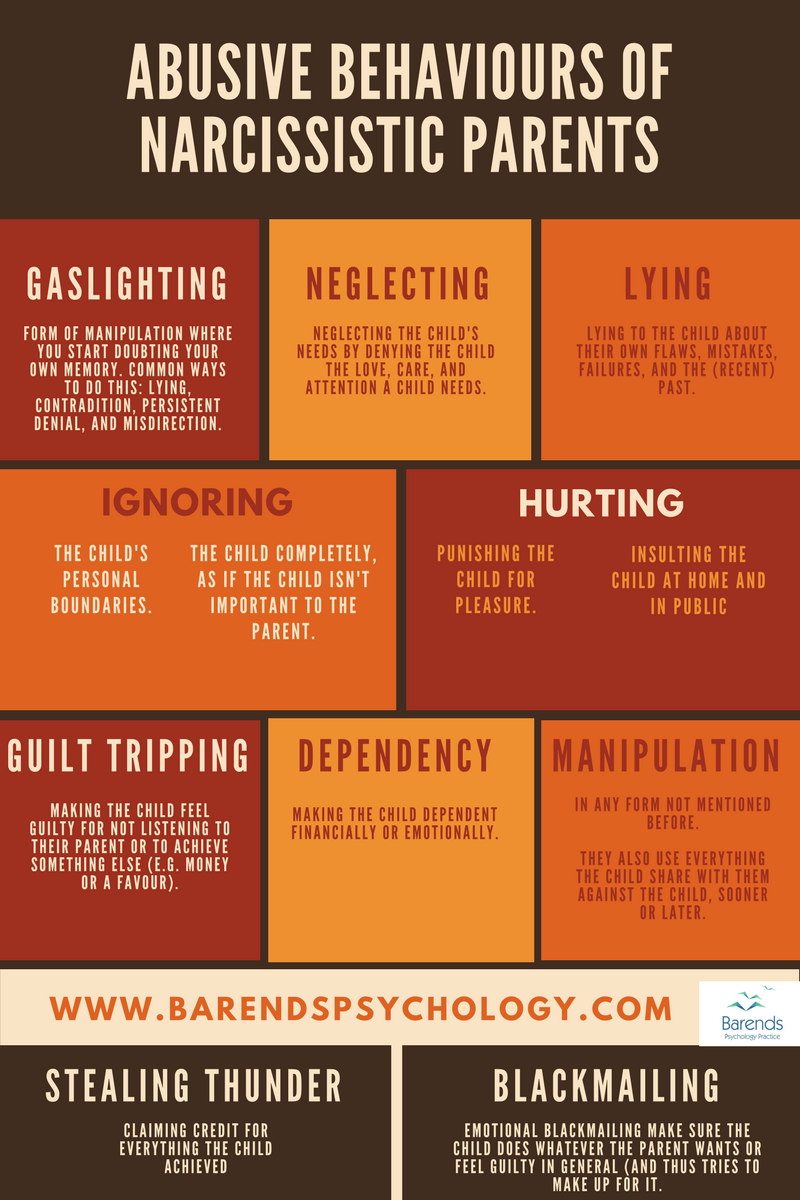
Children of narcissistic parents pressured to meet adult's needs
by Neil Rosenthal
Did you have a parent who constantly criticized you? Did this parent expect you to admire them and give them constant attention? Or perhaps your parent insisted that everything be done their way, and your contributions were ignored or devalued. If these descriptions of one or both of your parents ring true, it is very likely that you have been shaped by a parent with destructive narcissism.
An adult with healthy narcissism has a good sense of self, has empathy for others, is able to delay gratification, assumes responsibility for him/herself and for others, has a capacity to develop and maintain meaningful and satisfying relationships and has clear and firm boundaries, says Nina Brown in her book Children of the Self-Absorbed (New Harbinger Publications).
An adult with destructive narcissism, on the other hand, cannot reliably respond to a child's needs, or nurture, or respond empathetically, or put a child's needs above his/her own — or tune into the emotional life of a child. Instead, the child is expected to meet the adult's needs.
The child constantly receives messages about what they are supposed to be or do for the parent. When the child becomes an adult, the expectations are so internalized that they now respond to other people in the same way they responded to their parents, says Brown.
As an adult, you will either cater to others (and then resent them) or you will ignore others — and they will be unhappy with you. [this is what makes children of narcissists targets for pathological relationships - Barbara]
Here's a description of various components of how parents with destructive narcissism act, courtesy of Brown:
Needs attention: Becomes uncomfortable when the spotlight is turned to someone else. Will brag, throw a tantrum, sulk, act loud and boisterous, complain, act seductive and engage in one-upmanship.
Needs admiration: Fishes for compliments or approval, flaunts possessions, is vain, gloats over wins, tries to impress others and does everything — so others think they are “superman” or “superwoman.”
Feels what they have to say is more important than what others have to say, so they frequently interrupt others; does not wait their turn; becomes angry when ignored or overlooked; tries to find a way around rules or laws; expects to be taken care of first and to receive more service than others.
Has a lack of empathy. Is more interested in their concerns than in yours; ignores your feelings and fails to listen to you; diminishes the importance of your concerns, issues or feelings and calls you “touchy” “oversensitive” or that “you brought it on yourself” if you say you feel devalued or upset.
Wants to control what you do and say. Expects you to drop what you're doing and attend to them; uses your possessions without first asking permission; gets angry when you don't act as they tell you to; forces you to accept unwanted touching or kisses, and makes you feel inept when you don't rely on them to tell you what to do.
Considers others as inferior. Is easily offended by any hint that you think they are wrong or mistaken; is wounded when you disagree with their opinions or suggestions; is arrogant and acts as if they are control of everything.
Has shallow emotions, except for anger and fear.
Acts entitled. Expects to receive more attention, special consideration and deference. Assumes that their wants and needs take priority over yours, and that things be done in their way.
Exploits others by making misleading statements, being manipulative, lying, not reciprocating a gift or favor or by using emotional blackmail.
Is emotionally abusive. Makes demeaning comments about your appearance or abilities, is critical, devalues you and your accomplishments, suggests that whatever you do or say is never quite right, attacks without provocation and keeps you on the defensive.
THIS INCLUDES GRANDCHILDREN!!!
Neil Rosenthal is a licensed therapist in Westminster and Boulder, Colorado
Labels: adult children of narcissists, control, criticism, lack of empathy, narcissist, narcissistic father, narcissistic mother, narcissistic parent, rage
Friday, January 12, 2018
Adults Shamed as Children

The following is quoted from Shame & Guilt: Masters of Disguise by Jane Middelton-Moz, Ph.D.
1. Adults shamed as children are afraid of vulnerability and fear exposure of self.
2. Adults shamed as children may suffer extreme shyness, embarrassment and feelings of being inferior to others. They don't believe they make mistakes. Instead they believe they are mistakes.
3. Adults shamed as children fear intimacy and tend to avoid real commitment in relationships. These adults frequently express the feeling that one foot is out of the door, prepared to run.
4. Adults shamed as children may appear either grandiose and self-centered or seem selfless.
5. Adults shamed as children feel that, “No matter what I do, it won't make a difference; I am and always will be worthless and unlovable.”
6. Adults shamed as children frequently feel defensive when even minor negative feedback is given. They suffer feelings of severe humiliation if forced to look at mistakes or imperfections.
7. Adults shamed as children frequently blame others before they can be blamed.
8. Adults shamed as children may suffer from debilitating guilt. These individuals apologize constantly. They assume responsibility for the behavior of those around them.
9. Adults shamed as children feel like outsiders. They feel a pervasive sense of loneliness throughout their lives, even when surrounded with those who love and care.
10. Adults shamed as children project their beliefs about themselves onto others. They engage in mind-reading that is not in their favor, consistently feeling judged by others.
11. Adults shamed as children often feel angry and judgmental towards the qualities in others that they feel ashamed of in themselves. This can lead to shaming others.
12. Adults shamed as children often feel ugly, flawed and imperfect. These feelings regarding self may lead to focus on clothing and makeup in an attempt to hide flaws in personal appearance and self.
13. Adults shamed as children often feel controlled from the outside as well as from within. Normal spontaneous expression is blocked.
14. Adults shamed as children feel they must do things perfectly or not at all. This internalized belief frequently leads to performance anxiety and procrastination.
15. Adults shamed as children experience depression.
16. Adults shamed as children lie to themselves and others.
17. Adults shamed as children block their feelings of shame through compulsive behaviors like workaholism, eating disorders, shopping, sexual addiction, substance abuse, list-making or gambling.
18. Adults shamed as children often have caseloads rather than friendships.
19. Adults shamed as children often involve themselves in compulsive processing of past interactions and events and intellectualization as a defense against pain.
20. Adults shamed as children are stuck in dependency or counter-dependency.
21. Adults shamed as children have little sense of emotional boundaries. They feel constantly violated by others. They frequently build false boundaries through walls, rage, pleasing or isolation.
Labels: adult children of narcissists, boundaries, childhood abuse, compulsivity, guilt, rage, shame, victims