Sanctuary for the Abused
Tuesday, May 21, 2019
Pathological Narcissism - A Spiritual Disorder
Dr. Maria Hsia Chang, Professor
Political Science, University of Nevada
In psychology, personality disorders refer to individual traits that reflect ingrained, inflexible, and maladaptive patterns of behavior that cause discomfort and impair a person’s ability to function--including her relations with friends and family. At least ten distinct personality disorders have been identified, one of which is the narcissistic personality disorder (NPD) that the American Psychological Association (APA) classifies as a "cluster B" disorder.
NPD is a highly complex psychological-behavioral syndrome that confounds and baffles those close to the afflicted. Once understood, however, one achieves clarity of vision.
Socio-biologists maintain that narcissism is natural for both individuals and groups because self-love is an instinctive, natural-selection trait. That is why all children are narcissists. As individuals mature into adulthood, however, they become less narcissistic because their insecurity tends to diminish as a result of concrete achievements and successes. A certain degree of healthy self-love nevertheless continues into adulthood. It is when narcissism in adults is excessive that psychologists consider it to be a sign of immaturity or worse, a pathology--that of narcissistic personality disorder.
Although the phenomenon of excessive narcissism is as old as humanity, the formal diagnosis of NPD was made by the APA only as recently as 1990.
I’ve compiled the following, after having read, assimilated, and synthesized a great deal of the literature on this subject. Instead of the typical approach taken by the psychological literature on NPD--which describes the disorder as a syndrome of various attributes--what I attempt to do here is to uncover the central logic that accounts for the syndrome. In the following description of the NPD syndrome, I use the pronoun "she" to refer to the narcissist, for the sake of avoiding the cumbersome "he/she" and " his/her."
Some psychological literature, claims that male NPDs outnumber females. The literature also claims that the incidence of NPD is relatively rare, afflicting an estimated 1% of the population. Both of these claims, however, are not verified by my own personal experiences. The problem, as the psychological literature itself admits, is that the very nature of NPD prevents narcissists from admitting they have a problem and to seek professional help. As psychiatrist M. Scott Peck explains: "To receive treatment one must want it, at least on some level. And to want it one must consider oneself to be in need of it. One must, at least on some level, acknowledge his or her imperfection." The few narcissists who do seek therapy, do so when their narcissism has led to a major life crisis, such as divorce, drug addiction, unemployment, and imprisonment. Even when NPDs seek counseling, they typically do not complete the course of psychotherapy. Instead, when the therapist confronts them with their pathological narcissism, the NPD would simply abandon treatment and flee. Given this, I have every reason to conclude that the statistics claimed in the literature are suspect. The simple truth, I believe, is that psychologists don’t really know how many NPDs there are in the population, nor do they really know that male NPDs outnumber females.
The NPD Syndrome
At the core of the NPD syndrome is the construction of a false self as a way to cope with the external world by compensating for the individual’s feelings of insecurity and uncertainty of identity.. Like its namesake, the mythic Narcissus who is in love with his reflection in water, the self that the narcissist loves is not her real self, but a false self that is grandiose, perfect, and superior. The particular basis of the grandiosity is what the narcissist loves herself for. That varies according to the individual, and may be physical beauty, intellect, talent, power, etc. As a consequence, psychologists divide narcissists into two types: the somatic and the cerebral. The former are those whose narcissism is focused on their bodies; the latter are those who have a grandiose conception that they have a superior intellect.
I would add a third type: the spiritual narcissist. These are those who ooze with false piety, having a false conception of themselves as supremely virtuous.
Regardless of the particular basis of grandiosity, the narcissist strives to maintain and protect that false self at all costs. In effect, the grandiose false self acts like the center of a wheel, to which are affixed the spokes. The latter are the syndromatic attributes of NPD, which function to protect and maintain the grandiose false self. The constellation of attributes is not accidental because there is a functional reason for the various attributes. This is the underlying logic that accounts for the syndrome.
Together with the APA’s DSM IV criteria, those "spokes" may constitute a particularly malignant form of narcissism.
They include the following attributes
Using people—even supposed loved ones—as tools of self-aggrandisement to affirm and maintain the false self. The narcissist is hollow inside and derives her sense-of-self from seeing her reflection in the eyes of others. The psychological literature calls this "mirroring": the narcissist mainly uses other people as a mirror to reflect her grandiose self-conception. Like a vampire who must feed on others’ blood in order to live, the narcissist feeds on other people’s love, approval, admiration, and compliments. Once the source is sucked dry, the narcissist no longer has use of that person and will abruptly and mercilessly cast him/her aside.
To lure people into her web, the successful narcissist puts on an attractive social mask. She can be charming, gracious, socially adept, even obsequious. She must also be a consummate actor, skilled at simulating the whole range of human emotions, especially those of love, compassion, and kindness. The more successful she is at simulation, the greater her circle of friends and acquaintances who function as her primary and secondary feeding sources.
More than to lure people into her web, the narcissist’s charming social mask also conceals the false self from scrutiny. Concealment requires secrecy, evasion, dishonesty, and lying. In effect, the narcissist is a consummate pathological liar, i.e., she habitually lies, even about seemingly trivial, inconsequential matters.
Using other people as her "bloodbank" requires that the narcissist be a human emotional radar. The successful narcissist is psychologically astute and shrewd so that she can "size up" everyone she encounters for their potential to be her blood-donor.
Cynically using other people also requires that the narcissist be lacking in empathy. Do not be fooled by her simulations at empathy. A good experiment is for you to withhold your approval and compliments. You will discover that, overnight, the narcissist has lost her kindness and even simple civility.
The maintenance and protection of the false self also requires the narcissist to be constantly vigilant against being "attacked" by others. This is why the narcissist overreacts with rage and humiliation to any perceived criticism, no matter how minor or trivial the perceived criticism.
As the saying goes, "the best defense is offense." More than reacting with rage to criticisms, the narcissist attacks the critic. This is called scapegoating--projecting one’s own faults (what Carl Jung called our "shadow") onto another person, and blaming the other for the narcissist’s own inadequacies. The narcissist is very skilled at this.
The false self must be impervious, which requires the narcissist to resist self-examination and introspection. Doing so would open the narcissist to reality-based assessment--a dangerous undertaking because the false self is, by definition, unreal. As a consequence, instead of the insecurities of normal human beings, the narcissist exhibits an impassive and uncritical acceptance of herself.
The inability or unwillingness to be introspective, in turn, results in cognitive dissonance, cognitive gaps, and non sequiturs. Trying to engage a narcissist in serious dialogue--especially about herself or her beliefs and values--can be a disconcerting experience because nothing she says makes sense.
Since the false self is superior and grandiose, it needs no one. The narcissist dreads becoming dependent on others, but asserts and clings to an exaggerated independence. Since her love of herself is all-consuming, she is incapable of love and emotional commitments to other people. This is why the narcissist reacts to sincere declarations of love (verbal or in the form of behavior, such as significant gifts) by emotionally distancing herself and, in some cases, outright abandonment--because she is unable to reciprocate that commitment..
In effect, the narcissist’s grandiose self-conception makes her a god unto herself. Gods are not subject to the morality that governs lesser beings--"rules don’t apply to me." The narcissist refuses to subscribe to society’s moral rules and ethical standards. Instead, morality is subjective: "Nobody can judge me." One NPD I know exhibited this trait when she blithely received the Holy Eucharist (believed by Catholics to be the actual body of Christ) in Mass--although she is not Catholic. Another NPD, a former student of mine, responded with rage to my critique of his essay-exam, which garnered a respectable "B" grade, insisting that he was not subject to the grammatical rules of the English language.
Lacking an abstract universal system of moral codes--and being cognitively impaired--the narcissist lives in a world of feelings and sensations: "What’s good is that which makes me feel good." Narcissists tend to wallow in cheap "feel good" sentiments. • Since the false self is grandiose and perfect, relationship problems are never the fault of the narcissist. She blames everyone, but herself. This also means that narcissists do not ever apologize or admit that they are wrong or at fault. Instead, they will always subtly, if not blatantly, turn things around to blame you.
All of this means that narcissists do not, as a rule, seek therapy. In the few cases that do, it is because their problems have become so serious that they cannot be ignored (e.g., divorce, drug abuse, job loss, imprisonment). Even then, the narcissist resists therapy and is likely to blame the therapist (scapegoating!) and flee from treatment.
How to Deal With a Narcissist
The first rule is: Give up on your fantasy that you have an authentic relationship with the narcissist. Sadly, the person you think you love/like never existed.
The second rule is: Don’t be a bloodbank for the narcissist.
The third rule is: Be emotionally detached.
The fourth rule is: If you must interact with her, challenge the narcissist’s false conceptions of herself by insisting on reality-based assessment. Doing so, however, is guaranteed to alienate you from the narcissist--which is a good thing because the narcissist is incapable of genuine friendship and love. In the last analysis, you are better off without the narcissist.
If, unfortunately, you must have her in your life because your survival depends on her, as in the case of a child needing the narcissistic mother’s care, the way to get along with her is to feed her fantasies by lavishing compliments on her, i.e., by letting yourself be her bloodbank.
Pathological Narcissism is a Spiritual Disorder
A fifth-century theologian who called himself Dionysius the Aereopagite once wrote in The Divine Names that, "The denial of the true Self is a declension from Truth." In the last analysis, in constructing and clinging to their false selves, the entire persona of the NPD is a big lie. That being so, I have come to believe that NPD is not a psychological disorder at all, but a moral and spiritual disorder. Allow me to explain. An intrinsic attribute of the NPD syndrome is deception--of oneself and of others--in the service of maintaining the grandiose false self. Philosopher René Descartes wrote that "willful deception evinces maliciousness and weakness."A person does not deceive without thinking about and willing it. One does not lie unless one intends to hide the truth, which means that one knows that one is being deceptive. Nor can the NPD put together and maintain the elaborate and intricate NPD syndrome of attributes (e.g., using others for self-aggrandisement, attractive social mask, secrecy, evasion, lying, scapegoating, etc.) without conscious effort.
Psychologists say that, in their quiet moments, NPDs know that they are not really as grandiose as they pretend:
When NPDs cynically use others to "feed" their false self, they know it.
When they overreact to perceived criticisms, they know what the truth is.
When they lie to conceal their inadequacies, they have chosen to deceive.
When they scapegoat others, they do so with deliberation.
When they refuse to apologize, they know they are in the wrong.
All of which means that free will is fully engaged in this so-called "disorder."
In effect, the NPD is more than a mental sickness. Pathological narcissism is not some noxious virus or bacteria that overtakes a person. Whatever the early childhood experiences, free will is still operative here. Rather, NPD is a moral disorder, because it is immoral to lie and to use, exploit, blame, and hurt others.
More than immoral, NPD is, at its foundation, a spiritual blight. Since the false self of the narcissist is extremely grandiose, she excludes herself from the moral norms that govern "lesser" beings: "rules don’t apply to me." That makes NPDs their own gods. In so doing, they are in denial of the fundamentally flawed nature of all human beings.
The malignant narcissist is more than immoral, she/he is evil.
In his book, People of the Lie, Peck proposed to the psychological profession a new diagnostic category of the "evil personality disorder" (EPD) as a sub-type of NPD. As he put it, "The evil are ‘the people of the lie,’ deceiving others as they also build layer upon layer of self-deception." And when the narcissist intentionally hurts another, she has crossed the line from being an NPD to being an EPD. In Peck’s words, "evil individuals will flee self-examination and guilt by blaming and attempting to destroy whatever or whoever highlights their deficiencies.". Except for atheists (who must be very grandiose because they claim to know a negative, i.e., that God does not exist),viall of us--the religious as well as agnostics--believe in the existence of some supreme moral being or force in the universe.
Recognizing that, most of us harken to these words of Descartes: "I have been so constituted as to be some kind of middle ground between God and nothing .
I am not the supreme being, I lack quite a few things.
Dionysius the Areopagite concluded that being self-centered is "inherently wrong" because we have "no right to be the centre of things" as only God is the rightful center of all things.
Not only is vanity and pride the first of the Seven Deadly Sins, I believe that narcissism is the root of all evil. Decrying the ills that he saw rampant in modern society--the relativization of all moral norms and the reduction of life to the immediate pursuit of material gain without regard to its general consequences--VaÇlav Havel observed that "Given its fatal incorrigibility, humanity will have to go through many more Rwandas and Chernobyls before it understands how unbelievably short-sighted a human being can be who has forgotten that he is not God."
It is the misdiagnosis of pathological narcissism as a "personality disorder" instead of a moral-spiritual condition which accounts for psychiatrists’ characterization of it as "one of the most . . . difficult-to-treat conditions in the lexicon of mental illness.
JOIN OUR FACEBOOK SUPPORT GROUP FOR VICTIMS OF NARCISSISTS & PSYCHOPATHS
Labels: evil, exploitative, manipulative, narcissism, narcissists, spirituality


Friday, November 02, 2018
BETWEEN GOOD AND EVIL
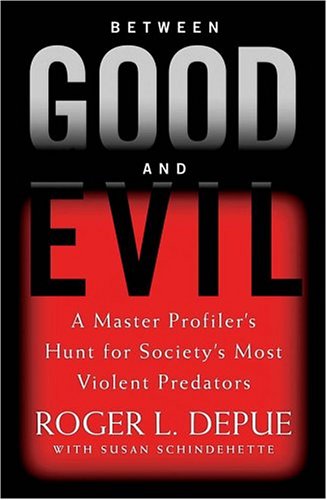
BETWEEN GOOD AND EVIL BY ROGER L. DEPUE.

In addition to his work as head of the FBI’s Behavioral Science Unit and founder of the elite private sector consulting firm, The Academy Group, Roger L. Depue has also worked as a police chief, a SWAT Team member, and is a former Brother of the Order of Missionaries of the Holy Apostles. He speaks widely as a corporate consultant and has been interviewed by People magazine, CBS’ 48 Hours, and most recently The Discovery Channel, for whom he constructed a hypothetical profile of Deep Throat for an upcoming program pegged to the 30th anniversary of the Watergate break-in. The Academy Group also served as the real-life basis for the Fox television series, Millennium.
Most recently, in addition to his ongoing casework with The Academy Group, Depue acted as a consultant on Universal Studio’s Red Dragon, a feature film version of Thomas Harris’ first Hannibal Lecter novel, which opened in October 2002 starring Anthony Hopkins, Ralph Fiennes and Edward Norton. His memoir, Between Good and Evil co-written by Susan Schindehette, was recently published by Warner Books.
CHAPTER ONE BY ROGER DUPUE CO-WITTEN WITH SUSAN SCHINDEHETTE
TESTAMENT
SHE WAS SOMEONE’S DAUGHTER, fifteen years old, found lying on a mound of earth just off a desolate country road, with frosted pink polish on her fingernails and a gaping wound where her throat had been cut. As I surveyed the scene, surrounded in stillness, I studied the details of this tableau—little girl’s hands, clothing missing below the waist, bruises circling the fragile neck. But beyond the obvious evidence of violence, there was something jarring about the way the killer had left her here.
She was on her back, arms straight down at her sides. Yet after a brutal sexual assault, her legs were together now at knees and ankles, drawn up and tipped, almost demurely, to one side. Her killer had left her in a position of peaceful repose. Gently, it seemed. Tenderly. As if she were a sleeping child.
For ten years beginning in 1979, I was chief of the FBI’s Behavioral Science Unit, at a time when its pioneering work in the field of criminal profiling first came to prominence, thanks in part to author Thomas Harris, who picked the brains of our profilers in conjuring up the character of Dr. Hannibal Lecter for his novel The Silence of the Lambs.
Today, in a related incarnation, I am the founder of The Academy Group, an elite international crime consulting firm whose half dozen members, all FBI, CIA, or Secret Service veterans, constitute a brain trust of the world’s top forensic behavioral science experts in their respective fields: from sexual homicide and child predation, to international terrorism and espionage.
In that role I have listened to tapes of the Columbine school shootings, studied the rage wounds inflicted with a golf club on Martha Moxley’s skull, analyzed the JonBenet Ramsey ransom note, and helped a colleague plan his approach in debriefing the notorious FBI agent-turned-traitor Robert Hanssen. I am summoned to cases when all other investigations have failed, when law firms, police jurisdictions, or the emotionally devastated families of victims have nowhere else to turn. It is work that calls on me to be an advocate, a father confessor, and, sometimes, even a bit of the diviner.
In the course of my career I have seen horrible things—cruelty and human depravity in every imaginable permutation. In the 1980s I supervised agents investigating a series of bizarre homicides in California, in which the killer not only eviscerated his victims, but lingered at the scene while blood pooled in their abdominal cavities. Only after carefully studying the crime scene did we recognize the special proclivity of twenty-seven-year-old Richard Trenton Chase, whom the press later christened the Vampire Killer. It was revealed in the odd ring marks found on the floor next to victims, the kind that might be left by someone drinking from a blood-filled plastic yogurt cup.
A decade later, reviewing the murder of a housebound elderly woman, I noted the tremendous amounts of blood—sprays of darkening crimson on the walls, ceiling, and floors in the room where she was killed. But I was also struck by something that had not been given much significance by local police—the fact there was no blood at all on any of the room’s baseboards. The killer, I realized, must have wiped them down afterward.
Even after forensic lab tests confirmed that scenario, there was still no obvious message, of the kind left as a taunt by the seasoned serial killer at a crime scene. This was evidence of a disordered perpetrator clinging to the control afforded by familiar routine. Of someone, I thought, who might recently have left a psychiatric facility. Ultimately, investigation did indeed bear out that theory—the perpetrator was a young man just released from a California state mental hospital, whose job had been cleaning the baseboards on his ward.
Now, at a rural crime scene near a farmer’s field, I was trying to solve the brutal murder of an innocent fifteen-year-old girl. And I began to try to decipher what our killer had written with his savagery.
Bloodstains pointed to the precise location of the murder, a dense wood thick with stands of evergreen and maple, fifty feet from the side of the road. But the killer had chosen not to leave his victim there, and I knew what that meant. Any subject with normal human response—one who had, say, raped this young girl and then, in a panic, killed her—would have done all he could to hide his crime and avoid detection. He would have left her in the woods, perhaps in a shallow grave, or at least made some effort to hide her corpse in the brush. But this killer followed a different imperative. He had deposited his victim where he was certain she would be found.
Why would he do such a thing? Was he a braggart, a provocateur? I didn’t think so. I have seen sexual predators make unspeakable displays of their victims, violating them with gun barrels and broom handles in what hardened investigators refer to as “stick jobs.” But this killer had shown no such contempt. It seemed to me that there was only one plausible explanation: He had moved his victim because he did not want to leave her in the woods, unseen, where she might be vulnerable to insects or animals. He wanted whoever found her to appreciate her—as he had—with her freshness and beauty still intact.
Even so, he might have dragged her by the hair, or simply dumped her body. Instead, he had gone to the trouble of laying her carefully on a raised berm, higher than the surrounding ground. And then I began to understand. This killer did what human beings have done with objects of veneration since time immemorial. He had placed his victim on an altar.
Quickly, the pieces began to fit. After he had brutalized her, he felt remorse, very nearly a tenderness toward her. He treated her gently after he killed her, and I knew now exactly how he had transported her to this resting place. He had carried her from the spot where he had killed her the way a parent would a sleeping child—slipping one hand beneath her back, and the other under her knees. Then, when he laid her down softly on the ground, as if not to wake her, her knees had rolled gently to one side. What did this mean?
It meant that he knew her. Finally, it was clear to me. Whoever killed this young girl had also, in his own evil way, loved her.
How can those two things—love and hate—exist together in a person? In the same way, I believe, that good and evil exist in the world. In a constant state of tension, fighting each other for dominance. I know something about that struggle. I believe that I have a deeper understanding of these things than most people do.
My work has given me a profound respect for what humans suffer at the hands of evil, and a particular sensitivity for what its victims endure. During every investigation that I participate in, there is always an invisible observer at my shoulder, whose presence I never forget. Regardless of the circumstances of a case, I am always giving voice to its silent victim.
What must this young girl’s final minutes have been like? Did she cry out while he was repeatedly stabbing her, or keep silent, breathing like a wounded animal, watching for the next glint of a blade? Did her thoughts turn to her parents in those final seconds, when she was overwhelmed by the deepest loneliness she had ever known? Did she experience a dissociative response, the sense of drifting upward and watching her own death as if from above? Or did she sink mercifully into unconsciousness, and feel nothing as her life ebbed away?
The most difficult part of solving a case is the fathoming of it, the understanding of the measure of evil that produced it. The rest—the legwork and interrogation—come only after the intuiting, as the means of proving an investigative hypothesis. In this instance, once I had a clear picture of how the crime had occurred, the rest was not difficult. Investigators narrowed their focus to a relatively short list of potential suspects, questioned them thoroughly, and ultimately charged and convicted an obsessive young man—the young girl’s neighbor.
When I was a young man, a friend taught me the ancient art of dowsing, and after a time, I became something of a practitioner myself, finding water underground as a kind of parlor trick for friends. It might seem odd that a man so rooted in grim reality would take an interest in something so ethereal. In fact, I’m fascinated by the unseen forces at play in the lives of human beings.
Still, I’m sometimes challenged by abstract intellectual discussion about the nature of evil. If Hitler genuinely believed that he was carrying out a noble mission by exterminating Jews, some wonder, was he truly evil? Were there mitigating factors, others ask, for the genocide of his countrymen carried out by Cambodia’s Pol Pot? What exactly runs through the mind of an Osama bin Laden? I’ve never had the time to engage in such armchair dialectics. My job has been to try to stop human predators before they kill again, and after studying them so closely over so many years, to me their traits seem clearly recognizable.
They are rational, sadistic, often intelligent, and almost invariably narcissistic. They see themselves as living in a realm somewhere above the rest of us, in a place where the rules of normal society do not apply. Over the years, I’ve drawn up a list of their common operating principles, something that I call the Anti-Commandments: “That which you love is what I most seek to destroy.” “Life is as meaningless as death.” “There are few things more pleasurable than hurting someone who is trying to help me.” “People die too easily. It should be more painful, and take longer.”
The depth of this psychopathic evil is beyond the comprehension of most normal people. I have seen it many times: a pedophile is arrested, a man from a comfortable, upper-class neighborhood. Suddenly, all of his neighbors express shock and disbelief. “He was such a fine, upstanding man, a doting father. Why, he even coached Little League. He can’t possibly have done what he’s accused of.”
What those good people don’t fully comprehend is that, as a pedophile, this man is, above all, a sexual abuser of children. That is what he is at his core. He hurts children because, to him, their suffering is of no consequence. It is a meaningless by-product of behavior that makes him feel good, and his own pleasure is more important to him than anything, or anyone, else. Invariably, even from behind prison bars, he will never concede that what he did was damaging to a child. No, he insists, what he did was done out of love. It’s the rest of the world that doesn’t understand.
The reality is that this man’s wife, his nice house in the suburbs, his coaching job, even his own children, are props—the artifice that covers up, and facilitates, what he truly is. He continues to do what he does because that is what he cherishes above all else. What is most real about him is his evil.
Evil is more than a vague notion. It is an entity, and it is manifest on the earth. It has reflexes and intuition, senses vulnerability, and changes its form to adapt to its surroundings. Those who do not believe the Devil walks this earth have not seen the things that I have seen.
The stories I will relate are not fabrications. I have witnessed the unbelievable. Eviscerated children. Mothers who have sold their own toddlers into prostitution, and profited from the videotapes of them being victimized by strangers. Fathers who sleep with their daughters, and their daughter’s daughters. A man who, because a six-year-old girl doesn’t know her spelling words, binds her with duct tape and pierces her with an embroidery needle more than two hundred times.
Evil is not a discrete entity that springs forth fully formed. It is born in the mind, takes root there as fantasy, and prospers when normal human restraint can no longer contain it. I have seen it devour the personalities of men like Richard Speck, Jeffrey Dahmer, and Ted Bundy, turning them into blank-faced sociopaths who clearly know right from wrong, but choose, time and again, to follow their own base urges, with complete disregard for the terrible human suffering they cause.
I believe that every act of homicide causes a slight unbalancing in the world, and that it diminishes life’s universal equation. In the interest of justice, it is imperative that someone try to right that imbalance. But the task of fighting evil can take a terrible toll on the people who are charged with it. It can cost them their families, their equilibrium, their capacity for joy.
A relentless diet of human misery and sadistic violence can bring any human being—even those armored by years of experience in a law enforcement career—to the brink of despair. I once came to that place myself. But I returned from it, because, along with the evil, I have also come to know something about the redemptive power of good.
A decade ago, I lost the person who embodied most of what was true and worthwhile in my life, and the tragedy of her death caused a grief so great that I came to question God’s very existence. I made a decision to leave the world for a holy place, one that, I hoped, would be untouched by evil. I did my searching there, and made my peace. But ultimately, I came to understand that it was only by returning to the world that I would find redemption.
I have stood at the edge of the abyss and peered down into the darkest things that human beings are capable of, at times feared that evil, and very nearly seen it bring me to my knees. But, always, I have tried to conquer it, or at least to force it into submission. In the final accounting, I am a man of faith, in spite of the work that I have done. Or, perhaps, because of it.
How is it that a human being can dwell in the midst of such depravity, be reminded every day of the suffering of victims, and emerge from it intact? Is the path of evil irrevocable, or do we have the power to change it? It’s not for me to preach or posture. I can only bear witness to what I have seen.
I believe that we are all players in an ongoing battle, one that is both larger and more subtle than we often realize. What follows is a dispatch from the front lines of that war—a cautionary tale. It is the story of one man’s travels through darkness and redemption, a testament to the belief that in the unending struggle between God and the Devil, evil prevails in this world mostly when we, through apathy, fear, or indifference, allow it to.
In the fall of 1990 a phone call came to my Virginia consulting firm, The Academy Group, from a law firm in Bucks County, Pennsylvania, requesting our help with a cold case robbery-homicide that had taken place some six years before. Its victim, a young woman in her twenties, had been found early one morning, stabbed to death, in the kitchen of the fast food restaurant where she worked. Her name was Terri Brooks.
The attorney, Greg Sturn, with the firm of Harris and Harris, told me that despite a lengthy investigation, local police had never been able to solve the case. But since money was missing from the restaurant safe, and similar fast food robberies had been common in the early 1980s, the consensus was that this must have been the same thing—an armed robbery gone bad.
Now, said Sturn, the dead girl’s father and stepmother, George Brooks and his wife, Betty, intended to file a wrongful death suit against the Marriott Corporation, owner of the restaurant chain where Terri had worked. Since Terri’s death occurred while she was on the job, state law dictated the case be filed as a workmen’s compensation claim; that was the sole legal remedy available to the Brookses. And that presented a problem. Under workmen’s comp rules, the only parties eligible for a monetary award were the victim’s dependents, and Terri, who was single and childless at the time of her death, had none. Which meant that her only living survivors—her parents and siblings—could file a claim, but weren’t eligible to collect a financial settlement.
It seemed like a cruel catch-22. But there was an alternative, said Sturn. Pennsylvania law allowed one exception to the workmen’s comp provision: If a plaintiff could prove that something called “personal animus”—malevolent ill will—had existed between killer and victim, then Terri’s parents could step outside the workmen’s comp restriction and take their case to civil court. Of course, the idea that Terri’s killer knew her might well make a negligence case against the corporation more difficult to prove, but Sturn wasn’t worried about that. Marriott company policy clearly stated that employees weren’t supposed to work alone at night. And on the night she was murdered, Terri had been closing up the restaurant alone.
That was the financial issue, but of course, it wasn’t the only one. After George Brooks and his first wife—Terri’s biological mother—had divorced, he went on to raise Terri and her three brothers and sisters by himself, and it was obvious he had loved his daughter deeply. He managed to survive in the wake of her murder, as the parents of many murdered children do. But it hadn’t been easy. George Brooks did the best he could to carry on with his life. But six long years after Terri’s death, he was still grieving. He needed to know who had killed his little girl.
After talking it over with my colleague, Ken Baker, we agreed to take on the case, and I asked the law firm to send us what information they had. A few days later, it arrived—a large manila envelope of investigative reports, depositions, police reports, autopsy information, and crime scene photographs. I poured myself a cup of coffee, we closed the door behind us, and sat down at the table in our conference room to begin reconstructing what had happened to Terri Brooks in the final hour of her life.
Just after 6:00 a.m. on the foggy morning of February 4, 1984, the general manager of a Roy Rogers restaurant at Oxford Valley Road and Route 1 in Falls Township, in Bucks County, came to work. He found the outer restaurant doors unlocked, the inner doors locked, and immediately became suspicious. He went inside, and was heading for the kitchen when he saw shoes and a set of store keys on the floor. Then he discovered Terri Brooks, twenty-five, his assistant manager, lying on the floor. She had been brutally murdered, and $2,579 was missing from the office safe.
When Terri didn’t return home that morning, her father, George, called the restaurant to see if she was there. He was told Terri had been taken to the hospital. “Is she all right?” he asked. “Is she all right?” Finally, they gave him the terrible news: Terri was dead.
All murder cases are tragic in their own way, but this one broke your heart. George Brooks was working class, and he had helped put Terri through college at the University of Maryland. She hoped to have a career in restaurant management, and she often stayed after closing at the restaurant, finishing up the paperwork. She was also engaged to be married that coming summer. In fact, two days before her death, she and her fiancé had put down a deposit on a honeymoon trip to Hawaii. Later that week, Terri was going to pick out her wedding dress.
A good investigator can tell a lot about a killer by studying evidence at the scene of the crime—blood splatter, the position of the body, the pattern of wounds. But the killer isn’t the only one to leave telling information. Sometimes, the victim leaves a message, too. And as I looked at the horrific murder scene photographs, I felt it: Terri herself was trying to tell us something.
She was found lying in a pool of blood on a dark industrial tile floor, on her back, not far from the restaurant’s office, still wearing her winter jacket. Her shoes, keys, and cigarettes were lying nearby. Her face was cut and badly bruised. The hyoid bone in her throat was fractured, which meant she had been strangled. A clear plastic trash bag liner was wrapped around her neck, covering her head. And a butcher knife was protruding from her throat, lodged with such force it couldn’t be pulled out from between the vertebrae of the spinal column.
In all of my years of law enforcement, I had never before seen anything quite like it: beating, strangulation, stabbing, and suffocation—four distinct modes of death. At that moment, I had no idea who had taken this young woman’s life so brutally, or why. But I did know that whoever murdered Terri Brooks had killed her four times.
We began to piece together a hypothetical sequence of events. It was a Friday night, and the kitchen had been cleaned and prepped for the morning shift, and Terri was ready to go home. She had her coat on and her purse, cigarettes, and keys with her. She was closing up when someone came to the door. Whether she knew the person or didn’t, she let him in. Then something began to go horribly wrong. It was as if she had suddenly said to herself, “I’ve got to get out of here.” She bolted for the door, and if it had only opened outward instead of inward, she might have made it.
He hit her like a football player, tackling her so hard she was literally knocked out of her shoes. Her purse, keys, and cigarettes flew onto the floor. She was stunned, but after taking a moment to recover, she started to fight back. She had played intramural sports in college. She was young and athletic, and fought with all her strength. They exchanged blows. He punched her in the face repeatedly, hitting her as hard as he could.
At some point, he dragged her across the tile floor, causing holes in her nylons on the top of her feet, worn away by the friction. There was a tremendous bruise line across her upper chest, from where she was slammed into the stainless steel counter. He started to strangle her, with such force he fractured the hyoid bone, just below the larynx. But she continued to fight.
Then came the butcher knife. Maybe the killer was the one who took it first, from the rack above the oven. Maybe it was Terri who grabbed it in an effort to defend herself, in which case he would have wrested it away from her. She had defensive wounds on her hands, which meant that as he was trying to cut her throat, she put her hands up to keep the blade away. Finally, perhaps holding her around the neck from behind, he plunged the knife into the front of her throat, where it partially cut her spinal cord. Still, she struggled. He pulled the knife out, but only partway, and then plunged it in again, harder. This time, the blade entered between the sixth and seventh vertebrae, and severed the other half of her spinal cord.
Now she was paralyzed from the neck down, and she went limp, slipping to the floor. When she was found, her arms and legs were not cocked or bent, but extended straight out. At that point, she would have offered no resistance.
The knife was still protruding from her throat, lodged tightly between the vertebrae of the spine. As she struggled before she was stabbed, her neck had been extended, and the blade was thrust into her with such force that when she dropped to the floor, her head snapped forward, wedging the blade between her vertebrae. Even after all that, she was still alive. The blade had not severed her jugular vein or carotid artery. Her assailant realized she was still breathing. So he went to a storage area where the supplies were kept, and found a plastic trash bag. He wrapped it around her neck and head and, in one final spasm of violence, asphyxiated her.
There are many ways to kill a human being. If the perpetrator uses a gun, it is a more distanced act, cold and impersonal. But this killer wanted the pleasure of using his hands. He wanted to see his victim’s face, to look her in the eye as she died. One thing was clear. No matter what the local police had concluded, this was no simple robbery. Terri Brooks had not been fighting for the money, or even for her virtue. This young woman had been fighting for her life.
After I examined the file and talked it over with Ken, we found that we both had the same reaction. The Academy Group had been hired by a law firm to make a determination on a legal technicality in this case—the existence of personal animus—which was very different from being assigned as a homicide investigator to find the killer. Strictly speaking, it was not our job to provide a definitive resolution to the crime.
But after seeing how Terri Brooks had met her end, Ken and I looked at each other and said, “Let’s solve the damn thing anyway.”
After all these years, it wasn’t about the accolade. I’d had plenty of recognitiby that time—citations and promotions, moments in the limelight, the respect of my peers. This was about something deeper, about knowing that the person who’d killed this young woman was still out there somewhere, living his life, as if it were the natural order of things. He’d done something unspeakable, and he was smug in the knowledge that he’d gotten away with it. There was no one to fight on Terri’s behalf. No one but us.
It wasn’t going to be easy to solve this crime, but I knew what it would take. Working along with Ken, I’d have to tap into everything I’d learned in forty years of law enforcement. Still, wasn’t that the value of the past—its bearing on the future? The search for Terri Brooks’s killer would mark a chapter in a journey that had begun many years before. It would serve as a clear reminder of where I had come from, and how far I had already gone.
Copyright © 2005 by Roger L. Depue and Susan Schindehette
thanks to Holly for bringing this book to my attention!
Labels: bizarre, cia, cruelty, depravity, evil, fbi, missionary, psychopath, shock, sociopath
Tuesday, October 30, 2018
On Evil
"Truly evil people avoid extending themselves. They will take any action in their power to protect their own laziness, to preserve the integrity of their sick self. Rather than nurturing others, they will actually destroy others in this cause. If necessary, they will even kill to escape the pain of their own spiritual growth."
by M. Scott Peck, Psychiatrist, Author People of the Lie
Labels: destroy, evil, lazy, narcissism, pain, psychopathy, sickness, sociopathy
Saturday, October 13, 2018
When Others Believe Your Abuser
(Narcissistic, Sociopathic or Psychopathic) ABUSER
Since when is it good to be friendly with bad people? Since when is winking at their wrongdoing a virtue?
Perhaps someone can quote chapter and verse in the comments, because holier-than-thous really deserve to have their religion's true teachings show what frauds their twisting of religious doctrine makes them.
In the New Testament, in Revelations, I believe, in one of the letters to the churches, some holier-than-thou Christians are read the riot act for that very same pretense.
The author unloads both barrels at them with this truth: "Good people are not lukewarm toward evil" it says.
Cowards are.
Loving good is hating evil. And vice versa. Love is an attraction; hate a repulsion. But that is too simple for complex people to understand.
Now I am not saying that we must reject everyone not perfect, for then we would reject everyone, including ourselves. But decent people need no instruction.
There is a point at which behavior becomes predatory and malicious - a point at which one is morally obligated to separate themselves from that person.You thus take away a bad actor's safety in numbers. You show disapproval. You discourage others from behaving the same way. You comfort the victim by showing him or her that the pain caused them by the bad guy matters to you.
Is any of that evil?
It's just a way of discouraging the harm the bad guy is doing others by showing that you want nothing to do with someone who hurts others like that.
Where is the sin in that, pray tell? Sounds like fine, upstanding conduct to me.
Jesus spoke of this when he said that "indecent conduct" is a special case and justification for divorce even. At the time, the terms "indecent" or "lewd" conduct simply meant "lowdown" or "despicable" conduct of any sort.
And that statement of his, qualifying his disapproval of divorce, is just common sense.
Why? Let's say you are married to a Mafia boss. Is it right for you live in his big fancy house, being waited on by his hired staff? Is it right for you to PROFIT from the crimes he commits and ther damage he does to people?
To the contrary:
it is immoral for you not to divorce him when you find out what he is.
The same people who make a virtue of "accepting" abusive narcissists, relentlessly persecute anyone for any hint of racism or sexism. THAT they won't tolerate. They wouldn't DREAM of tolerating anything politically incorrect like that.
But though they know and believe that the narcissist has brutally abused you, they see no reason to show any disapproval of that.
Hmmm. Whom do they think they're fooling?
They make nothing of that narcissist's abuse of you. They countenance it.
If instead they rejected the narcissist, they would be doing the one small thing they could to get on the right side, the victim's side.
But they abandon the victim and smile in the abuser's face.
Not so holy as they pretend.
by Kathy Krajco
SOURCE: Narcissist Sympathizers
Labels: blame, cognitive dissonance, disbelief, divorce, evil, guilt, narcissist, psychopath, sociopath, sympathy
Monday, January 29, 2018
The Dirty Dozen - Characteristics of a Psychopath
1. The ‘Jekyll/Hyde’ Psychopath comes on strong, sweeps us off our feet. Appearing to be our 'soulmate', he falsely mirrors our values, interests, goals, philosophies, tastes and habits. He mimics our ambition, integrity, honesty and sincerity. He wants to marry us quickly. This control freak wants us dependent on him. He portrays false integrity, appears helpful, comforting, generous in his 'idealization' of us phase. It never lasts as Jekyll turns into Hyde. He blames others. His victims are objectified and disposable. He convincingly mimics human emotions. His lack of conscience is shocking, incomprehensible and emotionally painful to us. We remember his odd reaction to situations. We end the relationship and salvage what we can, or we are quickly discarded as he cultivates a "new perfect soulmate". He will have numerous relationships. He may drop verbal clues about his true character early in the relationship, but we fail to grasp its meaning. Later, when the psychopath eventually emerges, we remember his early warning. His targets suffer emotional and financial devastation and our emotional recovery is lengthy. Defense Strategy: Abandon your efforts to help or cure him. His true mask exposed, your 'soulmate' is gone forever. Accept the reality. Seek therapy. Join a support group to know you are not alone. Don't take the bait when he blames or lies. They fool even trained professionals. Do not be vulnerable or naive. Prepare for a nasty divorce. Accept no abuse. Learn about mental diseases and disorders.
2. The Female Psychopath: Using her false mask, this charming "Southern
Belle" schemer appears helpless or needy, pitiful, inept or emotionally unable to cope. Even total strangers give her things she gratefully accepts. Falsely claiming to be the victim, this passive parasite lures and abuses the normal protector/ provider instincts in her male target. When her mask comes off she is cunning, ruthless, predatory, and loveless. Defense Strategy: She'll try to hook and reel you in. Take the hook out of your lip. Don't make her emotional neediness your problem. This black hole of need can never be filled. Understand the mask of helplessness is not the "real her". If she won't give reasonable answers to reasonable questions turn and run. Beware and remember "...deadlier than the male." Realize she uses sexuality as a lure. Avoid financial or emotional involvement.
3. 'Liar Liar' He will lie for no reason. He will skilfully twists our words, evade
questions, and omit important facts in his ever-changing, self-serving goals. "Hang 'em high" he says about the murderer on the 6:00 news. This hypocrite claims high morals then proceeds to exploits, manipulate and abuse others. His lies and projection are emotionally cruel. He will accuse you of being crazy. Defense Strategy: Quietly verify what he says. The grain of truth he drops occasionally is deceptive manipulation. Do not try to negotiate or bargain. Head for the door when things don't add up. Learn about projection.
4. The Thrill Seeker never learns from his past follies. Easily bored, his hunt for new thrills escalates. His reckless disregard for others endangers them. Poor impulse control, bad judgment, criminal activity and substance abuse are common. Defense Strategy: Don't get involved. Use your good judgment. Say No. Don't take the bait of his rage or manipulation. Don't bail him out.
5. The Malevolent Psychopath is now fully unmasked. We remember when his
eyes were vacant, cold and predatory. This wife-beater, murderer, serial killer,
stalker, rapist, fighter, harasser, terrorist has a 'chip-on-his-shoulder' attitude. His short fuse erupts into rages. He anticipates betrayal, humiliation or punishment. He imagines rejection and rejects first to 'get it over with'. He will harass to get your reaction and try to make you look out of control. Can become dangerous and unpredictable. He has no remorse, no conscience and no regard for the rights of others. This coward sadistically picks on the vulnerable, women, children and the elderly. Defies probation or the courts. He has bad judgment. He never learns his lesson and and repeats past actions to his own detriment. The media loves stories about his heinous acts. Defense Strategy: Act to protect yourself physically, financially and emotionally. Don't tip your hand that you're leaving. Don't take the bait of his over-reactions. Be aware of the services of the police, law and shelters.
6. The Arrogant Psychopath Displays his false mask and his haughty strut as he
demands centre stage. He seeks envy, attention even our fear and hatred. He can never get enough. Fame or infamy are the same to him if he can acquire notoriety. Reacts disproportionately to situations. He boastfully displays his possessions to garner attention. Defense Strategy: Learn the red flags of behaviour. Demand equal treatment. Deny him the attention he demands. Learn about Malignant Narcissism
7. The Charismatic Leader manipulates others to obtain status, control, compliance, money, attention. His effective brainwashing tactics often found in religious cults or political venues. He targets the naive, vulnerable, uneducated or mentally weak. He falsely portrays himself to be virtuous, the perfect father, husband, spiritual leader, advisor, mentor, friend. Defense Strategy: Avoid him. Know his payoff is attention, money or abusing us. Be suspicious of excessive charisma emanating from others. Pay attention when your gut instinct tells you to avoid him.
8. The Promiscuous Psychopath (male or female). Pornography, hypersexuality, masturbation, poor boundaries, exhibitionism, use of prostitutes, incest are reported by his targets. Anyone, young, old, male/female are there for his gratification. This predator takes what is available. Can have a preference for 'sado-maso' sexuality. Easily bored, he demands increasingly deviant stimulation. The internet a favourite hunting ground. However, another type exists, the one who withholds sex or affection. Defense Strategy: Expect this type to try to degrade you. Get away from him. Expect him to tell lies about your sexuality to evade exposure of his own. Be aware of their frequent presence on the internet.
9. The Nomadic Parasite has a lack of long-term goals. With unrealistic expectations, he is aimless and lacking commitment, focus or direction. He aggressively pursues opportunistic predatory use of others. Defense strategy: Be aware of their red flags. Don't bail him out. Know his ability to appear helpless, pitiful, confused and needing our assistance.
10. Conman/Manipulator pits people against each other. We may be used as his proxy interacting with others as he sets us up to take the fall while he enjoys watching the performance he orchestrates. Keeps his allies and targets separate to avoid exposure. Verbally skilled at twisting our words, this charmer usually gets his way. Applying 'fear' selling tactics, this scam artist crafts situations to appear indispensable, ready to solve our problems. Money and conning others are his objective. He will agree to anything then turn around and do the opposite. He will accuse you of breaking the contract. Legal, custody agreements and normal social or personal protocol mean nothing to him. Enjoys orchestrating police/legal action and playing the role of the 'poor me' victim. Defense Strategy: Expect him to disregard the agreement. Know the 'nature of the beast'. Facing consequences is his best lesson. Avoid involvement. Be self-sufficient. Avoid any "Trust-Me" get-rich-quick sales pitch. Learn how swindlers and scam artists operate.
11. The Professional Psychopath is often successful and intelligent in his field. He can masterfully fake his abilities and credentials. He exploits others, and must be in absolute control. He relies on his intellectual manipulation, and charisma. His eye on the boardroom, he backstabs his way to high position. He ruthlessly abuses his power. His bad judgment has adverse affects on many levels of society. He places others in problem or failure situations. This professional bully has no social conscience, and is often suspicious and paranoid. Others may support him to further their own objective but this wheeler-dealer leaves them holding the bag. Defense Strategy: Keep your references and resume up to date. Don't get involved in anything illegal. Document thoroughly to protect yourself. Thwarting them may backlash with a cascade of retaliation.
12. The Psychopathic Child displays signs as early as age 3. This juvenile delinquent shows early red flags of psychopathy including lying, fighting, stealing, bullying, bad judgment, cheating, cruelty to animals, vandalism, truancy, sexual activity, fire-setting, substance abuse, and running away from home. Many see him as 'sneaky'. Defense Strategy: Fix the problem, not the blame. Maintain domestic stability. Recognize signs in early childhood. Reinforce and reward positive behaviour. Seek therapy. Establish firm moral integrity practices and standards within the home.
(most psychopaths we know of have combinations of the traits listed above)
Labels: arrogant, con man, defense, evil, liar, manipulator, narcissist, psychopath, sex addict, sociopath, traits
Monday, January 15, 2018
People of the Lie


Review from Amazon.com
"This book really scared the daylights out of me, amazed me, and also gave me terrific insight into hidden evil. From blatant wartime evil, to deeply hidden malevolency in people around you. Conscious evil, (evil parents really disturbed me...wait till you get to the story of the rifle... absolutely horrific and 100% FACT). Dr. Peck really has studied how evil hides, lies, and distorts facts to manipulate those around it.
A great read. You'll be amazed at how evil manifests itself and stunned at the same time."
A great read. You'll be amazed at how evil manifests itself and stunned at the same time."
Labels: evil, lie, m. scott peck, narcissists, people, psychopath, sociopaths
Tuesday, January 09, 2018
Smear Campaigns - Part III in a Series

ImageShack.us
Carefully tending to his or her image as an ''innocent and upstanding' whistleblower who is 'bravely speaking up against evil' is a necessary part of the smear campaigner’s plan. Whether smear campaigners claim to be your victim or just a conscientious bystander (or both), they know that being seen as “the good one” fools the most people possible.
The smear campaigner must work to make people believe them. They will put on a good face, agree with their listeners and feign integrity and kindness.
This is a righteous and brave warrior of truth – not someone who is having a tantrum because you got in their way when they were doing something wrong. This is not a cowardly tyrant who is seething with revenge — certainly not. This is just a decent person who is bravely trying to help others by spreading the word to be careful and avoid a monster of an abuser – you!
Smear campaigners may claim that they don’t want to say anything bad about anyone, and that it’s “not like them”, but they just have to say something about you in order help good people snuff out your supposed evil. They must break with their usual humble moral humility in order to step up and save the decent people of the world by finally exposing the truth about you that nobody has ever known!
Of course, it’s not the truth; it’s a smear campaign. But most everybody wants to support a person who has been hurt by someone abusive and will rush to their defense, so that’s the role the smear campaigner often plays — the good and innocent victim-hero. Smear campaigners play on the sympathies of others, using people’s empathy to gain social leverage against their victims.
Most smear campaigners are highly narcissistic, and narcissists cannot ever be expected to apologize, come clean or admit any wrongdoing, even if caught red-handed in their lies. They truly believe, in their own way, that a smear campaign is the right thing to do to you, because you have opposed them, and you should have known better than to do such an unthinkable thing, so it’s simply all your fault they’re smearing you anyhow. They’re teaching you a lesson — agree with whatever they want, or else. You “asked for it”, and they’re teaching you better.
Smear campaigners are like spoiled playground bullies who kick another child when the teacher’s back is turned, just because the child doesn’t give them whatever they want. They cannot be made to empathize, and they are well-practiced in their abusive games, because they have been playing them all their lives. Next we’ll be discussing a list of ways to counter smear campaigns.
Labels: attack, bullies, character assassination, evil, false, harassment, libel, narcissist, pychopath, slander, smear campaign